

- Trump claims Iran won’t close Hormuz strait again |
- Trump says Israel ‘prohibited’ from bombing Lebanon |
- Iran, US say Strait of Hormuz is fully open to commercial vessels |
- WHO, UNICEF Urge Bangladesh to Keep E-Cigarette Ban |
- Nearly 900 Rohingya Dead or Missing in Sea Crossings |
Artemis II Sends Humans Farthest in Moon Mission
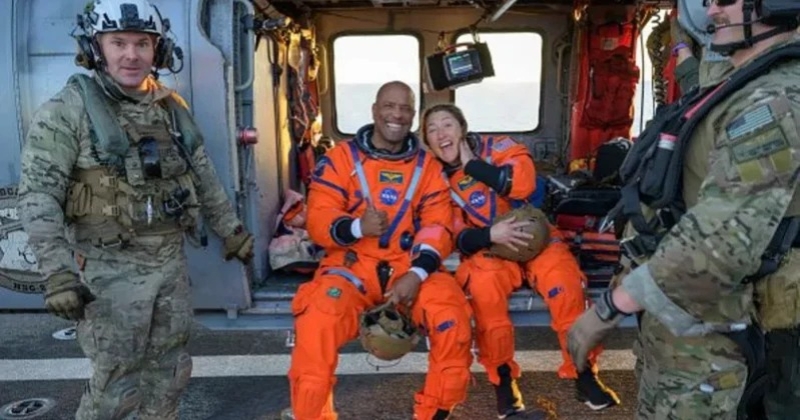
Four astronauts have completed a landmark mission, travelling farther into space than any humans before on a 10-day journey around the Moon and back to Earth.
The NASA-led Artemis II mission followed every stage of the flight, from liftoff to re-entry, drawing global attention as it marked a major step in deep-space exploration.
The spacecraft launched from Kennedy Space Center atop a 98-metre rocket, producing a powerful display of light, sound and force. On board were astronauts Reid Wiseman, Victor Glover, Christina Koch and Jeremy Hansen, beginning a journey of roughly 250,000 miles.
Soon after reaching space, the crew shared their first views of Earth. “Earth, you look beautiful,” Glover said, as the spacecraft headed towards the Moon.
Ahead of the mission, the astronauts had spoken candidly with their families about the risks involved. Wiseman and Hansen both described having honest conversations with loved ones about the possibility of not returning, highlighting the high-stakes nature of the mission.
As the spacecraft approached the Moon, its surface came into clearer view, revealing new details. In an emotional moment, the crew named a visible crater after Wiseman’s late wife, drawing a heartfelt response from both the astronauts and teams on the ground.
Life aboard the capsule was challenging. The crew lived and worked in a confined space roughly the size of a minibus, with limited privacy as millions followed the mission in real time. Even basic systems, including the onboard toilet, faced minor technical issues, requiring backup solutions.
Engineers and flight controllers closely monitored the mission throughout, as it marked the first time humans travelled on this rocket and spacecraft configuration. Safety remained the top priority.
The mission surpassed the distance record set by Apollo 13, reaching approximately 252,756 miles from Earth. Along the way, the astronauts captured images and shared observations of the Moon’s surface.
Artemis II is a key step in future plans to return humans to the Moon later this decade, with longer-term ambitions of sending astronauts to Mars.
The most critical phase came during re-entry, when the capsule endured extreme heat and temporarily lost communication with Earth. Tension eased once contact was restored and the spacecraft safely descended under parachutes before splashing down in the Pacific Ocean.
Mission control erupted in applause as the crew’s safe return was confirmed, marking the successful completion of a high-risk test flight.
The astronauts described the experience as life-changing, saying the journey had forged a lasting bond among them and offered a rare glimpse of Earth from deep space.