

- Dhaka-Seoul Ties Set for Strategic Partnership Push: Envoy |
- BSEC vows investor protection as top priority in IPO reform drive |
- Facebook post triggers tension in Shahbagh JCD-DUCSU brawl |
- Grameen Kalyan plans 300 healthcare centres in 64 districts |
- Italy dismisses replacing Iran at the World Cup, as Trump official says |
Artemis II Sends Astronauts Toward Record Moon Flight
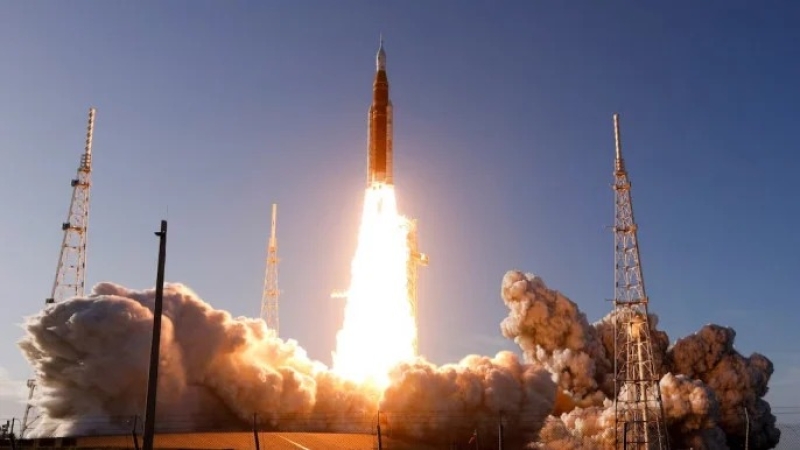
NASA’s Artemis II mission took a major step forward on Wednesday as the Orion capsule carrying four astronauts completed a crucial thruster burn, sending the crew out of Earth’s orbit and on course for the moon.
The successful manoeuvre, known as the translunar injection burn, has put the astronauts on track to enter the moon’s gravitational sphere by Sunday. If the mission continues as planned, the crew is expected to travel farther from Earth than any humans in history, surpassing the distance record set by Apollo 13 in 1970.
“We are getting just a beautiful view of the dark side of the Earth lit by the moon right now. Phenomenal,” Canadian astronaut Jeremy Hansen told mission control shortly after the burn.
The astronauts launched from Florida about 26 hours earlier and spent their first day in space testing cameras, steering the Orion spacecraft and resolving minor technical issues, including problems with the onboard toilet and email access.
Before the burn, the crew had been orbiting Earth in a highly elliptical path, reaching as far as 43,000 miles from the planet at one end and about 100 miles at the other. The thruster firing, which began at 7:49 p.m. ET, effectively slung the capsule out of Earth’s orbit and onto its lunar trajectory.
This was the mission’s final major engine burn, meaning Orion will now rely largely on orbital mechanics for the rest of its journey.
Mission commander Reid Wiseman said photographing Earth from deep space had proved challenging, comparing it to trying to take a clear picture of the moon from a backyard on Earth.
The crew is using a mix of GoPro cameras, iPhones and professional Nikon cameras to document the mission. NASA is expected to release more images later in the flight, including a possible “Earthrise” photograph similar to the iconic image captured during Apollo 8 in 1968.
By the sixth day of the mission, the astronauts are expected to reach about 252,000 miles from Earth, making it the most distant human journey ever undertaken. At that point, Earth is expected to appear no larger than a basketball from beyond the moon’s far side.
The mission also experienced a minor issue with Orion’s toilet shortly after launch. NASA said engineers later resolved the problem.
The spacecraft is equipped with a modern waste management system designed for longer missions. Unlike the rudimentary solutions used during the Apollo era, Orion’s toilet is housed in a small private compartment and is designed to offer astronauts at least a brief sense of privacy during the mission.