

- UNESCO Grants ‘Enhanced Protection’ to Mideast Sites |
- Solar Irrigation Cuts Diesel Use for Bangladesh Farmers |
- Trump claims Iran won’t close Hormuz strait again |
- Trump says Israel ‘prohibited’ from bombing Lebanon |
- Iran, US say Strait of Hormuz is fully open to commercial vessels |
Artemis II Sends Astronauts on Historic Moon Mission
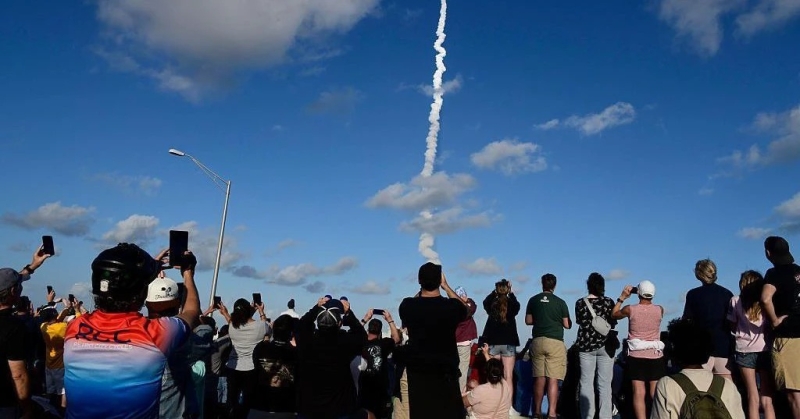
Four astronauts blasted off on Wednesday on humanity’s first crewed mission around the moon in more than 50 years, marking a major milestone in NASA’s push to return humans to the lunar surface.
The towering 32-storey Space Launch System rocket lifted off from NASA’s Kennedy Space Center, carrying three American astronauts and one Canadian on the high-stakes Artemis II mission.
Tens of thousands of spectators gathered along roads and beaches near the launch site to witness the historic moment, recalling scenes from the Apollo era.
“On this historic mission, you take with you the heart of this Artemis team, the daring spirit of the American people and our partners across the globe, and the hopes and dreams of a new generation,” launch director Charlie Blackwell-Thompson told the crew moments before liftoff.
“Good luck, Godspeed Artemis II. Let’s go.”
The spacecraft launched from the same site used during the Apollo moon missions, with surviving Apollo astronauts looking on as the rocket thundered into the evening sky toward a nearly full moon about 248,000 miles away.
Just five minutes after launch, commander Reid Wiseman spotted the moon and radioed back: “We have a beautiful moonrise, we’re headed right at it.”
Wiseman is joined by pilot Victor Glover, mission specialists Christina Koch and Canadian astronaut Jeremy Hansen. The crew is the most diverse ever sent on a lunar mission, including the first woman, the first Black astronaut and the first non-American to fly to the moon aboard NASA’s Orion capsule.
NASA Administrator Jared Isaacman hailed the mission as a major turning point.
“NASA is back in the business of sending astronauts to the moon,” he said after liftoff.
Launch hurdles cleared
The mission followed a tense day of launch preparations, as engineers closely monitored the fuelling process after earlier tests had exposed dangerous hydrogen leaks that delayed the programme.
This time, however, NASA reported no major leak, allowing more than 700,000 gallons of fuel to be loaded successfully.
Engineers also resolved last-minute issues involving battery sensors and communications with the rocket’s flight termination system, clearing the way for launch.
A 10-day journey around the moon
The Artemis II crew is expected to spend the first 25 hours of the 10-day mission orbiting Earth while conducting system checks before firing the spacecraft’s main engine for the journey to the moon.
Unlike Apollo 8, the mission will not enter lunar orbit. Instead, the Orion capsule will fly past the moon and travel roughly 4,000 miles beyond it before looping back to Earth for a splashdown in the Pacific Ocean.
During the Earth-orbit phase, the astronauts will also test manual control of the spacecraft, including manoeuvres near the rocket’s upper stage in case automated systems fail.
Critical step in NASA’s lunar plan
NASA says the mission is crucial to its broader Artemis programme, which aims to establish a long-term human presence on the moon and lay the groundwork for future missions to Mars.
The mission comes more than three years after Artemis I, an uncrewed test flight. Artemis II adds a human crew and introduces more complex systems, including life support, water supply and waste management.
However, not everything went smoothly after launch. Christina Koch reported a malfunction in the capsule’s toilet shortly after activation, prompting mission control to advise use of a backup system while engineers investigate the issue.
NASA official Lori Glaze said the mission carries enormous significance for the agency’s lunar ambitions.
“There’s always been a lot riding on this mission,” she said before launch.
A new era beyond Apollo
NASA says Artemis is designed to inspire a new generation and revive human exploration beyond low-Earth orbit for the first time since the Apollo era.
“This is their Apollo,” said NASA science chief Nicky Fox, referring to younger generations who never witnessed the original moon landings.
Unlike the Apollo missions, which were driven by Cold War rivalry, Artemis is intended to support a sustained human presence on the moon, particularly near the lunar south pole, with eventual ambitions to reach Mars.
NASA is also racing to maintain its lead in lunar exploration as China advances its own moon programme.
Like Apollo 13, Artemis II will follow a free-return trajectory, using the gravity of the Earth and moon to guide the spacecraft safely through space and back home.
Risks still remain
Despite the celebratory mood, NASA has acknowledged that the mission carries significant risks.
The Space Launch System has faced repeated technical setbacks, including hydrogen leaks and concerns over heat shield damage seen during Artemis I.
Although Wednesday’s launch went ahead successfully, uncertainties remain as the spacecraft embarks on its journey.
Apollo astronaut Charlie Duke sent his support to the crew ahead of the mission, while Christina Koch said the flight represents something far greater than a single voyage.
“It is our strong hope that this mission is the start of an era where everyone on Earth can look at the moon and think of it as also a destination,” she said.
Victor Glover added: “It’s the story of humanity — not Black history or women’s history, but human history.”