

- River ports asked to hoist cautionary signal No 1 |
- Oil prices drop 9% & Wall Street rallies to a record after Iran reopens Hormuz |
- UNESCO Grants ‘Enhanced Protection’ to Mideast Sites |
- Solar Irrigation Cuts Diesel Use for Bangladesh Farmers |
- Trump claims Iran won’t close Hormuz strait again |
Trump to Address US as Iran War Hits Ratings
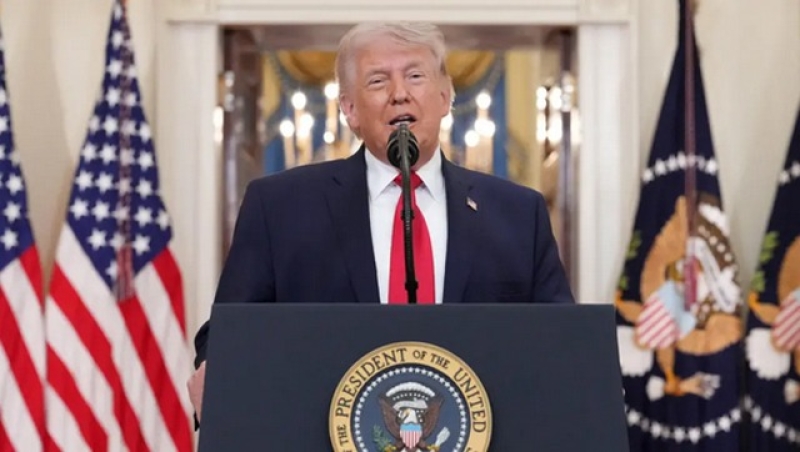
US President Donald Trump is set to deliver a prime-time address to the nation on Wednesday night as the war with Iran weighs heavily on his approval ratings, the economy and Washington’s ties with key allies.
The speech, scheduled for 9:00pm local time (0100 GMT), will be Trump’s first formal televised address on Iran from the White House since the conflict began a month ago.
While the White House has released few details, Trump is expected to argue that US military objectives are being achieved and that his administration has a strategy to bring the war to an end.
The address comes at a politically sensitive moment for the 79-year-old Republican, with recent polls showing his approval rating slipping below 40 percent as public concern grows over the war and its economic consequences.
Earlier on Wednesday, Trump claimed Iran’s president was seeking a ceasefire, though the assertion was quickly rejected by Tehran’s foreign ministry.
Trump has repeatedly said the conflict could begin winding down within three weeks, insisting that Washington’s key objectives are close to being met. At the same time, however, he has continued to issue threats of further escalation.
He has warned that the United States could target Iran’s civilian energy and water infrastructure and has even suggested the possibility of deploying ground troops.
His messaging has also remained inconsistent over the Strait of Hormuz, a critical route for global oil shipments.
As recently as Tuesday, Trump appeared to downplay the issue, suggesting the waterway was not a central objective. But on Wednesday, he said he would only consider a ceasefire once Hormuz was “free and clear.”
“Until then, we are blasting Iran into oblivion or, as they say, back to the Stone Ages!!!” Trump wrote on his Truth Social platform.
Recent polling indicates that support for the Iran campaign has fallen sharply, with a majority of voters opposing the war and independent voters turning increasingly against it.
The economic impact has further complicated matters for Trump. Petrol prices have risen above $4 a gallon for the first time in years, while consumer confidence has weakened, adding to pressure on an already fragile economic outlook.
NATO tensions deepen
The war has also strained Washington’s relations with its allies.
Trump has called for a “reconsideration” of US membership in NATO after several European countries refused to back the military campaign against Iran, raising the prospect of a wider diplomatic fallout.
Despite the political uncertainty, financial markets responded positively to Trump’s latest signals suggesting a possible end to the conflict.
Global equities rose on Wednesday and oil prices eased on hopes that the war may not continue for much longer. Brent crude fell about one percent to $102.85 a barrel, while stock markets across Asia and Europe posted gains.
Even so, analysts warned that the underlying risks remain serious, with oil prices still elevated and the Strait of Hormuz, through which around a fifth of the world’s oil supply passes, still effectively shut.
Critics say the strategic reality of the war is becoming harder to reconcile with the administration’s claims of success.
Although US and Israeli forces have struck thousands of targets and caused significant damage to Iran’s military infrastructure, the conflict has continued, Iran’s leadership remains in place and the global economic shock has intensified.
That has fuelled growing doubts over whether Trump can present a credible endgame.
The uncertainty is also being felt in Washington, where even some of Trump’s allies reportedly see the war as an increasing political burden ahead of the November midterm elections.
A White House official said Trump’s speech would emphasise what the administration sees as the success of the military campaign and its progress towards the goals outlined before the operation.
According to the administration, those goals include destroying Iran’s navy, crippling its missile capabilities and production facilities, neutralising its regional proxy militias and ensuring that Tehran can never obtain a nuclear weapon.
The official added that Trump is expected to repeat his claim that the operation could conclude within two to three weeks.