

- Let's build a society of love, tolerance, peace and harmony: Tarique Rahman |
- Bangladesh at a Crossroads as 2025 Reshapes the Nation |
- Khaleda Gets Eternal Farewell from Over a Million of Hearts |
- Sea of Mourners Gathers to Pay Tribute to Khaleda Zia |
Bangladesh at a Crossroads as 2025 Reshapes the Nation
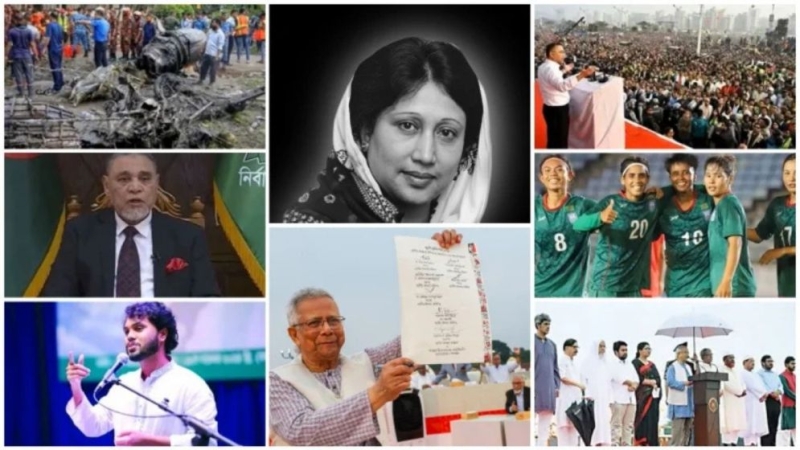
As Bangladesh bade farewell to 2025, the nation stood at a defining crossroads, shaped by political upheaval, social awakening and renewed public expectations. The year unfolded amid the post–July Uprising reality, with governance reform, democratic accountability and electoral preparedness dominating national discourse.
Youth emerged as vocal and influential stakeholders, widely seen as both the drivers of change and a demographic dividend. Together, these forces made 2025 a year of reckoning and reorientation, setting the tone for Bangladesh’s political and social trajectory ahead.
Khaleda Zia’s demise
The year ended on a somber note with the death of former prime minister and BNP chairperson Begum Khaleda Zia on 30 December. A towering figure in Bangladesh’s political landscape for more than four decades, she endured imprisonment and house arrest yet remained a symbol of resilience and dignity.
Bangladesh’s first woman prime minister and the second in the Muslim world, Khaleda Zia entered politics unexpectedly after the assassination of her husband, president Ziaur Rahman, in 1981. She went on to become one of South Asia’s most formidable leaders, known for her uncompromising stance against military rule and her role in restoring democracy.
Her death at the age of 80 drew tributes across political divides at home and from world leaders abroad. Millions attended her namaz-e-janaza, and she was laid to rest beside her husband at Zia Udyan following state honours.
July National Charter
On 17 October, political parties signed the landmark July National Charter-2025 after prolonged consultations with the National Consensus Commission led by Chief Adviser Professor Muhammad Yunus. Calling it the “birth of a New Bangladesh,” Yunus said the charter marked a return to civilisation grounded in rule of law and democratic consensus.
The document traced Bangladesh’s political journey from colonial rule to the July 2024 mass uprising, criticised autocratic practices and disputed elections, and pledged a seven-point commitment to uphold democratic principles.
Rise of new political forces
On 28 February, the National Citizen Party (NCP), led by student and youth leaders of the July Uprising, formally launched with a pledge to pursue national unity and a vision of a “second republic.”
Key political milestones
Professor Yunus unveiled the July Declaration on 5 August, reaffirming the spirit of the uprising. On 25 December, BNP acting chairman Tarique Rahman returned home after 17 years in exile, drawing massive crowds and delivering a call for peace, unity and a “safe Bangladesh.”
Earlier in the year, the government banned the Awami League on 12 May, followed by the suspension of its registration. On 17 November, the International Crimes Tribunal sentenced deposed prime minister Sheikh Hasina to death in absentia over crimes against humanity linked to the July Uprising.
Tragedies and unrest
The killing of July Movement leader Sharif Osman Hadi in December sparked nationwide protests and state mourning. In July, a Bangladesh Air Force training jet crash at Milestone School and College killed at least 36 people, most of them students, triggering grief and public outrage.
A 5.7-magnitude earthquake in November killed at least 10 people and damaged buildings across Dhaka and surrounding districts, renewing concerns over urban safety.
Democratic revival on campuses
After decades-long gaps, student union elections were held at major public universities, including Dhaka, Jahangirnagar, Chittagong and Rajshahi universities, marking a revival of campus democracy.
Sporting achievements
Amid turmoil, Bangladesh celebrated historic sporting success. The women’s national football team qualified for the AFC Women’s Asian Cup 2026 for the first time, earning the Ekushey Padak, while the U-20 women’s team clinched the SAFF U-20 Women’s Championship unbeaten.
Together, these events defined 2025 as a year of loss and hope, upheaval and renewal—one that reshaped Bangladesh’s political landscape and left the nation poised for a decisive chapter ahead.