

- Let's build a society of love, tolerance, peace and harmony: Tarique Rahman |
- Bangladesh at a Crossroads as 2025 Reshapes the Nation |
- Khaleda Gets Eternal Farewell from Over a Million of Hearts |
- Sea of Mourners Gathers to Pay Tribute to Khaleda Zia |
Rigid Procurement Rules Deter Investors in Solar Projects
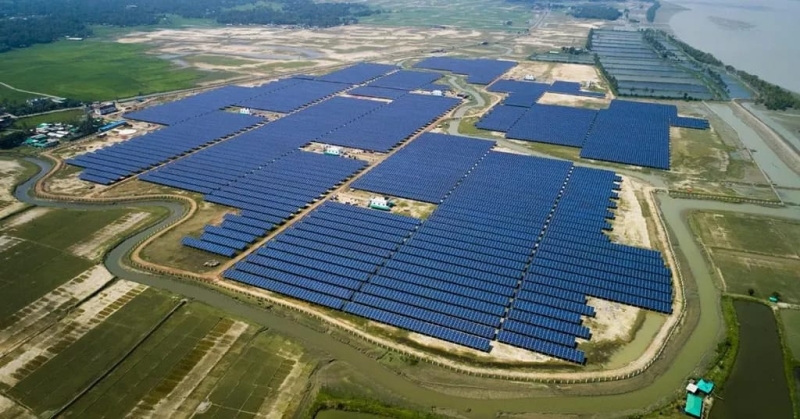
Representational Image
Bangladesh’s latest drive to procure solar power projects under the Public Procurement Act (PPA) and Rules (PPR) has failed to attract adequate investor interest, raising concerns about the country’s renewable energy ambitions, a study has found.
The study, conducted by the Centre for Policy Dialogue in partnership with the Australian High Commission in Dhaka, shows that weak competition, strict qualification requirements and limited risk-sharing measures have discouraged both local and foreign firms from participating in tenders issued since December 2024.
Following the repeal of the Quick Enhancement of Electricity and Energy Supply (Special Provision) Act, 2010, the interim government brought all power and energy procurement under the PPA-PPR framework. Subsequently, the Ministry of Power, Energy and Mineral Resources invited bids for 55 solar power plants, ranging from 10 megawatts to 250 megawatts, in four phases.
However, participation has remained low. Of the 55 packages, 23 received only a single bid, while 13 attracted no bids at all, with an average of just 1.4 bids per package.
The study, titled Renewable Energy Procurement under the Public Procurement Act and Rules: Enterprise Survey Findings on Transparency, Accountability, and Efficiency, reviewed regulatory provisions, monitored the ongoing procurement process and assessed it against international standards.
One of the biggest deterrents identified was the financial capacity requirement. Bidders must show access to liquid assets or credit facilities of at least USD 1.14 million per megawatt, amounting to USD 57.2 million for a 50 MW project and USD 114.4 million for a 100 MW plant. While most foreign firms found this manageable, more than four-fifths of local firms said the requirement was difficult to meet.
Investor confidence was further weakened by the absence of sovereign guarantees. As no implementation agreements are being signed, power purchase agreements lack sovereign backing, affecting project bankability. Nearly 70 percent of firms said this negatively influenced their decision to participate.
The study also highlighted land acquisition as a major challenge, as responsibility rests entirely with the winning bidder. Land scarcity and bureaucratic hurdles were described as very or moderately discouraging by more than half of the respondents.
Technical and contractual provisions were also criticised. Fixed annual generation targets over a 20-year period were viewed as unrealistic by most firms due to solar panel degradation and variable sunlight. In addition, a clause allowing contract termination with just 28 days’ notice was considered highly problematic by nearly two-thirds of respondents.
While most firms reported timely access to tender information and responsive pre-bid clarifications, perceptions worsened after bid submission. Many expected slow decision-making, with over 60 percent anticipating inefficient or very inefficient processes.
Concerns were also raised about documentation quality and transparency. Only 40 percent of firms found tender documents clear and complete, while issues such as missing technical details, late publication and limited online access were frequently cited. Nearly half of the bidders reported experiencing discrimination during evaluation, with all foreign bidders surveyed making similar claims.
The study concludes that without targeted reforms in procurement design, risk-sharing mechanisms and institutional capacity, Bangladesh’s efforts to scale up solar power may remain constrained, despite policy intentions to strengthen governance under the PPA-PPR framework.