

- First cruise ship crosses Strait of Hormuz since war began |
- MDBs stress co-op support global stability amid uncertainty |
- PM opens first Hajj flight, visits Ashkona camp |
- River ports asked to hoist cautionary signal No 1 |
- Oil prices drop 9% & Wall Street rallies to a record after Iran reopens Hormuz |
Solar Irrigation Cuts Diesel Use for Bangladesh Farmers
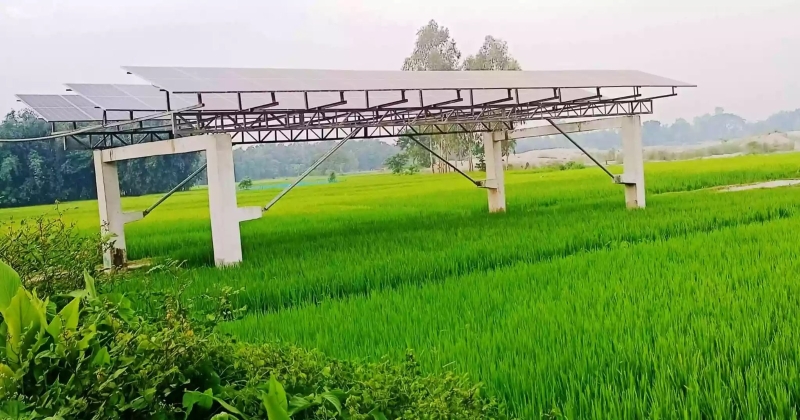
Bangladesh’s farmers are turning to solar-powered irrigation to cope with rising fuel costs and supply uncertainty, reducing dependence on diesel during the peak irrigation season.
In the Rangpur division, solar irrigation systems are now generating প্রায় 5.9 megawatts of electricity daily, helping save an estimated 7.5 million litres of diesel in a single season, according to officials.
The shift is easing pressure on farmers who previously relied on costly and often unreliable diesel supplies. With solar power, irrigation has become more predictable, allowing timely watering of crops and lowering production costs.
At a Bangladesh Agricultural Development Corporation (BADC) deep tube well in Doani village under Hatibandha upazila in Lalmonirhat, operator Atiar Rahman said the solar system is irrigating around 15 bighas of land used for maize and vegetable cultivation.
“Even if diesel is scarce or prices rise, farmers no longer face disruptions, as the system runs on solar energy,” he said.
However, he noted that the solar panels remain underused for much of the year, as irrigation demand typically lasts only four months. He suggested introducing net metering so surplus electricity could be supplied to the national grid during the off-season.
Farmers say the benefits are already clear. Sudhan Chandra Sen from Kaunia upazila said solar irrigation has removed concerns over fuel availability and improved crop output.
“Earlier, electricity was unreliable and irrigation was delayed. Now, water is available when needed, and costs are lower,” he said.
Local stakeholders say expanding solar irrigation could strengthen food security and modernise agriculture. Shafiqul Islam, a local environmental advocate, said wider adoption would support marginal farmers and improve resilience.
Officials say 596 solar-powered irrigation units were operational across eight districts in Rangpur during the last season. With an average capacity of about 10 kilowatts per unit, total output reached প্রায় 5.96 megawatts, enough to significantly reduce diesel consumption over four months.
Authorities also noted that while no new projects have been launched since 2022, existing systems remain functional, and limited net metering initiatives have already begun.
Energy experts say accelerating the shift from diesel to solar irrigation could reduce fuel imports, save foreign currency, and cut carbon emissions. They added that with proper policy support, surplus solar power from irrigation systems could contribute to the national grid.
Farmers have called for expanding solar irrigation projects, rehabilitating older systems, and enabling grid connections to make full use of generated power.
“If sunlight can grow our crops, it can also help power the country,” one farmer said.