

- 90pc of 3Mt annual e-wastes not recycled, cause health hazards in BD |
- UNGA backs historic World Court climate crisis ruling |
- Air France, Airbus found guilty of manslaughter over 2009 jet tragedy |
- Navy, Coast Guard are working to protect security of sea - Navy Chief |
- Call agriculture national profession: Krishak Oikya Foundation |
90pc of 3Mt annual e-wastes not recycled, cause health hazards in BD
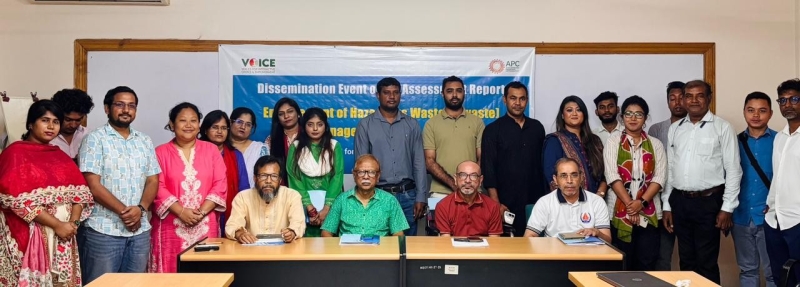
Participants at the dissemination of an assessment report on enforcement of e-waste maangement rules 2021 on Saturday 23 May 2026
GreenWatch Desk
Generation of electronic wastes is rising in Bangladesh without corresponding efforts to collect and recycle those thus 90 percent of such wastes pollute the environment with huge adverse health impacts especially on women and children suffering premature deaths, deformed child births and deforming or damage of foetus.
This was stated at the dissemination of an assessment report on the enforcement of hazardous waste (e-waste) management rules by Voices For Interactive Choice and Empowerment in Dhaka City on Saturday.
The assessment puts annual generation of e-waste at 3 million metric tonnes of which of which only 10 percent is officially recycled. Dhaka, Gazipur and Chattogram are the primary informal recycling hubs which rely on open burning, acid leaching thus exposing workers ro 1000 plus hazardous chemicals. Bangladesh enacted the e-waste management rules 2021 as a key milestone but its implementation remains at zero percent.
The assessment noted that the businesses marketing smart phones, computers, television sets, refrigerators and other electronic gadgets do not tell consumers of their end of life cycle, nor practice the return of old gadgets thus harming the environment in the absence of awareness of consumers.
The event, supported by Association for Progressive Communication (APC), organized by the rights-based advocacy organization VOICE at the NGO Forum for Public Health. According to VOICE's latest assessment report, while 100% of the 15 surveyed entities were registered with the Department of Environment, not a single one collected even one end-of-life product in the last fiscal year; 78% have no take-back system in place, only 22% verify Restriction of Hazardous Substances (RoHS) compliance, and not one entity maintains proper hazardous waste storage or record-keeping clearly demonstrating that the Hazardous Waste (E-waste) Management Rules, 2021 are not being operationally enforced, leaving an estimated $200–221 million in annual economic recovery potential entirely unrealized, said a press release.
Representatives from prominent media outlets including BBC News, 71 TV, Independent TV, Financial Express, Business Standard, Dainik Sangbad, Wave 24, Deepto TV, Ittefaq, RTV, Bangladesh Pratidin and many more attended the event, reflecting the broad media interest in the state of e-waste governance in Bangladesh.
Ahmed Swapan Mahmud, Executive Director of VOICE, highlighted the strategic necessity of the initiative. He remarked, "Bangladesh made history with the Hazardous Waste (E-Waste) Management Rules, 2021. But legislation alone does not protect communities or the environment, implementation does."
Musharrat Mahera, Deputy Director (Programmes) of VOICE, shared the impacts of e-waste, " The mismanagement of e-waste is causing severe environmental damage, leading to increased child mortality, maternal mortality, and premature deaths. Effective measures need to be taken urgently to reduce its devastating impact."
The report’s lead author, Bandhan Das, VOICE, discussed the key findings and methodology of the report. He stated, “The data we gathered presents a mixed picture. Although there is legal intent on paper, there is no practical implementation at the field level. The accountability mechanism remains largely ineffective, while workers continue handling e-waste without adequate health and safety protection. This report is not just a document; it is an urgent warning for civil society.”
Md. Aminul Russell from Unnayan Dhara Trust highlighted the broader environmental context, stating, “Although e-waste was initially presented as a positive issue, various accidents later exposed its negative impacts. Several studies have shown that despite the existence of regulations on e-waste management, they are rarely followed in practice. Therefore, extensive media coverage is crucial to influence policymakers.”
Mihir Biswas from Bangladesh Poribesh Andolon (BAPA) mentioned two recommendations, saying, “First, the specific challenges must be clearly identified, and secondly, continuous collaborative discussions should be carried out to implement the recommendations that have emerged.”
Finally, all participants called for coordinated and sustainable efforts to strengthen the implementation of e-waste policies and environmental accountability. They also emphasized the importance of collective action to protect future generations from this growing risk, the press release said.