

- PM urges every citizen to plant tree to ensure clean environment |
- Indian Air Force AN-32 Transport Aircraft Crashes During Landing in Assam |
- WHO Warns Global Blood Shortages Put Lives at Risk Report |
- US Thrash Paraguay 4-1 in Dream World Cup Start |
- FY27 Budget Reflects Public Aspirations: Khosru |
Bangladesh Set for Nuclear Power Milestone
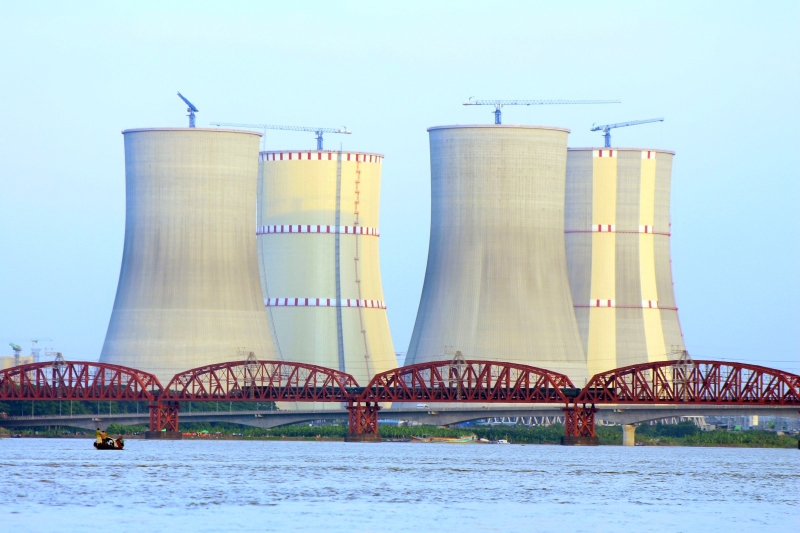
In a historic leap toward energy independence, Bangladesh is poised to formally enter the global atomic era this year. The Rooppur Nuclear Power Plant (RNPP), the country's most ambitious infrastructure project, is nearing its final commissioning phase, marking a transformative shift in the nation's energy landscape. Situated on the banks of the Padma River in Ishwardi, Pabna, the facility represents a multi-billion-dollar investment aimed at securing a stable and low-carbon energy future for the next six decades.
The project has reached a critical turning point, after years of construction and complex engineering work. Dr. Md. Kabir Hossain, Project Director of the Rooppur Nuclear Power Plant, confirmed that the facility is on track for a formal inauguration later this year.
“The power plant is likely to be formally launched later in August with around 30 percent capacity, generating approximately 300MW to 350MW of electricity at the initial stage,” Dr. Hossain said.
He highlighted the significance of recent technical milestones and noted that important stages have already been completed.
“We successfully loaded nuclear fuel into the reactor on April 28. It may take approximately one month to proceed toward launching after fuel loading. So, it is difficult to determine a specific date for the launch as we are still going through various trials and tests,” he said.
The Project Director emphasised that the launch will depend on coordinated readiness between the plant and the national power grid.
“If all factors, including grid readiness for power transmission, remain on track, we will be able to proceed with the launch later in August this year,” he added.
At the initial stage, the plant will begin with roughly 30 percent of its first-phase target of 1,200MW.
Responding to a question, Dr. Hossain said the commissioning is expected to be a high-profile international event and they expect Prime Minister Tarique Rahman to officially inaugurate the nuclear power plant. Sources also indicated that Russian President Vladimir Putin may join the event virtually, reflecting the strong bilateral cooperation that made the project possible.
The roots of the Rooppur Nuclear Power Plant date back several decades. However, the project's modern implementation began in October 2013 with the laying of the foundation stone. Construction work on Unit-1 officially started in November 2017, while Unit-2 followed in July 2018.
The plant uses Russian-designed Generation III+ VVER-1200 reactors, specifically the V-523 model. These advanced reactors are equipped with enhanced safety systems, including passive protection mechanisms such as core catchers and double containment structures capable of withstanding extreme external impacts.
Once both units become fully operational, the plant will have a total generation capacity of 2,400 megawatts. This is expected to contribute nearly nine percent of Bangladesh's overall electricity demand.
The project reached a major milestone in October 2023 when it received its first shipment of nuclear fuel, officially designating Rooppur as a nuclear facility. Another significant achievement followed in March 2025 with the successful completion of hydraulic testing and turbine installation work for Unit-1.
The financial scale of the RNPP is unprecedented in Bangladesh's history. Initially estimated at Tk 1.13 trillion, equivalent to approximately $12.65 billion, the project cost has undergone revisions due to multiple global and domestic challenges.
The Executive Committee of the National Economic Council (ECNEC) recently approved an increase of Tk 25,592 crore, bringing the total project expenditure to around Tk 1.39 trillion.
Officials attribute the increase to several factors, including depreciation of the local currency against major foreign currencies, disruptions caused by the COVID-19 pandemic, and logistical complications arising from the Russia-Ukraine conflict.
To address the increased financial requirement, the Ministry of Science and Technology recently sought an additional Tk 50.88 billion for the current fiscal year, largely financed through Russian loans.
Financing of the project remains heavily dependent on a bilateral agreement with the Russian Federation. Russia has provided an export loan worth up to $11.38 billion, covering nearly 90 percent of the total project cost.
Recent amendments to the financing agreements were also approved by the Russian State Duma, enabling transactions in alternative currencies beyond those classified as "unfriendly" by Russia. This adjustment aims to ensure financial continuity despite international sanctions and geopolitical tensions.
Project delays, however, have generated additional costs. Experts estimate that Bangladesh is paying daily interest expenses ranging from Tk 100 million to Tk 120 million to the Russian contractor, Rosatom.
Despite the financial burden, experts believe that the long-term benefits significantly outweigh the costs.
Nuclear engineering specialists argue that the plant could save Bangladesh nearly $1 billion annually by reducing dependence on imported fossil fuels and minimizing exposure to global energy market volatility.
As the plant moves toward power generation, technical experts are paying particular attention to integrating this large power source into the national grid.
A single reactor producing 1,200MW requires a highly stable and reliable transmission infrastructure to prevent system failures.
A senior official of the Bangladesh Atomic Energy Regulatory Authority (BAERA) said that maintaining grid stability currently remains one of the major technical challenges.
Nuclear power systems require precise frequency control at a constant 50 hertz.
“Even slight fluctuations in grid frequency can create significant risks and may automatically trigger reactor shutdown mechanisms,” the official warned.
Engineers plan to gradually increase power generation levels to minimize risks.
After the initial production of around 300MW begins, engineers will closely monitor frequency levels, voltage performance, and various technical indicators before gradually moving toward the full capacity of Unit-1.
Unit-2 is expected to follow a similar process, with fuel loading currently planned for April 2027.
Safety monitoring measures have also been strengthened.
BAERA has initiated regular inspections, with monitoring activities scheduled every five days to evaluate reactor performance, boric acid concentrations, and radiation levels.
Safety remains the highest priority for the project. Radioactive waste management has long been considered a critical concern for countries operating nuclear facilities.
Bangladesh has attempted to address this challenge through the implementation of the “National Policy on Radioactive Waste and Spent Nuclear Fuel Management-2019” and bilateral agreements with Russia.
One of the most important achievements of this arrangement is the agreement to send all high-level radioactive waste, including spent nuclear fuel, back to Russia for processing.
This arrangement significantly reduces Bangladesh's long-term burden of managing an estimated 50 to 60 tons of highly radioactive waste generated annually.
Within the country, the plant is equipped with specialized systems for handling low and intermediate-level radioactive waste, including waste solidification technologies and temporary storage facilities.
Although establishing a permanent repository for such waste remains a long-term objective, existing safety mechanisms comply with standards established by the International Atomic Energy Agency (IAEA).
Beyond electricity production, the RNPP has also brought significant socio-economic changes to the surrounding region. The project has transformed Ishwardi and neighboring areas into rapidly developing economic centers.
Local officials say the arrival of more than 7,500 experts and workers from Russia and other countries has created a multicultural environment and stimulated economic activity.
The region has experienced substantial infrastructure development, including new roads, improved communication systems, residential facilities, healthcare expansion, and commercial establishments.
Healthcare services have also expanded with the establishment of clinics and specialized facilities such as the Institute of Nuclear Medicine and Allied Sciences (INMAS).
Economic activity has increased through the development of shopping centers, markets, and employment opportunities for local workers and skilled professionals.
Subir Kumra Das, former Upazila Nirbahi Officer of Ishwardi Upazila in Pabna, described the project as a symbol of progress that has significantly improved living standards for local residents.
He also noted that the project has encouraged greater participation of women in technical and leadership roles within the country's growing nuclear sector.
The formal commissioning of Unit-1 is expected to become a defining moment for Bangladesh's energy journey, positioning the country among South Asian nations utilizing nuclear power technology.
Challenges involving grid management, manpower development, and financial sustainability remain, but experts believe the long-term outlook remains highly promising.
The Rooppur Nuclear Power Plant is expected to provide clean and reliable electricity for at least 60 years, with the possibility of extending operations by another two decades. Officials have indicated that the Rooppur site has sufficient capacity to accommodate additional power units in the future.
Authorities are also considering the potential adoption of Small Modular Reactors (SMRs) to diversify Bangladesh's future energy mix.
As Bangladesh prepares for its entry into the nuclear energy era, the Rooppur Nuclear Power Plant stands not merely as a power generation facility, but as a symbol of technological ambition, international cooperation, and the nation's pursuit of a cleaner and more secure energy future.