

- PM urges every citizen to plant tree to ensure clean environment |
- Indian Air Force AN-32 Transport Aircraft Crashes During Landing in Assam |
- WHO Warns Global Blood Shortages Put Lives at Risk Report |
- US Thrash Paraguay 4-1 in Dream World Cup Start |
- FY27 Budget Reflects Public Aspirations: Khosru |
Over 99% of Energy Allocation Reserved for Development
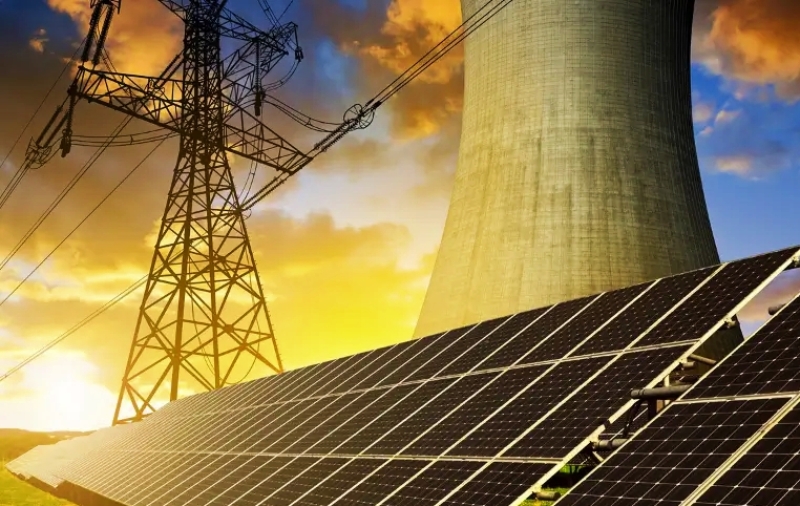
Over 99 percent of the allocation for energy and power sector is meant for the development spending as Fianance Minister Amir Khasru Mahmud Chowdhury laid out the proposed budget for the coming fiscal amid global energy crisis caused by the Iran war.
According to the budgetary documents provided on Saturday the sector’s stake in the 17,345 crore budget is roughly 1.85 percent with the allocation of over Tk 17,193 crore for energy and power divisions, keeping only Tk 152 crore or 0.88 percent for their operating expenditures.
Proposing the sanction for the sector in his budget speech Chowdhury said the government intended to make a critical shift away from high import dependency and costly, inefficient infrastructure by leading the sector toward self-reliance alongside promoting green energy and ensuring fiscal accountability.
“To meet the growing demand for electricity and ensure quality supply, the government is working to increase electricity generation capacity to 35,000 MW by 2030 and expand transmission lines to 25,000 circuit kilometres,” he said.
The proposed budget visibly made an effort to promote green energy keeping intact fossil fuel expansion as it suggested a zero percent tax rate on the solar power sector until 2035 to encourage environment friendly solar power generation.
The government expects to meet 20 percent of electricity demand with renewable energy by 2030 while the finance minister also proposed granting consumers a 5.0 percent tax rebate on payments made against their solar electricity bills.
In the annual development programme (ADP) part of the budget, the finance minister proposed Tk 17,192 crore of which energy division would get Tk 2,254 crore and power division Tk 14,938 crore.
In the outgoing 2025-26, the budgetary allocation for power, energy and mineral resources ministry was Tk 22,520 crore and in the revised budget the amount stood at Tk 16,951 crore.
The ADP allocation for outgoing fiscal was Tk 22,370 crore while the revised ADP sanctioned Tk 16,809 crore.
Chowdhury said the government took various initiatives for oil and gas exploration, increase production, expand refining capacity and diversify import sources to ensure energy security.
He said that model production sharing contract (PSC) with petroleum explorers was revised to particularly to attract international oil giants for offshore exploration safeguarding national interests.
“We are prioritising exploration and 72 production of natural gas both onshore and offshore to strengthen domestic capacity through BAPEX (Bangladesh Petroleum Exploration and Production Company Limited),” Chowdhury said.
He said that plans were adopted to undertake 270 km of geological surveys, 700 line-km of two-dimensional (2D) seismic surveys and 700 square kilometres of three-dimensional (3D) seismic surveys during FY2025-26 to FY2027-28, reports BSS.
He said the BAPEX also plans to drill 69 wells and carry out workover operations on 31 wells using its own drilling rigs.