

- WHO Warns Global Blood Shortages Put Lives at Risk Report |
- US Thrash Paraguay 4-1 in Dream World Cup Start |
- FY27 Budget Reflects Public Aspirations: Khosru |
- 3 Red Cards Mar Mexico vs South Africa World Cup Opener |
- Hwang In-beom inspires South Korea's 2-1 victory over Czech Republic |
How Sustainable Is Budget’s Inclusive, Democratic Uplift Call
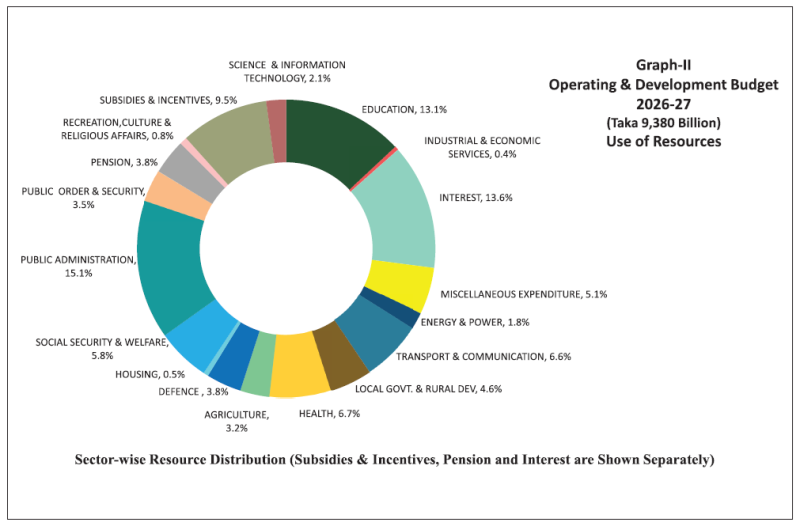
National Budget for 2026-27 - Use of resources.
Mostafa Kamal Majumder
When Finance Minister Amir Khashru Mahmud Chowdhury rose in Parliament to present his Taka 9.38 lakh crore national budget for 2026-27, he framed it as a democratic promise: a budget for all citizens, inclusive in spirit, humane and equitable in design. He spoke of fairness, participation, and shared prosperity. Yet beyond the rhetoric lies the pressing question—does this budget truly lay the foundation for a sustainable economy, one that secures livelihoods while protecting the environment and regenerating the nation’s natural wealth?
The Minister himself admitted that this budget was prepared on the spoils of a massive economic downturn. He pointed to years of economic mismanagement, the deliberate increase of inequality to create a class supportive of autocracy, the plunder of once vibrant banks, and the laundering of billions of dollars abroad over the last two decades. He also acknowledged the extreme instability in the international order, aggravated by incessant war in the Middle East. This candour sets the stage: the new budget is not crafted in calm waters, but in the turbulence of both domestic and global crises. The question is whether it can steer Bangladesh towards sustainability and resilience.
At the heart of sustainability is the capacity to generate income through productive investment. The Minister’s speech highlighted allocations for industrial expansion, agricultural modernization, and infrastructure development. But the emphasis leaned heavily on conventional growth metrics—GDP expansion, export competitiveness, and industrial output—without a clear roadmap for how these investments will translate into higher incomes for ordinary citizens. A sustainable economy requires not just more factories, but factories that produce without polluting; not just more farms, but farms that regenerate soil and water. The budget’s provisions for investment remain vague on these fronts. Without binding commitments to pollution‑free production systems and regenerative agriculture, the promise of higher incomes risks being undermined by degraded health and ecosystems. Without strict pollution controls and investment in wastewater treatment, the promise of inclusivity rings hollow. Citizens cannot participate equally in democracy if their lungs and rivers are sacrificed to unchecked industrial growth.
The Minister spoke eloquently of ensuring nutritious food and accessible healthcare. Yet the allocations tell a different story. While subsidies for staple crops continue, there is limited emphasis on diversifying agriculture toward nutrient‑rich foods. Regenerative farming practices—crop rotation, organic inputs, soil conservation—are mentioned only in passing. Healthcare spending has increased, but much of it is directed toward infrastructure rather than preventive care. A sustainable budget would prioritize clean air, safe water, and healthy diets as the first line of defence against disease. Without such preventive measures, hospitals will remain crowded while the roots of ill‑health persist in polluted environments and poor nutrition.
Bangladesh’s cities choke under smog – Dhaka often cited for having the worst air pollution in the world - and its rivers carry industrial effluents. The Minister acknowledged environmental concerns, but the budget’s environmental allocations remain modest compared to the scale of the crisis. Clean air and water are not luxuries; they are prerequisites for human productivity and dignity. To his credit, the Minister promised the excavation of 20,000 kilometres of canals to expand the supply of surface water, alongside efforts to revive dead rivers in the southwest. He also pledged to gradually reduce salinity intrusion in the region by constructing a barrage on the Bangladesh side of the Ganges to take water through its distributaries to the region, and to implement a master plan to stop riverbank erosion of the Teesta while ensuring water supply in the lean season. These are ambitious undertakings and need tackling environmental fallouts, but their success depends on timely implementation and strong governance.
The budget speech included references to forest conservation and wildlife protection. This time, the Minister went further, promising to plant 25 crore trees over five years. Such a commitment, if realised, could transform landscapes, sequester carbon, and restore biodiversity. Yet the challenge lies in execution. True regeneration requires not just planting trees, but ensuring their survival, integrating community stewardship, and protecting existing forests from encroachment. Without these safeguards, tree‑planting risks becoming a symbolic gesture rather than a transformative policy. Forests are not just ecological ornaments; they are carbon sinks, water regulators, and a cultural heritage. Without serious investment in conservation, the democratic promise of the budget excludes future generations who will otherwise inherit barren landscapes.
One of the brighter notes in the Minister’s speech was the commitment to renewable energy. Solar and wind projects are slated for expansion, and incentives for green energy investment have been announced. This is a step toward sustainability, yet the scale remains insufficient. Bangladesh’s energy demand is rising rapidly, and fossil fuels still dominate. A truly sustainable budget would set clear targets for phasing out coal and gas, while massively scaling up renewables. Without such ambition, renewable energy risks becoming a decorative add‑on rather than the backbone of a new economy.
The Minister invoked the idea of circular production systems—reducing waste, reusing materials, and recycling resources. This is a visionary concept, but the budget provides little detail on implementation. Circularity requires systemic change: incentives for eco‑design, penalties for wasteful production, and infrastructure for recycling. Without these, the notion of circularity remains aspirational. Factories will continue to generate waste, and landfills will expand. A sustainable budget must embed circular principles into every sector, from textiles to electronics, ensuring that growth does not come at the cost of mountains of waste. A silver lining is that some garment factories are already practicing circular production processes to sustain exports.
The Minister promised to strengthen disaster management systems, a vital pledge in a country so vulnerable to cyclones, floods, and climate shocks. He also committed to expanding social safety net programmes for the poor. These measures are essential for inclusivity, ensuring that the most vulnerable are not left behind in the march towards development. Importantly, the budget also promises to build more shelters to protect communities against disasters, and to allocate funds for procuring equipment for rescue and recovery operations in the face of looming threats such as earthquakes. These pledges add credibility to the government’s commitment to resilience. Yet sustainability demands more than reactive disaster relief. It requires proactive resilience—building embankments, restoring wetlands, and designing cities that can withstand climate extremes. Social safety nets must be paired with opportunities for decent work, so that poverty is not merely cushioned but overcome.
The Minister’s repeated emphasis on democracy in budgeting is commendable. Participation, transparency, and inclusivity are vital. Yet democracy must extend beyond parliamentary speeches to the lived realities of citizens. The budget should have had clear directions to free the people from exploitations of the state-sponsored oligarchs created in the last two decades to support and sustain an unelected regime for an indefinite period of time. Law and order also need to be consolidated to save the weaker segments of the society from thugs, vulnerable people from mob attacks; women and children from discrimination and repression. A budget that fails to secure clean air, safe water, healthy food, and regenerative ecosystems cannot be truly democratic, for it excludes the basic needs of the people. Sustainability is not a technical add‑on; it is the essence of democracy. Without it, the promise of inclusivity collapses into rhetoric.
Amir Khashru Mahmud Chowdhury’s budget speech was rich in promise, but thin in transformative detail. It gestures toward sustainability—renewable energy, circular production, conservation—but stops short of embedding these principles into the core of economic planning. For Bangladesh to build a truly sustainable economy, the budget must go beyond inclusivity in words to inclusivity in outcomes. It must ensure that every citizen breathes clean air, drinks safe water, eats healthy food, and inherits forests and wildlife. It must invest not just in production, but in pollution‑free production. It must generate income not just through growth, but through regenerative growth. The pledges to plant 25 crore trees, excavate canals, revive rivers, build barrages, strengthen disaster management, expand social safety nets, construct shelters, and procure rescue equipment are steps in the right direction. But only through rigorous implementation, transparent monitoring, and genuine community participation will these promises move from paper to reality. Only then will the budget fulfil its democratic promise—not as a speech, but as a lived reality.
(A writer and researcher, Mostafa Kamal Majumder is a former editor of The New Nation and is currently editing the monthly Green Watch news magazine alongside the online news portal GreenWatch Dhaka.)