

- 11-Year Run of Record Global Heat Continues: UN Agency |
- Gaza Ceasefire Not Enough as Children Continue to Die |
- Bangladesh Sets Guinness Record With 54 Flags Aloft |
- Gambia Tells UN Court Myanmar Turned Rohingya Lives Hell |
- U.S. Embassy Dhaka Welcomes Ambassador-Designate Brent T. Christensen |
Tracking Air Pollution in Asia-Pacific Using Satellite Data
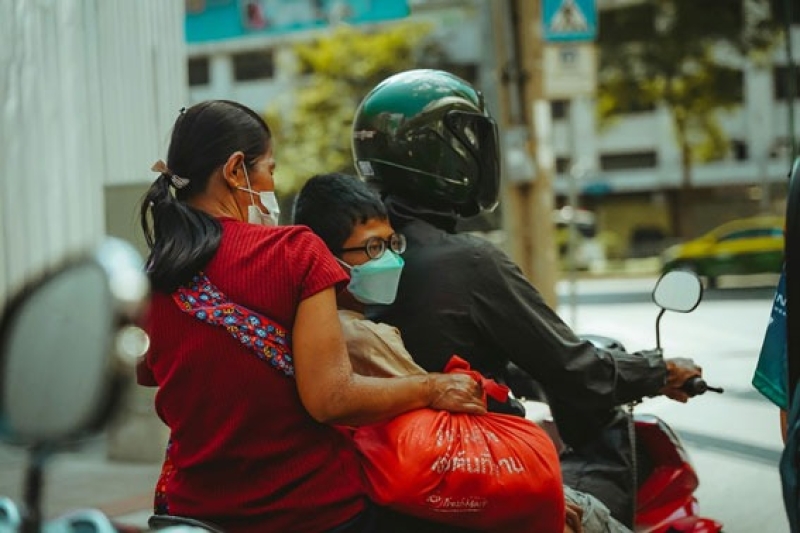
A mother and a son with mask were riding on a motorcycle in a street of Bangkok. The capital of Thailand experienced high level of PM2.5 particle pollution.
Take a deep breath.
In many countries across Asia and the Pacific, the air we breathe falls short of the safety standards for air quality set by the World Health Organization. While the start of a new year signals new beginnings, it also marks the continuation of a recurring air quality crisis across the region.
In 2024, 25 of the most polluted cities were in the Asia-Pacific, with dangerous levels of fine particulate matter (PM2.5) far exceeding the annual safe limit of 5 micrograms per cubic metre.
Often, air pollution is associated with car exhaust or factory chimneys belching black smoke. But it is more than a by-product of urban development—it is a multi-hazard crisis caused by wildfires, sand and dust storms, and volcanic eruptions, all of which know no borders. Access to clean air is a human right, and those contributing least to pollution are often the most vulnerable.
Rising temperatures create a vicious cycle: heat intensifies wildfires, releasing toxic smoke composed of carbon dioxide, carbon monoxide, and PM2.5. Higher temperatures also accelerate the breakdown of waste, generating more pollutants. Volcanic eruptions add sulfur dioxide and volcanic ash, which can linger in the atmosphere for months. The result: climate change worsens air pollution, which in turn aggravates the climate crisis—a feedback loop threatening both human health and ecosystems.
Can a heavily polluted environment be restored? In principle, yes, but it requires transformative change and collective action across society and the economy. Improving urban mobility means prioritising efficient public transport, low-emission vehicles, and cleaner alternatives such as walking, cycling, and ride-sharing. Nature-based solutions, such as green cooling corridors, can further improve air quality by lowering surface temperatures and buffering against desertification, land degradation, drought, and dust storms.
However, not all sources of air pollution can be addressed through emission reductions alone. Natural hazards present inherent limits to prevention, requiring a shift in focus from mitigation to adaptation and preparedness.
Satellites and Air Quality Monitoring
Earth observation plays a critical role in monitoring, early warning, and informed decision-making. Advanced sensors aboard platforms such as Sentinel-5 Precursor and the Geostationary Environment Monitoring Spectrometer (GEMS) detect key pollutants, including nitrogen dioxide (NO2), sulfur dioxide (SO2), tropospheric ozone, and carbon monoxide, at unprecedented spatial and temporal scales.
The collaboration of ESCAP with regional partners for the Pan-Asia Partnership for Geospatial Air Pollution Information shows how satellite data can be integrated with ground observations to create robust monitoring systems. These datasets enable tracking transboundary pollution events—from agricultural fire smoke to volcanic sulfur emissions to urban photochemical smog. Satellites bridge gaps left by ground-based observations, giving authorities the spatial coverage needed to understand, monitor, and manage air pollution.
The Clean Air for Sustainable ASEAN project recognises that addressing transboundary air pollution requires strengthened monitoring and decision-making capacities enabled by technology-driven solutions. Thailand’s Check Phoon application (Phoon meaning “dust”) uses space technology to support air quality monitoring and public health by providing real-time, high-resolution PM2.5 data nationwide. The system integrates satellite data, meteorological information, pollution hotspots, and ground-based validation from monitoring stations.
Building on the framework of SatGPT for flood hotspot mapping, a version for volcanic hazards has been proposed, potentially supporting the understanding and management of air pollution linked to volcanic activity.
The Regional Action Programme on Air Pollution advances air quality management through science-based cooperation, best practice sharing, and strengthened technical and financial support across ESCAP member states. Complementing this effort, the Regional Space Applications Programme facilitates the sharing of Earth observation data and expertise essential for monitoring air pollution and assessing impacts.
These initiatives contribute to accessible and actionable geospatial information, strengthening early warning systems and enabling authorities to forecast and quantify air quality with greater precision.
The transboundary nature of air pollution demands urgent regional cooperation. While the Asia-Pacific has shown resilience in the face of cascading disasters, efforts must accelerate to match the scale and pace of this evolving crisis.
Keran Wang is Chief of Space Applications Section, ESCAP; Sheryl Rose Reyes is Consultant, Space Applications Section, ESCAP; Taisei Ukita is former Intern, Space Applications Section, ESCAP.