

- Gaza Ceasefire Not Enough as Children Continue to Die |
- Bangladesh Sets Guinness Record With 54 Flags Aloft |
- Gambia Tells UN Court Myanmar Turned Rohingya Lives Hell |
- U.S. Embassy Dhaka Welcomes Ambassador-Designate Brent T. Christensen |
- Survey Shows Tight Race Between BNP and Jamaat-e-Islami |
MIDA–Sasakawa MoU to Boost Marine Fisheries Conservation
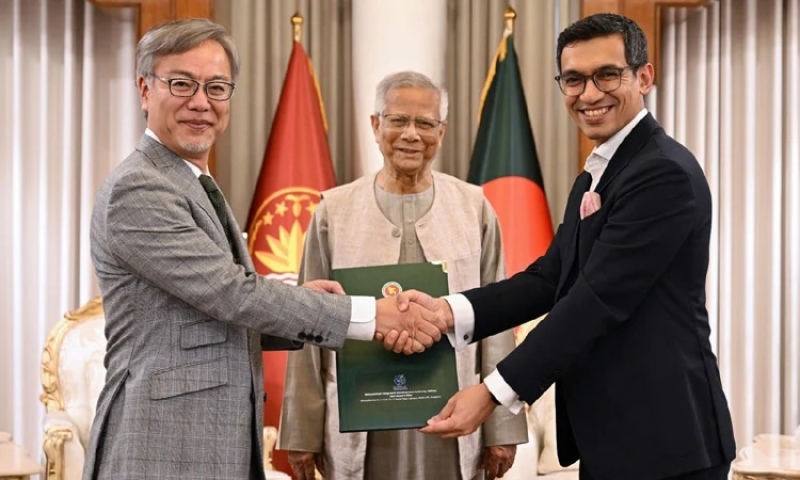
Chief Adviser Professor Muhammad Yunus witnessed the signing ceremony of the MoU between MIDA and SPF held the at the State Guest House Jamuna this afternoon.
Chief Adviser Professor Muhammad Yunus on Tuesday said the Memorandum of Understanding (MoU) between the Maheshkhali Integrated Development Authority (MIDA) and Japan’s Sasakawa Peace Foundation (SPF) would play a key role in conserving oceans and protecting marine fisheries.
He made the remarks after witnessing the signing ceremony of the MoU at the State Guest House Jamuna in the afternoon.
The MoU was signed by Chowdhury Ashik Mahmud bin Harun, Executive Chairman of MIDA, and Professor Mitsutaku Makino, President of the Ocean Policy Research Institute (OPRI) of SPF, aiming to strengthen cooperation in fisheries and marine affairs in support of a sustainable blue economy.
The agreement will be formally endorsed by SPF President Dr Atsushi Sunami in the coming weeks. Dr Emadul Islam, Senior Research Fellow at OPRI, and Commodore Tanzim Faruq, Member of MIDA, were present at the ceremony.
Speaking on the occasion, Professor Yunus stressed the urgency of ocean conservation, noting that marine pollution has reached alarming levels.
“Our ocean is a major asset, yet it is increasingly polluted. Plastic waste has now been detected several thousand metres deep in the sea. This MoU will help protect our marine environment and keep our seas clean,” he said.
Highlighting the importance of the partnership, he said the Sasakawa Peace Foundation is globally respected for marine research and policy work. He added that the Marine Science Institute of Chittagong University would remain connected with SPF, with research collaboration expected to expand gradually.
Under the MoU, SPF will support MIDA in developing three villages in Maheshkhali as model fishing villages based on Japan’s Umigyo concept, which promotes marine industry-led community development.
As the interim government’s dedicated agency for coastal development and strategic infrastructure in Maheshkhali and beyond, MIDA will work with SPF to advance national priorities in fisheries and marine affairs shaped by more than 20 ministries, departments, and agencies.
The Sasakawa Peace Foundation is one of the world’s largest independent philanthropic institutions, with long-standing engagement in maritime policy, disaster risk reduction, and inclusive development across the Indo-Pacific region.
The collaboration will cover feasibility studies on adopting Japan’s blue economy models in mariculture, fisheries, post-harvest management, seafood processing, and the welfare of fishing communities. It will also focus on integrated coastal livelihoods, safety at sea, community-based marine resource management, sustainable local economic development, and two-way communication between fishing communities and the government.
Baseline studies on fisheries resources and coastal tourism potential will be conducted, alongside infrastructure development including jetties, automated fish landing facilities, cold-chain logistics, seafood processing units, and market-chain development.
Training programmes will also be implemented on deep-sea fishing, seafood handling and preservation, mariculture, technology transfer, export diversification, disaster management, safety standards, quality control, hygiene, working conditions, and labour standards.
Professor Mitsutaku Makino said the partnership offered a valuable opportunity to promote an integrated and sustainable blue economy, particularly in the fisheries sector, while strengthening Japan–Bangladesh cooperation and supporting coastal communities.
MIDA Executive Chairman Ashik Chowdhury said the authority aims to preserve traditional fishing livelihoods while opening new economic frontiers. He noted that the partnership would allow Bangladesh to learn from Japan’s Umigyo approach and scale up the science, strategy, and systems needed to unlock the potential of the Bay of Bengal.
The MoU was signed on the sidelines of the two-day Northeast Indian Ocean Regional Dialogue on Sustainable Blue Economy, Connectivity, and Resilience for Small Island Developing States, held in the capital from January 13–14, 2026, with participation from Bangladesh, Sri Lanka, the Maldives, and India’s Andaman and Nicobar Islands.