

- ADP Implementation Hits Five-Year Low at 1.85% |
- NYC BNP leaders, activists upbeat ahead of Tarique Rahman’s arrival |
- PM off to New York to attend UNGA |
- 8 Killed in Ashulia Garment Factory Fire |
- Apratim Murder Suspects Confessed, Says Home Minister |
Legendary journalism trainer Golam Kibria was a great nationalist
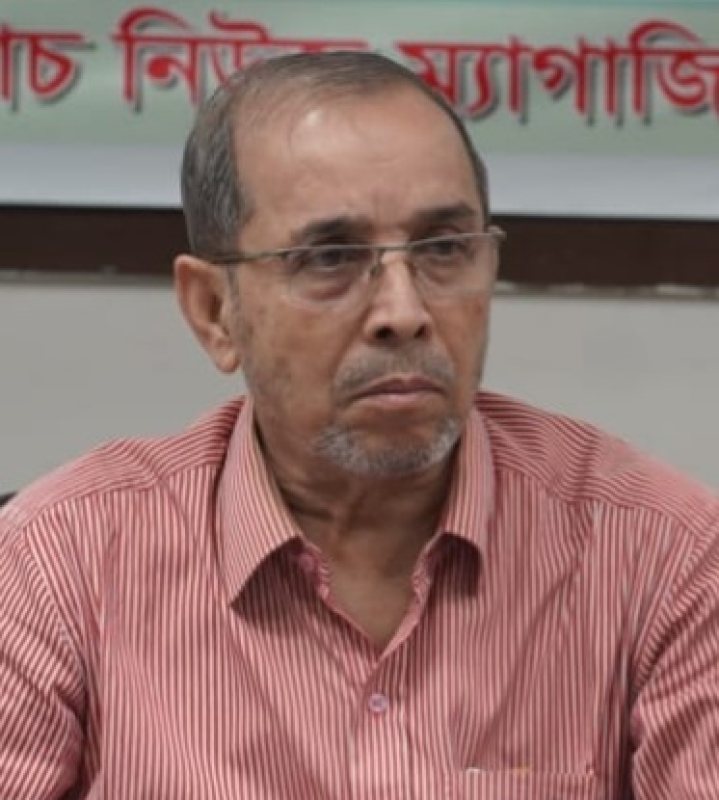
Mostafa Kamal Majumder
Mostafa Kamal Majumder
I am shocked at the passing of Journalism Legend Golam Kibria. Renowned journalist, former Acting Director General of the Press Institute of Bangladesh-PIB, and distinguished intellectual
Mohammad Golam Kibria passed away on Saturday, March 21, while undergoing treatment at a hospital in the capital at the age of 77. 
Legendary journalism trainer Mohammad Golam Kibria dies on 21 March 2026.
In a career spanning five decades, he left an indelible mark on
journalism training, the legal profession, and academic research in Bangladesh. He was a pioneer in media training and intellectual discourse.
Born on January 1, 1949, Golam Kibria dedicated over half a century to the service of the nation through his multifaceted
talent.
He began his journey in 1972 as an Assistant Editor for the newspaper Ganobangla. He later served with great distinction at
the Dainik Sangbad for a significant period of time. In 1979, after earning a Higher Diploma in Journalism from the Thomson
Foundation in the UK, he played a leading role in introducing modern, international standards to journalism training in
Bangladesh.
Mr. Kibria was associated with the Press Institute of Bangladesh-PIB since its inception on August 18, 1976 at the initiative of
the late President Ziaur Rahman. Working alongside the celebrated editor Abdus Salam, he helped solidify the foundation
of the institute. After serving as the Director of Training for many years, he took on the role of Acting Director General in
1991.
He represented Bangladesh at various international seminars, including those hosted by UNESCO, where his research papers on the state and development of the Bangladeshi press earned high acclaim.
In addition to journalism, Golam Kibria was a successful lawyer and educator. He was enrolled as an advocate of the
Bangladesh Supreme Court in 2003.
As a guest faculty member at Stamford University and National University, he mentored a new generation of journalists on
media law and ethics. His published books include The History of Newspapers in Bangladesh, Market Economy and
Bangladesh, and Newspaper and Media Issues in Bangladesh.
A staunch believer in the philosophy of Bangladeshi nationalism, Mr. Kibria played a crucial role in drafting the BNP’s
election manifesto following the 1990 mass uprising.
He is survived by his wife, a son, and a daughter, who currently reside in the United States. He was also a close relative of
the current government’s State Minister for Foreign Affairs, Shama Obayed.
An honest and polished gentleman Golam Kibria used to maintain rapport with leading èditors and journalists when he remained associated with the PIB. After his retirement he worked under a senior advocate of the Bangladesh Supreme Court. He also did part time journalism till such time as he was physically capable of movement on his own. For about a decade up to his death he remained confined to his apartment at the Japan Garden City, Mohammadpur.
An orphan since early life he grew up under the care of his grandmother. He was a dignified and well-behaved man. Golam Kibria used to publish a weekly named 'Parjabekkhak' which did not prove to be a business success. He wrote a book on Bangladeshi nationalism, propagated by President Ziaur Rahman in the late eighties.
I came into close touch with him when I coordinated two fellowship programmes on environmental journalism jointly organised by the Press Institute of Bangladesh and the Panos Institute, London od which I was the Bangladesh Representative for five years. Under these programmes 24 fellows from Bangladesh were sent to four SAARC countries to do fellowship works under my supervision. The selection of fellows was made under a rigorous process. The programmes started when Golam Kibria was the Acting DG and ended under DG Tawhidul Anwar who was deputed from Dhaka University.
After his retirement from PIB Golam Kibria worked at the New Nation editorial section for sometime. He lived a solitary life in his closing years as his family lives in the US. A heart attack he suffered about a decade ago restricted his movement. He tried to purchase an apartment in Segun Bagicha to live near the Supreme Court and the Jatiya Press Club with which he remained associated. But due to bad luck a friend in his effort to help him actually ended up doing harm to Golam Kibria who ultimately had to go to Japan Garden City.
For reasons not fully known to me he had a treasure of love for me. He did praise me for my success in briefing 30 candidates of fellowships on three topics each in one sitting. He said when other members of the fellowship committee fell silent after briefing 10 candidates I continued with the same zeal until the 30th candidate was briefed.
He sought to know how that was possible. I told him I used to write about 60 mini-features for the Panos feature service every year. In addition I used to write features also for Deapthnews Asia, the Down To Earth magazine, New Delhi and several other international feature outlets at intervals. So the topics that came up for briefing 30 candidates were not new to me.
I feel guilty that I did not maintain regular contact with him before his death. Part of the guilt was due to the fact that the nearly 16 years of autocratic rule put my professional and individual life under severe strain. May Allah Almighty grant Golam Kibria peace in the eternal life putting him in Jannatul Firdous. Ameen.