

- WHO Says Traditional Medicine Use Surges Worldwide |
- UN Report Calls for New Thinking to Secure a Sustainable Future |
- BNP moves to finalise seat sharing as alliance friction grows |
- BNP plans universal 'Family Card' for all women: Tarique Rahman |
- Tangail saree weaving gets recognition as intangible cultural heritage |
Next UN Chief Needs US Backing—or Faces Certain Veto
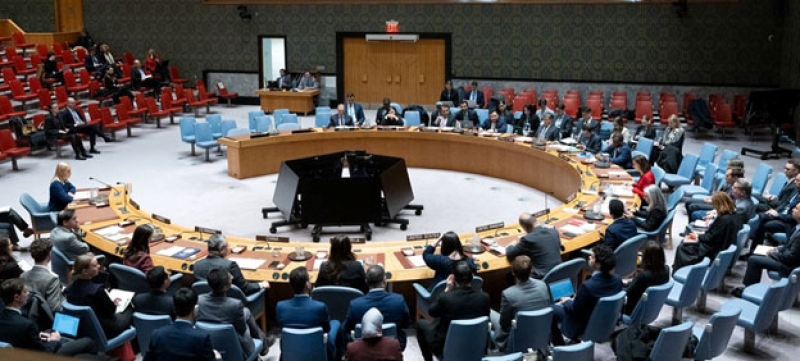
The Security Council in session.
When widespread speculation emerged in the 1980s that a UN Under-Secretary-General (USG)—a graduate of Oxford and Cambridge—was planning to run for Secretary-General, I asked him during an interview in the UN delegates’ lounge to confirm or deny the rumor.
“I don’t think,” he said, “anyone in his right mind will ever want that job.”
Fast forward to 2026.
As a financially strained UN searches for a new Secretary-General to take office in January 2027, the USG’s remark from decades ago seems prophetic—a warning of the disaster now unfolding.
The current Secretary-General faces the daunting challenge of fighting for the UN’s very survival, with a hostile White House forcing the organization to slash staff, cut funding, and move several UN agencies out of New York.
The bottom line: the incoming Secretary-General will inherit a severely weakened United Nations.
Addressing the General Assembly last September, President Trump remarked, “What is the purpose of the United Nations? It’s not even coming close to living up to its potential.”
Dismissing the UN as outdated and ineffective, he boasted: “I ended seven wars, dealt with the leaders of each and every one of these countries, and never received a phone call from the United Nations offering to help finalize the deal.”
Whoever is elected, the next UN chief will be expected to abide by the Trump administration’s policies, which run counter to many UN principles, including racial equality and gender empowerment (DEI).
“Diversity, equity and inclusion (DEI) policies that were adopted to address historical and structural injustices are being vilified as unjust,” said Volker Turk, UN High Commissioner for Human Rights.
In his 345-page book Unvanquished: A US–UN Saga (1999), former Secretary-General Boutros Boutros-Ghali wrote that although Washington accused him of being “too independent,” he ultimately did everything possible to accommodate the United States. But when he ran for a second term, the US—champion of majority rule—used its veto even though Boutros-Ghali received 14 of the 15 Security Council votes, including all four other permanent members.
Tradition would have demanded that the dissenting US abstain and respect the overwhelming majority. But it did not.
Unlike many of his predecessors and successors, Boutros-Ghali refused to blindly play along with US demands, despite occasionally yielding to pressure at a time when Washington was notorious for manipulating the organization to protect its own national interests.
Jesselina Rana, UN Advisor at CIVICUS’ UN Hub in New York and steering committee member of the “1 for 8 Billion” campaign, told IPS that when key international norms are openly violated by member states, and the veto is used to undermine the UN’s founding principles, structural reforms alone may not restore trust.
“Can the UN80 process genuinely rebuild trust in multilateralism,” she asked, “when the process itself has been opaque and has lacked meaningful civil society participation?”
She said an accountable, transparent Secretary-General selection process requires stronger support from member states. A process that is open, inclusive of civil society, and grounded in feminist leadership would strengthen the UN’s capacity to navigate today’s challenging geopolitical environment and help restore faith in multilateralism.
After 80 years of male leadership, the next Secretary-General should be a woman with a proven record in gender equality, human rights, peace, sustainable development, and multilateralism, she added.
Felix Dodds, Adjunct Professor at the Water Institute at the University of North Carolina and Associate Fellow at the Tellus Institute, told IPS that the UN now faces its most difficult period since the Cold War.
He said relocating some UN bodies may not be a bad idea. UNDP did so under Helen Clark—moving closer to the communities they aim to help. While it may be cost-cutting, it could also be strategically beneficial.
“The new SG must be someone Trump allows, as he has a veto,” Dodds noted.
“Of the candidates we considered previously, the only realistic one is Rebeca Grynspan from UNCTAD. She has proven herself an effective bureaucrat and led UNCTAD well, just as she did for Costa Rica when she was Deputy President,” said Dodds, who also serves as City of Bonn International Ambassador.
“We may be looking at a man again,” he added.
Clearly, the incoming Secretary-General in 2027 faces enormous challenges. Whoever is chosen will have to make concessions to the P5 regarding the size and scope of the UN. Current cuts are likely only the first of more to come.
“A UN with a clearer mandate may result,” he said. Stakeholders must defend the UN as a vital multilateral institution while simultaneously proposing simple, practical reforms that strengthen their sectors of work.
Security Council reform is impossible for now, he said—but proposals should still be tabled. The realistic question is: what reforms can stakeholders and governments actually achieve together?
Ultimately, the goal must be a more effective UN delivering real impact on the ground. “Do the reform proposals accomplish that?” he asked.
“The organization has always operated under political pressures. The UN80 process offers a chance for dialogue on realistic reforms. The question is: what are they?”
Dr. Stephen Zunes, Professor of Politics and International Studies at the University of San Francisco, told IPS that after the Napoleonic Wars, the Council of Europe kept the peace until the Central Powers rejected its legitimacy—leading to World War I. The League of Nations did the same until the Axis powers dismissed it—leading to World War II.
“We are now at a similar crossroads,” he warned, “where the UN system is being challenged by both Russia and the United States, which—as shown by the invasions of Iraq and Ukraine—no longer feel constrained by the prohibition on aggressive war.”
He added that recent US actions are especially damaging, given Washington’s financial importance to the UN and its ability to push through Security Council resolutions that appear to legitimize illegal Israeli and Moroccan occupations.
“UN members must be willing to risk the wrath of the Trump administration by standing up for the UN Charter and the basic principles of international law. Nothing less than the future of the world body—and international peace and security—is at stake,” he declared.