

Thursday, July 30, 2026
News update
- Rivers Must Remain Alive Until They Meet Seas – Basin Summit |
- Monsoon Sets In Bangladesh With Erratic Signals |
- Freeing Bourses From Evil Grips of Cronies And Oligarchs |
- Uneasy Calm In BD Political Arena Over Amendment Or Reform |
- UN experts for urgest action to support Rohingya Refugees in BD |
CSOs Oppose Shift of Urban Healthcare to Health Ministry
Staff Correspondent:
Health
2026-07-30, 9:15pm
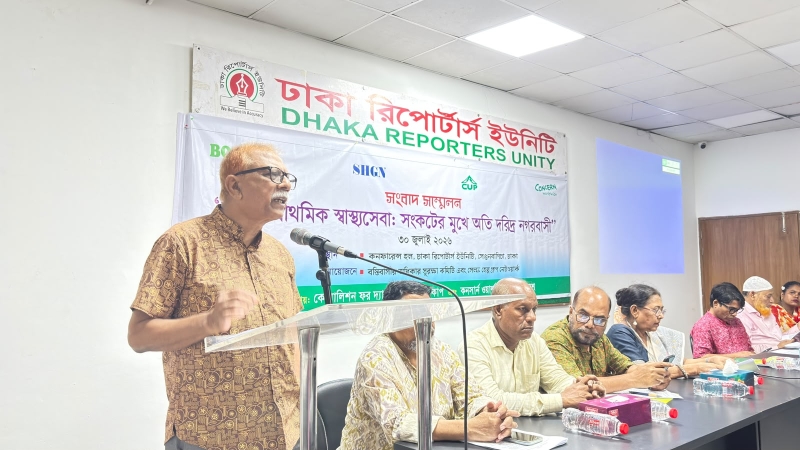
Civil society organisations (CSOs) on Thursday voiced strong opposition to the government's decision to transfer responsibility for urban primary healthcare services from the Local Government Division to the Ministry of Health and Family Welfare, warning that the move could disrupt essential services for millions of low-income urban residents.
Speaking at a press conference at Dhaka Reporters Unity, civil society leaders urged the government to consult non-governmental organisations and other stakeholders before implementing the decision. They warned that an abrupt transition could create a crisis in urban healthcare delivery, as the Health Ministry lacks the manpower and logistical capacity to manage services across cities and municipalities.
The speakers called for the uninterrupted continuation of the Urban Primary Healthcare Programme, restoration of free healthcare for the urban extreme poor and introduction of a nationwide Health Smart Family Card to ensure equitable access to primary healthcare.
The press conference was organised by the Coalition for the Urban Poor (CUP), with support from the Federation of Urban Poor Slum Dwellers (BOSC) and the Federation of Pavement Dwellers, Hut Dwellers and Self-Help Group Network.
Presenting a seven-point charter of demands, Hena Akter Rupa, focal person of the BOSC Youth Group, said the Cabinet had decided on April 22 to transfer responsibility for urban healthcare services from the Local Government Division to the Ministry of Health and Family Welfare.
The speakers said Bangladesh has yet to establish a permanent, government-led urban primary healthcare system, despite healthcare being recognised as a basic responsibility of the state under Article 15(a) of the Constitution.
As a result, millions of urban residents, particularly those living in slums and low-income communities, remain dependent on primary healthcare services provided by NGOs, they said.
They added that efforts to establish a dedicated urban primary healthcare system since the early 1990s had significantly improved access to essential services for disadvantaged urban communities and should not be undermined during the transition.
Former chief scientific officer and adviser to the Institute of Epidemiology, Disease Control and Research (IEDCR), Dr Mushtaq Hossain, said universal health coverage would not be possible without guaranteed access to primary healthcare.
"Although rural Bangladesh has a network of primary healthcare facilities, urban areas still lack an effective government-led primary healthcare structure. The outpatient departments of large hospitals cannot replace comprehensive primary healthcare," he said.
People's Health Movement Bangladesh Coordinator Md Aminur Rasul said the health allocation in the FY2026-27 budget had increased to Tk 69,409 crore, equivalent to around 1.1 percent of GDP, from 0.88 percent in the previous fiscal year.
"Public hospitals are already overwhelmed with patients. Suspending urban primary healthcare services would place even greater pressure on the healthcare system," he said, stressing the need for sustained investment in the sector.
CUP Executive Director Khondkar Rebecca San Yat said the current programme covers only 12 city corporations and 21 municipalities, leaving many urban areas outside its coverage.
She said the programme currently provides more than 16 essential services, including maternal and child healthcare, immunisation, family planning, nutrition and adolescent reproductive health services. However, she said service charges have recently increased and free healthcare for the poorest families has been discontinued.
The speakers demanded that the Urban Primary Healthcare Programme continue through partnerships between the Ministry of Health or the Directorate General of Health Services and existing NGO service providers.
They also called for the reinstatement of free Red Cards for the urban extreme poor, affordable medicines for low-income communities, retention of experienced healthcare workers, expansion of community-based health centres to all city corporations and municipalities, establishment of primary healthcare facilities in underserved urban wards and introduction of a Health Smart Family Card for all urban residents, with priority given to low-income communities.
The press conference was chaired by Hosne Ara Begum Rafeza and moderated by CUP Executive Director Khondkar Rebecca San Yat.
Among others, former Dhaka Reporters Unity president Rafiqul Islam Azad, Bangladesh Health Reporters Forum President Pratik Ejaz and Bangladesh Human Rights Journalists Forum representative Khairuzzaman Kamal addressed the programme.
The speakers urged the government to ensure adequate budgetary allocations and decentralise healthcare planning so that urban residents, particularly those living in slums and informal settlements, are not left behind in Bangladesh's pursuit of universal health coverage and the Sustainable Development Goals.