

- 42-Year Rainfall Record Broken as Chattogram Floods |
- Flash Flood Risk Rises as Rivers Swell: FFWC |
- Switzerland Beat Colombia to Reach World Cup Last Eight |
- Argentina beat Egypt 3-2 to reach World Cup quarter-finals |
- Bangladesh Leads South Asia in FDI Growth: UNCTAD |
DRC Ebola outbreak spreads, vaccine still months away
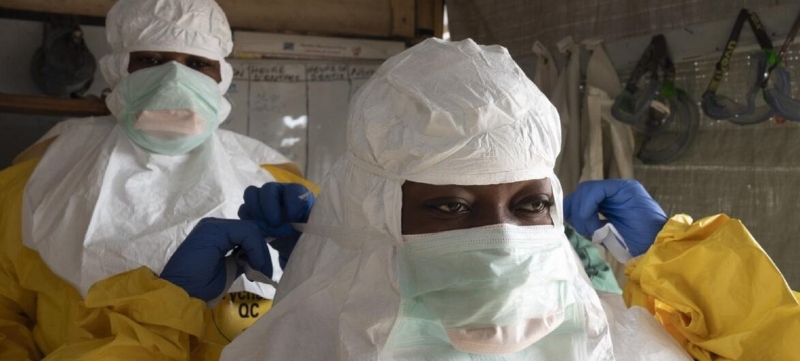
Health workers wearing protective clothing to prevent transmission.
A fast-spreading Ebola outbreak in the Democratic Republic of the Congo (Democratic Republic of the Congo) has prompted urgent efforts by health workers to contain transmission, while the rollout of a potential vaccine remains months away, according to the World Health Organization.
WHO’s representative in the DRC, Dr Anne Ancia, told reporters in Geneva that there are more than 500 suspected cases, including around 130 suspected deaths, while only 30 cases have been confirmed so far.
The agency is working closely with national authorities and is sending additional testing kits to eastern DRC to detect infections linked to the Bundibugyo strain of the Ebola virus, for which no approved vaccines or treatments currently exist.
“We have significant uncertainty about the number of infections and how far the virus has spread,” Dr Ancia said.
Early cases and spread
Speaking from Bunia in Ituri province, where the outbreak was first detected, Dr Ancia said the virus has now spread to North Kivu, with confirmed cases in Butembo and Goma. Uganda has also confirmed two imported cases.
WHO Director-General Tedros Adhanom Ghebreyesus declared the outbreak a Public Health Emergency of International Concern, citing the “scale and speed” of the spread.
Authorities are still working to determine the origin of the outbreak. “We don’t yet have patient zero,” Dr Ancia said.
She explained that the initial case appears to have involved a death in Bunia on May 5, followed by traditional funeral practices that may have contributed to further transmission.
Detection challenges
Early detection was complicated because local tests initially ruled out the more common Zaire strain of Ebola. The symptoms—fever, fatigue, diarrhoea, and vomiting—overlap with other diseases, delaying diagnosis. Some characteristic symptoms also appeared only after several days of infection.
It was later laboratory testing in Kinshasa that confirmed the presence of the Bundibugyo virus.
Response and vaccine development
WHO has convened technical experts to assess potential vaccines and treatments. One candidate, Ervebo, which targets the Zaire strain, is under consideration, but officials say it could take around two months before it becomes available for deployment.
Dr Ancia stressed that controlling the outbreak will depend heavily on community engagement, awareness campaigns, and efforts to counter misinformation, particularly around burial practices.
“If we use coercive measures and communities do not agree, we will see resistance and hidden cases,” she said, urging cooperation with local leaders, schools, and religious institutions.
WHO has deployed more than 40 health experts and supplies to support the government-led response in what it described as a complex situation marked by insecurity and displacement.
Humanitarian concerns
The UN refugee agency UNHCR warned that the affected regions of Ituri and North Kivu host more than two million internally displaced people, with limited access to healthcare due to ongoing conflict.
Thousands of refugees in the region also require urgent support, including preventive health measures and sanitation supplies.
Health officials noted that the country is still recovering from previous Ebola outbreaks, particularly the 2018–2019 epidemic, and said community trauma remains high.
Dr Ancia cautioned that while a vaccine may become available within months, the outbreak itself is unlikely to end quickly, adding that previous epidemics have lasted far longer than expected.