

- JS passes Tk 9.38 lakh crore budget for FY27 |
- Court ruling blocks Aslam Chowdhury’s MP oath |
- Prioritise natural resources regeneration in budget to make dev holistic |
- Finance Bill passed, tax-free threshold set at Tk 4 lakh |
- PM calls FY27 budget 'life-friendly', promises relief |
Over 1.35 lakh SSC candidates face uncertain futures over late syllabus changes
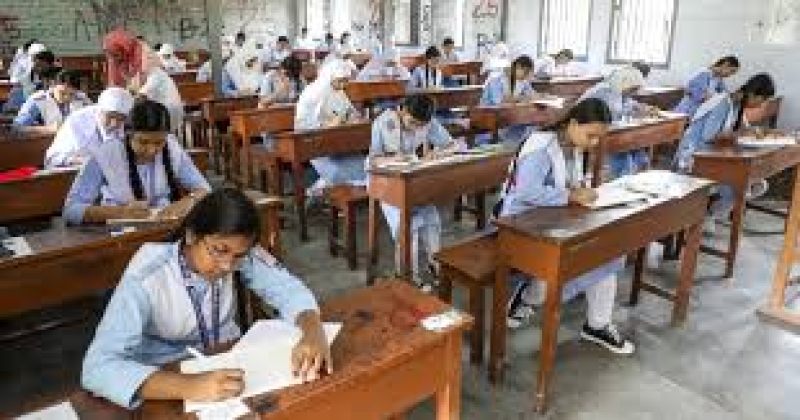
The academic future of more than 1.35 lakh SSC candidates for the 2026 session has been thrown into uncertainty following a sudden decision by the education authorities to examine them under the 2025 syllabus.
The affected students, who registered for the 2023-24 session but studied under the 2026 curriculum, are now reportedly being forced to sit for exams based on an "old" syllabus they never fully covered.
A notification issued by the Board of Intermediate and Secondary Education, Dhaka, on April 23—after the examinations had already commenced—clarified that students registered in 2023-24 must follow the 2025 syllabus.
However, many of these students had missed their 2023 academic year due to illness, accidents, or other personal reasons, effectively joining the new curriculum introduced in 2024.
According to Ministry of Education data, around 4.5 lakh students registered for the 2023-24 session are appearing for the 2026 SSC exams. Approximately 30 percent of them (1.35 lakh) studied the new curriculum in Class IX in 2024 and the short syllabus in Class X in 2025, leaving them unprepared for the full 2025 syllabus.
The lack of coordination became evident during the initial days of the examination. Abdul Awal, a parent of a student appearing at Motijheel Government Boys School, shared his daughter's ordeal.
"My daughter appeared for the Bangla 1st paper under the new 2026 syllabus, but on the second day, she was handed the Bangla 2nd paper question based on the old 2025 syllabus," he said.
He added that despite her 2023-24 registration, she had only studied the new curriculum after missing her 2023 session due to a physical injury.
Guardians and education observers have criticized the timing of the board’s notification, noting that neither the schools nor the boards had informed the students of this requirement earlier in the academic year.
Given the frequent changes to the SSC curriculum over the past few years, stakeholders are urging the government to consider the situation on humanitarian grounds.
They argue that forcing students to sit for exams on a syllabus they were never taught is a "wholesale decision" that risks the secondary education outcomes of over a hundred thousand learners, reports UNB.