

- Govt Proposes 17-Member Panel for Constitution Reform |
- Energy Security Lies in in Solar Power |
- Breaking The Iron Grips of Oligarchy in Bangladesh |
- PM Unveils 12-Point Plan for Clean, Green Dhaka |
- Fuel shortage, rains hit Boro harvest in Habiganj haors |
Breaking The Iron Grips of Oligarchy in Bangladesh
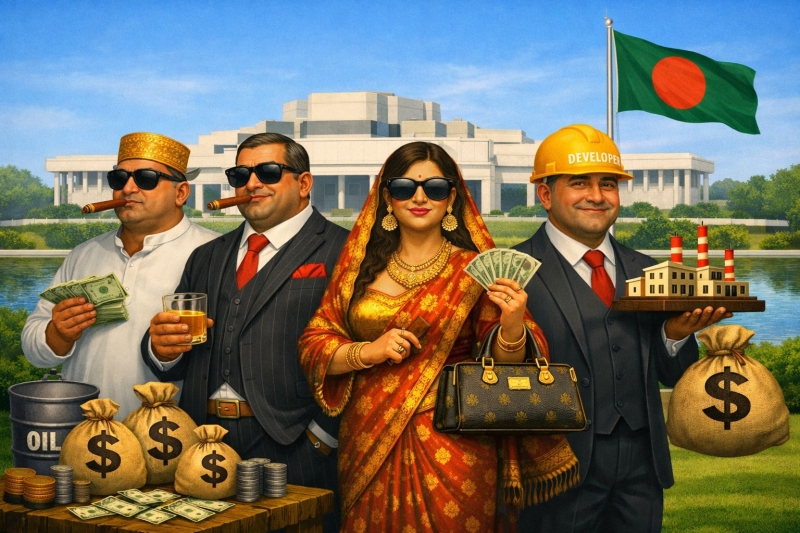
Representational image
The greatest question facing Bangladesh is not merely who is in the government. The real question is: Who governs the state? An elected government—or invisible economic elite? Parliament—or syndicates? The people—or a handful of families?
To answer this question, one must confront a single word: oligarchy. Once found in political vocabulary, oligarchy became Bangladesh’s lived reality until July 2024. Under the system a small but immensely powerful class of wealthy elites extended its influence over the state’s laws, policies, banks, markets, tax system, regulatory bodies, and even the judiciary and administrative apparatus.
They were not merely rich; they were policymakers. They were not merely businessmen; they were co-owners of state power. They were not merely beneficiaries; in many cases, they were the true managers of the state itself.
The rise of oligarchy in Bangladesh did not occur overnight. It emerged from years of political patronage, bureaucratic corruption, banking plunder, institutional decay and an increasingly authoritarian governance. Under former Prime Minister Sheikh Hasina’s fifteen-and-a-half-year rule, this reached a new and dangerous stage.
The state protected them. The law changed for them. Bank vaults opened for them. And public wealth flowed into their hands in the name of development. A newly elected government has come to power in February amid questions whether or not it would allow Awami League-linked oligarchs to return to the country through the approval of the Bank Resolution law.
According to experts, the interim government’s “Bank Resolution Ordinance 2025” was a bold initiative to restructure distressed banks and remove those from ownership who were responsible. However, when passed in Parliament as a bill, a controversial clause weakened its goals of reform and establish accountability. Many believe this change has created a pathway for notorious groups, bracketed as oligarchs, to re-enter the banking sector. Economist Zahid Hossain and TIB’s Dr. Iftekharuzzaman have cautioned that the law might effectively reward looters.
Oligarchy: The Corrupt Form of Power
Oligarchy refers to a system in which real power rests in the hands of a small number of wealthy, influential and politically connected individuals. Democratic institutions may formally remain as cover—elections may turn rituals, parliament may turn into a laughing stock, ministers may take oath—but the true power runs elsewhere.
Policy, resource allocation, economic opportunity and administrative decisions serve the interests of a narrow elite. Aristotle described oligarchy as a corrupt form of government: a system in which the state becomes the private instrument of a privileged few. By that definition, Bangladesh in the near past increasingly fitted the model.
The Political Economy of State Capture
Business–politics collusion is not new in Bangladesh. Since independence, successive governments have cultivated loyal business classes. But after 2009, this relationship moved beyond patronage. It evolved into state capture. It amounted to more than receiving state favour; it meant acquiring the capacity to shape laws, policies, institutions, regulators and administrative structures for private gain. That is precisely what occurred in Bangladesh.
Banking laws were amended to allow certain families greater control over boards. Bank licenses were issued on political grounds. Central bank oversight weakened. Loan rescheduling rules shifted to protect defaulters. Mega-project tenders, power-sector contracts, trade policy and tax exemptions disproportionately favoured a narrow circle. This was no longer ordinary capitalism. It was the organised transfer of public wealth through state patronage.
Who Are the Oligarchs?
Discussions of oligarchy in Bangladesh repeatedly return to a familiar set of names. Media reports, white papers and ongoing investigations have highlighted powerful business families and conglomerates. Not all allegations have been proven in the court, and not every successful business family qualified as oligarchic. Yet the concentration of wealth and privilege among politically connected conglomerates remained too systematic to dismiss as coincidence.
Banking Loot as the Engine of Oligarchic Wealth
The principal engine behind Bangladesh’s oligarchic rise was the banking sector. In a normal market economy, wealth accumulates through innovation, competition and production. In Bangladesh, vast fortunes accumulated through the looting of state-backed credit. Thousands of crores in loans were issued without adequate collateral. Single groups controlled multiple banks. Loans gained approval through political influence. Defaults followed.
Then came restructuring. Then fresh loans. Then capital flight abroad. Funds that should have gone to productive enterprises and small businesses instead flowed into the hands of a few families. Thus emerged a new oligarchic class almost overnight.
Development as a Vehicle for Plunder
Under former Prime Minister Sheikh Hasina, “development” served as the regime’s defining political slogan. Bridges, metro rail, expressways, power plants and flyovers all symbolized progress. But the central question remained: Development for whom? When project costs exceed international benchmarks several times over; when the same contractors repeatedly win bids; when idle power plants receive capacity payments; when commissions and kickbacks permeate everything from land acquisition to imports— development ceases to be development. It becomes a mechanism for wealth transfer. Public tax revenue, foreign loans and bank deposits together financed the enrichment of narrow elite.
Why Oligarchy Destroys Economies
Oligarchy is not merely a moral problem; it is economically destructive. First, it destroys competition. When success depends not on competence but on political access, genuine entrepreneurs cannot survive. Second, it wastes resources. The inefficient and nonqualified gain capital; the capable and productive are excluded. Third, it reduces productivity. Protected oligarchs face no pressure to innovate or improve efficiency. Fourth, it deepens inequality. A few families reap the gains of growth while the broader public bears inflation, unemployment and heavier tax burdens.
The Invisible Enemy of Democracy
Oligarchy also corrodes democracy itself. Oligarchs require weak democratic institutions, managed elections, compliant bureaucracies, pliant courts and captive media. They do not want real democracy. Because real democracy imposes accountability. And accountability threatens plunder. In Bangladesh, major business groups have repeatedly financed political parties, acquired media outlets, shaped public opinion and influenced state decisions. As a result, no matter who wins elections, oligarchic influence often remains intact.
Opportunity or Illusion?
Following the 2024 mass uprising, investigations into oligarchic networks began. Accounts were frozen. Assets were seized. Efforts commenced to recover funds laundered abroad. These steps matter—but they are not enough. History teaches that oligarchs rarely disappear easily.
They adapt. They change colours. They survive regime change by aligning themselves with whoever comes next. If Bangladesh’s oligarchs secure rehabilitation under a new political order, then the sacrifices of 2024 will have been in vain.
What Must Be Done
Dismantling oligarchy requires more than arresting a few businessmen. It demands structural transformation. First, the banking sector must be insulated from political interference. Second, monopolies and cartels must be broken through competition law enforcement. Third, public procurement must become transparent and independently audited. Fourth, stolen assets abroad must be pursued through international legal and financial mechanisms. Fifth, political financing must become transparent and regulated.
A New Entrepreneurial Class Must Rise
Removing oligarchs alone is insufficient. Some people must replace them. Bangladesh needs a new entrepreneurial class—young, innovative, competitive and technologically driven. Small and medium enterprises require capital and market access. The economy must diversify beyond garments and cartel-controlled sectors.
The First Condition is National Renewal. Because if elected governments exist but real power remains in the hands of wealthy elites, then democracy becomes a façade—an electoral oligarchy. If Bangladesh truly seeks national renewal, oligarchy must be dismantled. The state cannot be repaired while oligarchic power remains intact. Without uprooting their influence, reform will fail, democracy will weaken, and the old cycle of plunder will return under new patrons.
Some analysts argue that the old 22 families of the Pakistan era have been replaced by some 220 oligarchic families in Bangladesh. They used to accumulate wealth using the state apparatus, to those including owner of a group and adviser to the chief executive; a land developer turned corporate conglomerate, a serial killer of the best performing banks, a top beneficiary of the corrupt quick rental power plants that received more than a trillion of state money in capacity charges over the 15 plus years, to MPs turned bankers who owned also hospitals, universities, cold storages, and what not.
Economists argue that building an oligarch-free, inclusive economy will require stronger competition, banking reform and anti-corruption measures. (This story has been published in the April print edition of the GreenWatch)
(The writer is the Head of News at The Mirror Asia, a Germany-based online news portal.)