

- First cruise ship crosses Strait of Hormuz since war began |
- MDBs stress co-op support global stability amid uncertainty |
- PM opens first Hajj flight, visits Ashkona camp |
- River ports asked to hoist cautionary signal No 1 |
- Oil prices drop 9% & Wall Street rallies to a record after Iran reopens Hormuz |
FDI Drops 18% in Q4 2025 Amid Political Uncertainty
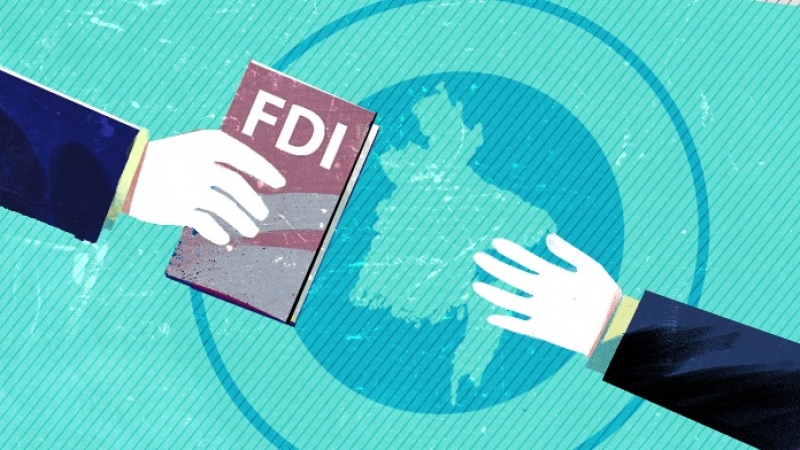
Foreign direct investment in Bangladesh fell by 18 per cent in the final quarter of 2025, reflecting investor caution amid political uncertainty during the closing phase of the interim government.
Data from Bangladesh Bank showed net FDI at $108 million in October–December 2025, down from $132.81 million in the same period a year earlier.
Economists attributed the decline largely to uncertainty over political direction and the timing of elections. Zahid Hossain said the investment climate was not conducive at the time, as investors remained unsure about policy continuity and long-term stability.
He noted that although efforts were made to attract foreign investment, the temporary nature of the administration and lack of a clear electoral roadmap discouraged fresh inflows.
Reinvested earnings also dropped sharply, falling by over 35 per cent to $217.4 million during the quarter, compared with $325.75 million a year earlier. This suggests that even existing foreign companies scaled back expansion plans.
Mustafizur Rahman, a distinguished fellow at the Centre for Policy Dialogue, said foreign firms remained cautious due to lingering political concerns, even as elections approached.
He added that beyond political factors, structural challenges continue to weigh on investment. These include complex policies, high costs of doing business, and limitations in infrastructure and logistics.
Bangladesh also trails several regional peers in port efficiency, transport systems, and cargo handling capacity, which further affects its competitiveness in attracting foreign capital.
According to central bank officials, private sector investment has also slowed, indicating a broader reluctance among both domestic and foreign investors to commit new funds.
Overall foreign investment—including equity, reinvested earnings and intra-company loans—stood at $363.82 million in the quarter, down from $494 million in the same period of 2024, underscoring the combined impact of political uncertainty and structural constraints.