

- Eliminate Wastes: Make Life Sustainable |
- Pay Scale Push Sans Funding Plan Alarms Economists |
- Early 2026 Spike In Migrant Deaths At Sea Is Alarming |
- Delhi spells out Mecca Pact has security implications for India |
- Trump Announces ‘Largest Oil Deal in World History’ With Venezuela |
Dhaka Medical College set for Tk 1,155cr infrastructure overhaul
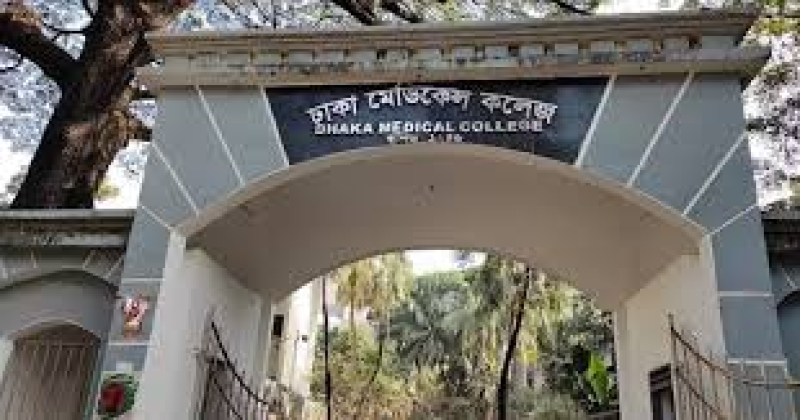
Dhaka Medical College, the country’s oldest medical education institution, is set for a major facelift as the government has taken up a Tk 1,154.83 crore project to replace its ageing and unsafe structures with modern academic, residential and support facilities.
The project, titled “Replacement and Reconstruction of Unusable Structures of Dhaka Medical College”, will be implemented by the Directorate General of Medical Education under the Health Education and Family Welfare Division of the Ministry of Health and Family Welfare.
The fully government-funded scheme will be implemented over four years from September 2026 to August 2030, according to project document..
The project seeks to address the longstanding infrastructure problems of Dhaka Medical College including old, earthquake-prone, weak and risky buildings while ensuring that ongoing academic activities are not disrupted during reconstruction.
Established in 1946, Dhaka Medical College is the country’s first and one of its most prominent medical education institutions. The institution currently has around 60 buildings, old and new, while its hospital has capacity for around 2,600 beds.
Despite that capacity, an average of around 3,500 to 4,000 patients are admitted to the hospital every day, placing considerable pressure on its existing infrastructure, according to the project document.
Around 1,500 students are currently studying at the college at MBBS and postgraduate levels.
The institution has four residential halls for students, but several of the existing facilities have become old and inadequate.
The Dr Fazle Rabbi Hall, built in 1955 for male students, has accommodation for around 700 students. However, the ageing condition of the building has reduced its usable capacity.
The Public Works Department has already declared the fourth floor of the main building abandoned, forcing students to live in a reduced space and creating accommodation problems, particularly for new batches.
The project document says the existing academic buildings and hostels have become unsuitable for repair and increasingly risky, making replacement and modernisation necessary.
Under the project, a 15-storey academic building with three basements will be constructed over 86,854.33 square metres.
It will have four lecture theatres, each with a capacity of 300 students, and two examination halls, each also accommodating 300 students.
A 15-storey student hostel with one basement will be constructed over 25,863.48 square metres, providing accommodation for around 800 students.
A 15-storey residential quarters building with two basements, covering 20,601.08 square metres, will also be built to address accommodation needs of teachers and officials.
The project also includes construction of a four-storey service building covering 1,277.41 square metres and a four-storey mosque covering 2,225.01 square metres, with space for around 800 worshippers.
The government plans to make the renovated campus more environmentally sustainable by incorporating solar energy, rainwater conservation, efficient use of water and electricity, green spaces and modern waste management.
According to the project document, residential buildings, including the student hostel and residential quarters, will account for around Tk 299.76 crore.
Construction of non-residential buildings and related infrastructure has been estimated at around Tk 577.04 crore.
The project also includes around Tk 15.10 crore for external health, sanitation and water supply facilities, Tk 118.26 crore for external electrification and electrical equipment, Tk 35.67 crore for furniture for the medical college, hostel and other facilities, and Tk 28.09 crore for equipment for the medical college.
The project was initiated following a meeting chaired by the Director General of the Directorate General of Medical Education on February 3, 2025, where the deteriorating condition of the college’s infrastructure was discussed.
Following the meeting, the Directorate of Architecture was instructed to prepare a comprehensive master plan incorporating modern facilities required for education, research and creative activities, including academic buildings, student hostels, lecture theatres, examination halls, prayer facilities and an auditorium.
Subsequently, the Public Works Department was instructed to assess the costs of essential buildings in line with the master plan and prepare a Development Project Proposal (DPP).
The DPP was eventually prepared based on the approved master plan, incorporating a new academic building, student hostel, residential quarters, mosque, service building and other essential facilities.
The project document says the reconstruction is necessary not only to eliminate safety risks but also to strengthen the institutional environment of one of the country’s leading medical education centres.
The government expects the new infrastructure to provide students and teachers with safer and more modern facilities, improve the quality of medical education and research, and help transform Dhaka Medical College into a sustainable and environmentally friendly campus. -UNB