

- Philip Sangma arrested for aiding Hadi murder suspects escape |
- Govt Issues Notice on Visa Extension for Expatriates |
- Khamenei Warns US, Israel in First Speech as Leader |
- Protests, Walkout Mark President’s Address in Parliament |
- UNSC fails to adopt resolution for halting Middle East crisis |
US Strikes Iranian Military Targets on Kharg Island
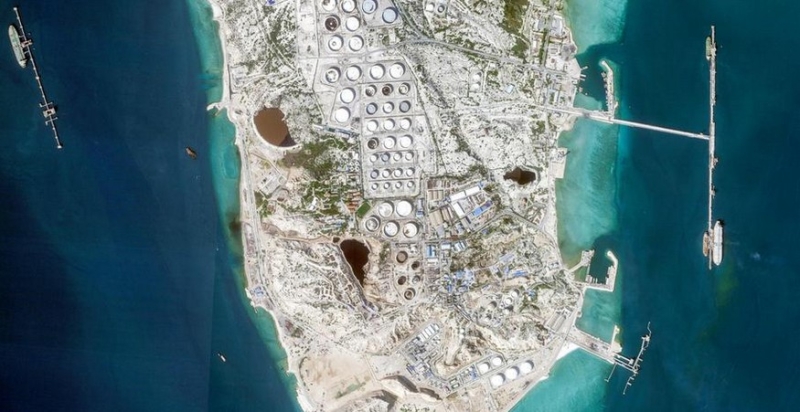
US forces have struck several military targets on Iran’s Kharg Island, prompting sharp warnings from Washington and threats of retaliation from Tehran as tensions across the Middle East continue to escalate.
US President Donald Trump said the attacks targeted military installations on the island, which serves as the main export hub for Iranian crude oil. Kharg Island handles about 90 percent of Iran’s oil shipments and lies roughly 300 miles northwest of the strategically vital Strait of Hormuz.
In a message posted on his Truth Social platform, Trump claimed the strikes had “totally obliterated” military targets on the island. He warned that Iran must halt attacks on commercial vessels passing through the Strait of Hormuz or face further US action.
According to Trump, the strikes deliberately avoided oil infrastructure. However, he said the United States would reconsider that restraint if Iran attempted to disrupt shipping through the narrow waterway linking the Persian Gulf with global markets.
The US president also issued a stark warning to Iran’s leadership and military forces, saying they should abandon hostilities to avoid further destruction.
Iran quickly responded to the threats. The country’s armed forces said any attack on Iranian oil or energy infrastructure would trigger strikes against facilities belonging to energy companies cooperating with the United States in the region.
Iranian media reported that more than 15 explosions were heard on Kharg Island during the US assault. Sources cited by the semi-official Fars News Agency said the strikes targeted air defence systems, a naval base and airport installations on the island.
The reports added that oil infrastructure, including pipelines, storage tanks and export terminals, remained intact after the attacks.
Energy markets were closely monitoring the situation for signs of damage to the island’s export facilities. Even minor disruptions could significantly affect global oil supply because Kharg Island is Iran’s primary crude export terminal.
The region has already experienced extreme volatility in energy markets since the conflict erupted late last month. The war began on February 28 with massive bombardments by the United States and Israel against targets in Iran, rapidly widening into a broader regional confrontation.
In parallel with the Kharg Island strikes, Iran said it had carried out additional attacks against Israeli targets. The country’s elite Islamic Revolutionary Guard Corps reported launching further operations alongside the Lebanese group Hezbollah.
Iranian media, including the Tasnim News Agency, said the attacks were part of coordinated operations against Israel following intensified air strikes on Iranian territory.
Israeli military officials said their air force struck more than 200 targets in western and central Iran over a 24-hour period. Those operations reportedly hit ballistic missile launchers, air defence systems and facilities linked to weapons production.
The widening conflict has also led to casualties among US forces stationed in the region. The US military confirmed that six crew members aboard a refuelling aircraft died after their plane crashed in western Iraq.
Separately, several US military tanker aircraft stationed at a base in Saudi Arabia were damaged by an Iranian missile strike and are currently undergoing repairs, according to US officials.
The conflict has increasingly turned neighbouring countries into flashpoints. Lebanon in particular has seen escalating violence as Israeli forces and Hezbollah fighters exchange strikes in and around the capital, Beirut.
Iran has also intensified missile and drone attacks against Israel and several Gulf states allied with the United States.
At the same time, the Iranian military has sought to disrupt maritime traffic through the Strait of Hormuz, a narrow passage that carries roughly 20 percent of the world’s oil and gas supplies.
In response, Trump said the US Navy would soon begin escorting commercial tankers through the waterway to ensure safe passage for international shipping.
Despite earlier suggestions that the conflict might end quickly, the US president declined to provide a timeline for when hostilities might cease.
“I have my own idea, but what good does it do?” Trump told reporters. “It will be as long as it’s necessary.”
The uncertainty has added pressure to global energy markets. While some Gulf producers have temporarily halted shipments because of security concerns, Iran has continued exporting crude oil.
Satellite imagery reviewed by oil-tracking firms showed several very large crude carriers loading at Kharg Island earlier this week. Estimates suggest Iran exported between 1.1 million and 1.5 million barrels of oil per day during the early weeks of the conflict.
Energy analysts warn that the ongoing disruption is already one of the most significant shocks to global oil supply in decades.
Bob McNally, president of the consultancy Rapidan Energy Group, said Trump’s latest remarks have heightened concerns in energy markets.
According to McNally, the comments have drawn attention to the possibility that the supply disruption could expand and last longer than previously expected.
Some industry observers also questioned whether Kharg Island’s oil infrastructure could remain untouched if the conflict continues.
Josh Young, chief investment officer at Bison Interests, said avoiding the oil facilities while striking nearby military sites may prove difficult if fighting intensifies.
Meanwhile, Iran’s new supreme leader Mojtaba Khamenei vowed that his country would keep the Strait of Hormuz closed to hostile forces.
In his first public remarks since assuming leadership, Khamenei warned neighbouring countries hosting US bases that they could face attacks if those facilities were used against Iran.
The statement has raised concerns across the Gulf region, where several countries host American military installations.
European powers have also begun consultations on how to protect commercial shipping and their strategic interests in the area.
Officials in France said discussions were under way with European, Asian and Gulf states about a possible plan to deploy warships to escort oil tankers through the Strait of Hormuz.
Nearly two weeks of fighting have already taken a heavy toll across the region.
An estimated 2,000 people have been killed since the conflict began, with most of the casualties reported in Iran. Significant losses have also occurred in Lebanon and other Gulf states drawn into the confrontation.
The war has also triggered a massive humanitarian crisis. Several million people have been displaced from their homes across the region.
In Lebanon, authorities say they are struggling to accommodate hundreds of thousands of civilians who have fled Israeli air strikes on Beirut’s southern suburbs and surrounding areas.
As military operations intensify and diplomatic efforts struggle to gain momentum, the conflict threatens to deepen instability across the Middle East and place further strain on global energy markets.