

- First cruise ship crosses Strait of Hormuz since war began |
- MDBs stress co-op support global stability amid uncertainty |
- PM opens first Hajj flight, visits Ashkona camp |
- River ports asked to hoist cautionary signal No 1 |
- Oil prices drop 9% & Wall Street rallies to a record after Iran reopens Hormuz |
Trump Says Iran War Near End, More Strikes Ahead
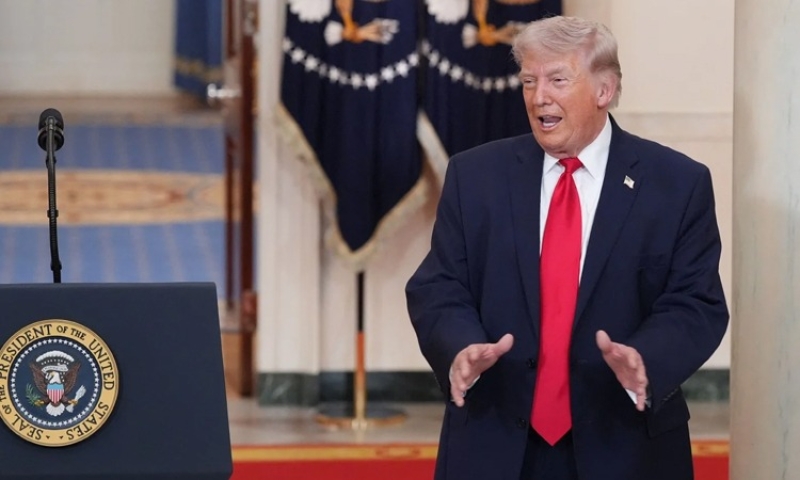
US President Donald Trump said on Wednesday that the US-Israeli military campaign against Iran was nearing its end, but warned that the country would face intense attacks for at least two to three more weeks as Washington pressed ahead with its objectives.
In his first national address since the war began on February 28, Trump sought to reassure a weary American public that the military operation was delivering results.
“Thanks to the progress we’ve made, I can say tonight that we are on track to complete all of America’s military objectives shortly, very shortly,” Trump said from the White House.
He added that the war’s “core strategic objectives are nearing completion”, but cautioned that “we are going to hit them extremely hard over the next two to three weeks”.
Trump also sought to reassure regional allies, including Israel, Saudi Arabia, Qatar, the United Arab Emirates, Kuwait and Bahrain, all of which have come under Iranian drone and missile attacks during the conflict.
“The United States will not let them get hurt or fail in any way, shape or form,” he said.
The US president also signalled that diplomacy may still be possible, saying Iran’s new leadership appeared “less radical and much more reasonable” than its predecessor.
His remarks suggested that Washington may still be pursuing a political arrangement to bring the conflict to an end.
However, Trump warned that if no agreement was reached, the United States was prepared to escalate further.
“We have our eyes on key targets, including the country’s electric generating plants,” he said.
Oil fears and Hormuz tensions
Trump’s speech did little to ease anxiety in energy markets, with oil prices climbing on Thursday after he urged other countries to help reopen the Strait of Hormuz.
Roughly one-fifth of the world’s oil supply normally passes through the narrow waterway, and its effective closure has fuelled fears of a prolonged global energy shock.
Iran’s Revolutionary Guards vowed on Wednesday to keep the strait shut to what they described as the country’s “enemies”.
Iran rejects US overtures
Iran on Thursday rejected Washington’s ceasefire overtures, describing US demands to end the conflict as “maximalist and irrational”.
“Messages have been received through intermediaries, including Pakistan, but there is no direct negotiation with the US,” Iranian foreign ministry spokesman Esmaeil Baqaei was quoted as saying by the ISNA news agency.
Earlier on Wednesday, Trump had claimed that Iran’s president had sought a ceasefire, but insisted that Tehran must first reopen the Strait of Hormuz.
In his address, however, he suggested the vital waterway would reopen “naturally” once the war came to an end.
Mounting political pressure
Trump’s speech came as he faces mounting domestic and international pressure over a conflict that has battered his approval ratings, rattled the economy and widened diplomatic tensions.
The war began when the United States and Israel launched a massive surprise air campaign against Iran, killing supreme leader Ali Khamenei and triggering a wider regional confrontation.
Hours before Trump’s address, Iranian President Masoud Pezeshkian appealed directly to the American public, questioning whether the war was truly putting “America First”.
In an open letter posted on social media, he accused Washington of committing war crimes and acting under Israeli influence.
He also said ordinary Americans were not Iran’s enemy, “even in the face of repeated foreign interventions and pressures”.
Missile strikes continue
Tehran announced another wave of missile and drone attacks on Wednesday evening, targeting Israel and US military facilities across the Gulf.
The strikes reportedly hit Israeli cities including Tel Aviv and Eilat, as well as US-linked sites in Bahrain and Kuwait.
Israel’s military said early Thursday that its air defence systems were working to intercept incoming fire.
As Israel prepared for the Passover holiday, which began at sunset on Wednesday, air raid sirens sounded repeatedly in the Tel Aviv area.
Emergency services said an Iranian missile strike earlier in the day wounded 14 people, including an 11-year-old girl.
The Revolutionary Guards also said they had struck an oil tanker in the Gulf that they claimed was linked to Israel.
A British maritime security agency reported that the vessel was hit off the coast of Qatar, sustaining damage but causing no casualties.
Escalation across the region
Large explosions were reported in Tehran on Wednesday afternoon, with strikes also hitting areas near the former US embassy.
Iranian media said an airport in Isfahan province and several steel complexes elsewhere in the country had been damaged.
Iran’s new supreme leader, Mojtaba Khamenei, who has not appeared publicly since his father was killed on the first day of the war, condemned what he called the brutality of the United States and Israel.
“The cruel and ruthless American and Zionist enemy knows no human, moral or vital limits,” he said.
Thousands of Iranians later gathered in Tehran for the funeral of the Revolutionary Guards’ naval commander, who was killed in an Israeli airstrike.
“We will resist until the end,” said mourner Moussa Nowruzi, 57.
In Lebanon, seven people were reported killed in strikes around south Beirut, while the Israeli military said it had targeted a senior Hezbollah commander.
Lebanon’s health ministry said Israeli attacks had killed more than 1,300 people in the country since hostilities between Israel and Iran-backed Hezbollah escalated on March 2.
Elsewhere in the Gulf, the conflict continued to disrupt civilian and economic infrastructure.
Kuwait reported a major fire at its international airport, Bahrain said a business facility had caught fire, and Saudi Arabia said several drones had been intercepted.