

- Chuadanga farmers thrive as cauliflower yields hit new high |
- Jamaat and allies set to begin seat-sharing discussions from Tuesday |
- ACC sues ex-minister Obaidul Quader, 13 more over illegal flat |
- Japan Issues Tsunami Alert After Strong 7.6 Quake |
- Bangladesh Plans Record Flag-Parachute Display on Victory Day |
Climate Crisis Threatens Munda Community’s Karam Festival
A dried Karam tree branch stands on the bank of a pond in Datinakhali village, adjacent to the Sundarbans. Despite many efforts, the tree could not be saved.
For two years, the Munda community in Bangladesh’s Sundarbans has struggled to save the Karam tree, essential for reviving their traditional Karam festival—once the community’s biggest celebration. Many trees are unable to survive due to rising salinity, including the Karam tree, which is central to the festival.
Bhakta Sardar, a priest from the Munda community, said the festival would be incomplete without Karam tree branches.
“We believe our prosperity and well-being are hidden in the branches of the Karam tree. We pray to God to achieve our prosperity through this festival. But frequent cyclones and salinity have killed the Karam trees,” he said.
“Now we celebrate the festival in name only, for the prosperity of the community. We cannot abandon it for the next generation,” added Bhakta Sardar, referring to a smaller-scale celebration using fig tree branches as a substitute.
While debates continued at the 30th Conference of the Parties to the UNFCCC (COP30) in Belém, Brazil, about integrating non-economic losses and damages from climate change, the Munda community is exploring ways to revive the Karam festival, a symbol of their prosperity. A recent study highlighted that such losses include the disappearance of religious and cultural practices.
The study notes that climate risks are increasing along Bangladesh’s coast, particularly in the southwest. If unchecked, small communities like the indigenous Munda community will face even greater crises. The study calls for policy and financial reforms to help communities adapt to climate change impacts.
In Search of the Karam Tree
The Karam tree, scientifically known as Mitragyna parvifolia and also called Kelikadam, blooms before the monsoon. As the tree has vanished locally, the Munda community now celebrates a smaller festival using fig tree branches (Ficus religiosa).
Datinakhali village, in Shyamnagar upazila of Satkhira district, once had many Karam trees. The village used to host grand Karam festivals, drawing people from various areas. Today, however, economic difficulties and environmental changes have disrupted this tradition.
Shukkuri Rani Munda recalled attending the festival in the courtyard of Fulsingh Munda’s house in Uttar Haztakhali village.
“To everyone now, the festival feels like a myth. A storm has swept it away. The next generation may forget the Karam festival entirely,” she said.
Balai Krishna Sardar, 38, president of the Sundarban Adivasi Unnayan Sangstha, has no memory of attending the festival, while Fulsingh Munda witnessed a small-scale celebration five years ago. After Fulsingh’s death, no one now knows how to initiate the festival.
‘A Symbol of Our Faith’
The Munda community believes the Karam tree’s branches conceal prosperity and well-being, ensuring good health and the welfare of future generations. Several tribal communities across India, including Jharkhand, West Bengal, and Bihar, celebrate the Karam festival similarly.
“The Karam festival is our faith. Perhaps our economic condition is deteriorating because we cannot follow our religious practices,” said Anandini Rani Munda of Datinakhali village, highlighting the link between religious and economic well-being.
Nilkant Pahan, a priest from Burigoalini village, conducted Munda community pujas for eight years. “We try to maintain continuity of this tradition. But we face a growing socio-economic and cultural crisis. We cannot observe religious traditions fully,” he said.
Impact of Salinity
Cyclone Aila in 2009 submerged the area in saltwater, killing Karam trees. Elderly Munda citizens recall that earlier cyclones, including a severe one in 1988, also contributed to the decline.
GM Mostafizur Rahman, Chief Scientific Officer of Khulna Soil Resources Institute, said, “Both the intensity and extent of soil and water salinity are increasing due to climate change; 81 percent of land in Shyamnagar is affected to varying degrees.”
Professor Saleh Ahmed Khan, Department of Botany, Jahangirnagar University, added, “The tree called ‘Karam’ by the Munda community, or Kelikadam, was not found among 528 species we studied. Salinity may have caused its disappearance.”
Fight to Revive the Karam Festival
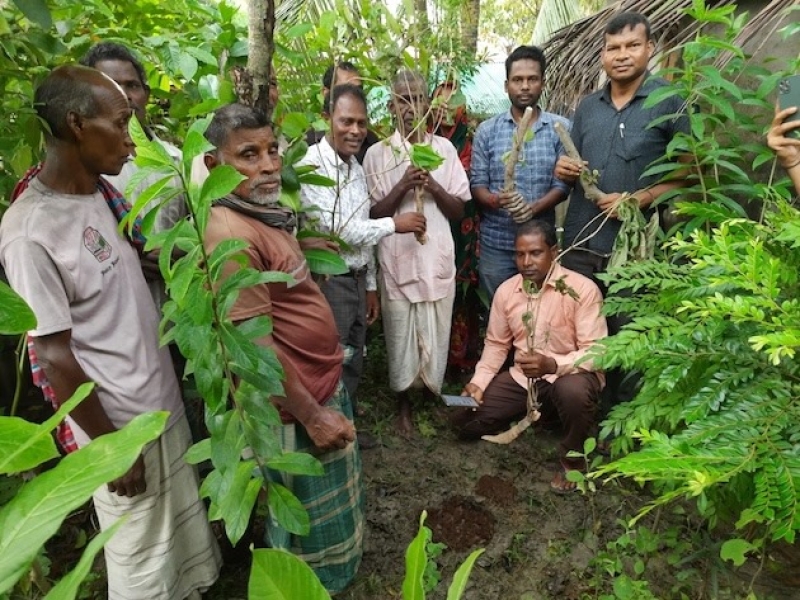
The Sundarbans Adivasi Munda Sangstha (SAMS) and community members are striving to restore the Karam tree and revive the festival, bringing branches from other districts. Two years ago, branches were planted in the SAMS office and in Datinakhali village, but they could not survive. Attempts will continue next year.
“We celebrate the Karam festival for our prosperity. We are trying to save the Karam trees, but salinity prevents survival. As an alternative, we use fig tree branches,” said Geeta Rani Munda.
Krishnapada Sardar, Executive Director of SAMS, said, “It is not enough for this festival to exist only in elders’ stories. Climate change has altered the Munda community’s food habits and livelihood opportunities. Families face extreme economic crises. Restoring the Karam tree can help revive our lost traditions and reconnect us with our roots.”