

- Revenue Collection Faces Tk98,000 Crore Shortfall |
- Nuclear Risks Test Global Pact at UN Talks Next Week |
- Iran Rejects Direct US Talks as Envoys Head to Islamabad |
- Pricing pollution: Does it work? |
- 13 years of Rana Plaza tragedy: Workers want justice, pay tribute |
Dhaka's air quality 'moderate' Thursday morning
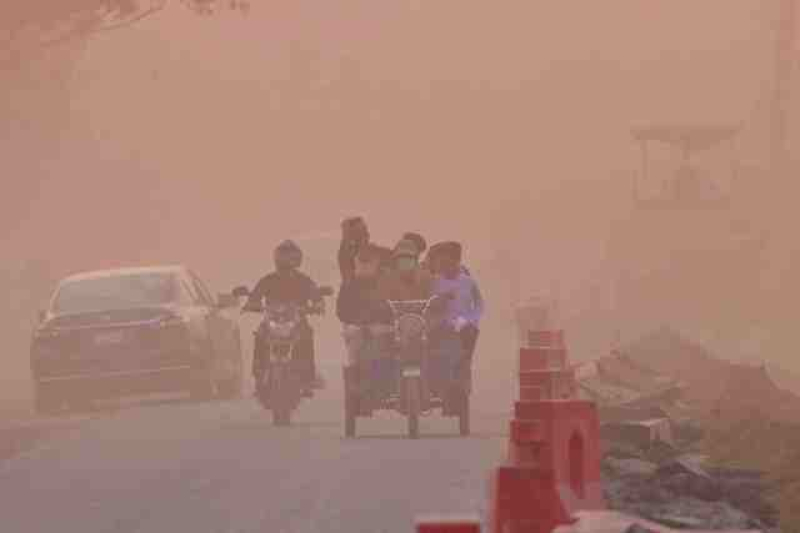
Air pollution in Dhaka City. File photo. Adnan Adid-UNB
Dhaka, June 22 - With an air quality index (AQI) score of 93 at 9 am this morning, the capital of Bangladesh ranked 15th on the list of cities worldwide with the worst air quality.
An AQI between 50 and 100 is considered ‘moderate’ with an acceptable air quality. However, there may be a moderate health concern for a very small number of people who are unusually sensitive to air pollution.
Pakistan’s Lahore, Jakarta’s Indonesia and South Africa’s Johannesburg occupied the first three spots on the list, with AQI scores of 161, 161 and 159, respectively.
An AQI between 101 and 200 is considered 'unhealthy', particularly for sensitive groups.
Similarly, an AQI between 201 and 300 is said to be 'poor', while a reading of 301 to 400 is considered 'hazardous', posing serious health risks to residents.
In Bangladesh, the AQI is based on five criteria pollutants -- Particulate Matter (PM10 and PM2.5), NO2, CO, SO2 and Ozone.
Dhaka has long been grappling with air pollution issues. Its air quality usually turns unhealthy in winter and improves during the monsoon.
Air pollution consistently ranks among the top risk factors for death and disability worldwide. Breathing polluted air has long been recognised as increasing a person’s chances of developing a heart disease, chronic respiratory diseases, lung infections and cancer, according to several studies.
As per the World Health Organization (WHO), air pollution kills an estimated seven million people worldwide every year, largely as a result of increased mortality from stroke, heart disease, chronic obstructive pulmonary disease, lung cancer and acute respiratory infections. - UNB