

- Second Teesta Bridge: Costly shortcut that heavy vehicles cannot take |
- March in Stockholm for stronger climate action ahead of polls |
- Dhaka ranks 18th in global air quality ranking Monday morning |
- Air Force officer Saifur sent to jail over Ilias Ali disappearance |
- Cultivation of Black Baby watermelons on a rooftop in Kalapara |
Landlocked States Unite to Tackle Farm and Climate Crises
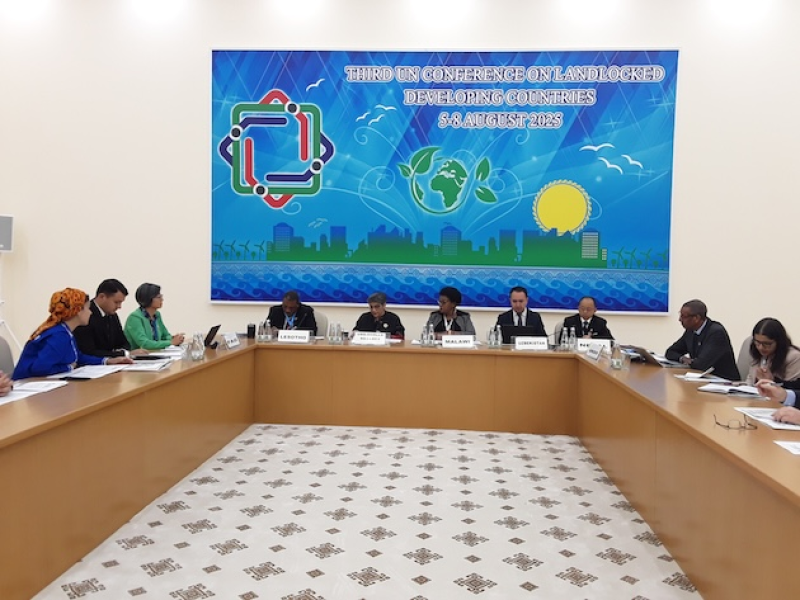
A high-level event focused on agriculture at the ongoing Third United Nations Conference on Landlocked Developing Countries.
Agriculture is a vital sector in landlocked developing countries (LLDCs), employing more than half (55 per cent) of their population—well above the global average of 25 per cent. But deteriorating food security in these nations is becoming a looming catastrophe.
There are 32 LLDCs with a combined population of nearly 600 million. The prevalence of moderate or severe food insecurity rose from an estimated 43 per cent in 2015 to 51 per cent in 2023, while undernourishment increased from 15 per cent to 19 per cent over the same period.
At a high-level event on agriculture during the Third United Nations Conference on LLDCs in Awaza, Turkmenistan, participants discussed efforts to establish regional agricultural research hubs to drive innovation, resilience, and transformation in the sector.
“Establishing regional agricultural research centres is an important deliverable in the Awaza Programme of Action, aimed at turning the untapped agricultural potential of LLDCs into drivers of inclusive growth, food security, and sustainable development,” said Rabab Fatima, UN Under-Secretary-General and High Representative for the Least Developed Countries, Landlocked Developing Countries and Small Island Developing States.
Nepal’s Foreign Secretary Amrit Bahadur Rai noted that agriculture contributes just 17 per cent of GDP in LLDCs, despite employing around 55 per cent of the labour force, highlighting a concentration of poverty and alarmingly low productivity in the sector.
These research hubs are envisioned as centres of excellence to champion sustainable agriculture, promote coordinated yet locally grounded innovation, and strengthen science-based research and development.
Adopted in December 2024, the Awaza Programme of Action (APoA) 2024–2034 offers a blueprint to tackle structural barriers in trade, infrastructure, climate resilience, and financing. Key actions include creating regional agricultural research hubs, launching an Infrastructure Investment Finance Facility, and forming a UN Secretary-General’s High-Level Panel on Freedom of Transit.
A landmark achievement for LLDCs under the APoA is the establishment of a formal negotiating group under the UNFCCC, ensuring that their climate vulnerabilities and unique challenges are addressed in global decision-making.
Bolivia chairs the LLDC group under the UNFCCC, while Malawi chairs the Least Developed Countries group. Malawi’s Vice President, Dr Michael Bizwick Usi, stressed that research reflecting LLDC realities will help these nations craft their own solutions rather than adopting imposed ones.
LLDCs face droughts, desertification, and floods that shrink farmland, while 54 per cent of their territory is classified as dryland. Between 2012 and 2023, they suffered more than 20 per cent of global droughts and landslides despite representing only 7 per cent of the world’s population.
Ahead of COP30, LLDCs hope their new negotiating platform will secure more favourable climate outcomes to safeguard millions of lives and livelihoods in some of the world’s most vulnerable regions.