

- Second Teesta Bridge: Costly shortcut that heavy vehicles cannot take |
- March in Stockholm for stronger climate action ahead of polls |
- Dhaka ranks 18th in global air quality ranking Monday morning |
- Air Force officer Saifur sent to jail over Ilias Ali disappearance |
- Cultivation of Black Baby watermelons on a rooftop in Kalapara |
UN Chief Urges Global Treaty to Tackle Plastic Pollution
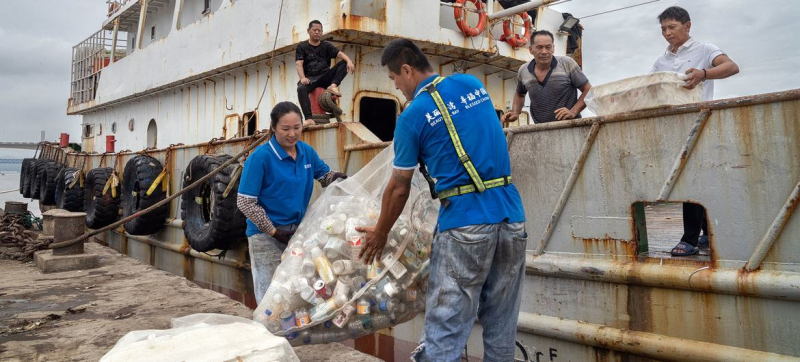
Plastic garbage is offloaded from a fishing boat on the east coast of China.
High-stakes negotiations began at the UN in Geneva on Tuesday to agree on a legally binding treaty to curb plastic pollution, with delegates from nearly 180 countries in attendance.
“The world wants, and indeed needs, a plastics convention treaty because the crisis is getting out of hand – and people are frankly outraged,” said Inger Andersen, Executive Director of the UN Environment Programme (UNEP), which is leading the talks.
“We know that plastic is in our nature, in our oceans, and yes, even in our bodies… What is certain is that no one wants to live with plastic pollution,” she added.
Without an international accord, plastic production and waste are projected to triple by 2060, causing severe environmental and health damage, according to UNEP.
Switzerland’s top environment official, Katrin Schneeberger, echoed the call for a binding treaty, warning that plastic waste “is choking our lakes, harming wildlife, and threatening human health. This is more than just an environmental issue; it is a global challenge that demands urgent and collective action.”
Speaking to journalists, Schneeberger noted that producing countries had made “no call for a production cap,” but stressed that measures on both production and consumption are necessary to advance negotiations.
Supporters of a deal have compared its significance to the Paris Climate Accord, while warning of pressure from petro-states whose crude oil and natural gas supply the building blocks of plastics.
“We will not recycle our way out of the plastic pollution crisis: we need a systemic transformation to achieve a transition to a circular economy,” Andersen has said previously.
With 10 days of talks scheduled, supporters hope the treaty will cover the entire life cycle of plastics, from design to disposal, promote plastic circularity, and prevent leakage into the environment.
The 22-page draft text contains 32 articles to be discussed line by line by the Intergovernmental Negotiating Committee (INC).
The UNEP-led talks follow a 2022 decision by Member States to develop a binding agreement to end plastic pollution, including in the marine environment, within two years.
Single-use products such as straws, cups, stirrers, carrier bags, and cosmetics containing microbeads continue to clog oceans and landfills. Andersen recalled seeing plastic debris worsen flooding in Pakistan in 2022, which killed more than 1,000 people.
Campaigners at the talks, including Shellan Saling of the Youth Plastic Action Network, urged for the most ambitious treaty possible, highlighting plastic’s links to health problems, disabilities, and environmental destruction.
Andersen said the treaty must be robust, fair to all countries, and able to stand the test of time.