

- Midterm Election Results: One of Biggest Reversals in US History |
- Republicans face midterm backlash over Trump's economic policies, Poll reveals |
- Waterlogging in Kumarkhali: Potential farm loss Tk35 crore annually |
- Substitute Ibrahim powers Bangladesh to 1-0 win over Bhutan in SAFF |
- Trump Threatens to ‘Destroy’ What Remains of Iran |
Could Trump Offer Concessions to Bring Kim Back?
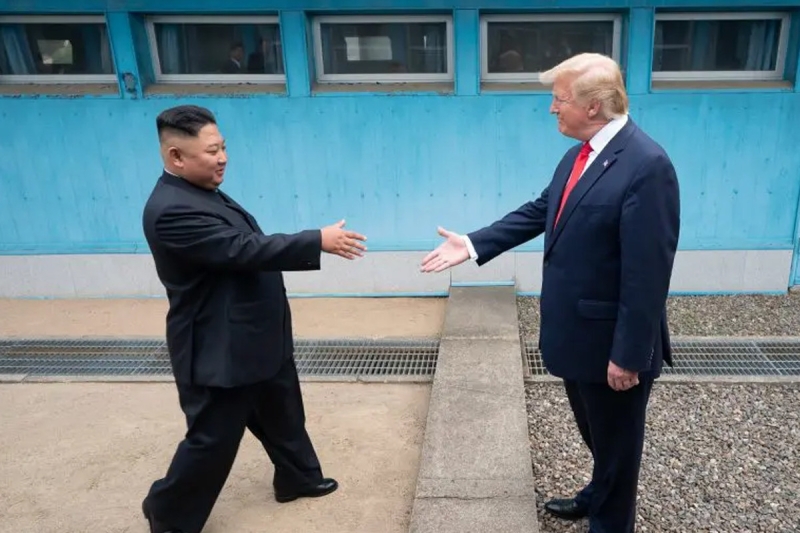
US President Donald Trump may seek to revive diplomatic engagement with North Korea during the final two years of his presidency, following his party's setback in the recent US midterm elections, analysts say.
However, any major concessions Trump might offer to bring North Korean leader Kim Jong Un back to the negotiating table could risk seriously straining Washington's relations with its regional allies in Asia.
Diplomatic sources and international affairs analysts in Seoul, Tokyo and Washington say Trump may increasingly focus on foreign policy as he faces obstacles to advancing his domestic agenda in Congress. With his efforts to end the wars in Ukraine and Iran yet to produce positive outcomes, North Korea could emerge as another potential diplomatic opportunity.
Ban Kil-ju, a professor of international relations at the Korea National Diplomatic Academy in Seoul, said Trump would naturally seek to demonstrate diplomatic achievements when facing significant political difficulties at home.
He suggested that Trump would also want a suitable successor to win the 2028 presidential election, making renewed engagement with North Korea a possible part of his political legacy.
However, analysts say Pyongyang currently has little incentive to respond positively to such an initiative or return to negotiations.
In an emailed response on Trump's North Korea policy, White House spokesperson Anna Kelly said the president had restored American strength on the international stage and strengthened relations with world leaders.
She added that his foreign policy had never followed conventional political rules and that, as commander-in-chief, he would always make decisions in the best interests of the American people and national security.
During his first term, Trump held three meetings with Kim Jong Un following a period of intense political and military tensions between Washington and Pyongyang. However, their high-profile summit in 2019 ended without an agreement on North Korea's nuclear weapons programme or the lifting of economic sanctions.
Seven years later, the geopolitical landscape and security risks have become considerably more complex. North Korea has significantly expanded its nuclear and missile arsenals, while its relations with Russia and China have strengthened to levels not seen in recent history.
As a result, Kim has little apparent urgency to reach an agreement with Washington, potentially putting Trump under pressure to offer more substantial concessions.
Trump has repeatedly praised his personal relationship with Kim, describing the North Korean leader as a great person and claiming that the two share an excellent understanding.
However, US and South Korean diplomatic officials consider a meeting between the two leaders this year highly unlikely. Washington has received no positive response from Pyongyang ahead of a regional summit scheduled to take place in China this month.
Kim's influential sister, Kim Yo Jong, recently said dialogue could be a path to peace but that Pyongyang currently saw no need for negotiations. She also strongly criticised Washington's hostile policies.
She dismissed as entirely false US allegations that North Korea was responsible for the theft of more than $6 billion in virtual assets from cryptocurrency platform Binance last week.
Kim Jong Un has previously indicated that he would be willing to resume talks if Washington stopped pressing Pyongyang to abandon its nuclear weapons. However, South Korea and Japan, two key US allies in the region, would not accept such a concession.
Leif-Eric Easley, a professor of international studies at Ewha Womans University in Seoul, warned that holding a summit while allowing North Korea to retain its nuclear weapons status would weaken regional security deterrence.
Such a move could create serious policy tensions and disagreements among Washington, Seoul and Tokyo, he said.
A senior Japanese official, speaking on condition of anonymity, said Seoul and Tokyo feared being sidelined if Trump pursued a direct deal with Kim, potentially with the tacit approval of Beijing and Moscow.
Japanese officials are particularly concerned about the limits of Trump's efforts to arrange a summit, the official said, warning that the US president might abandon the central demand for nuclear disarmament.
Trump has already referred to North Korea as a nuclear power on several occasions. However, the United States and its Western allies have not formally recognised the country as a nuclear-weapon state, despite its stockpile of nuclear warheads and nuclear materials.
Kazuhiro Maeshima, a professor at Sophia University in Japan, said US acceptance of North Korea's nuclear status through negotiations would dramatically change the regional security environment.
He described such a development as potentially the biggest regional shift since the Second World War, adding that it could occur during the remaining two years of the Trump administration.
Compared with his first term, Kim now has a significantly more advanced and destructive arsenal, including long-range missiles, hypersonic glide vehicles, advanced warships, submarines and sophisticated drones.
Therefore, if Trump genuinely wants to bring Kim back to negotiations, he may have to offer concessions extending beyond a partial easing of economic sanctions.
Moon Chung-in, a professor at Yonsei University in Seoul and a former presidential national security adviser, said implementing such decisions would be difficult because of the Democratic-controlled Congress and the limited time remaining in Trump's presidency.
He added that North Korea's own calculations would be the most important factor. If Pyongyang concludes that Trump is politically weakened towards the end of his term and lacks sufficient congressional support, Kim may see little reason or benefit in returning to negotiations.