

- 8 Die of Dengue as 1,595 More Are Hospitalised |
- Hasina to Face Execution Process if She Returns: Prosecutor |
- US to become 1st nation to fully shun a UNHR Council review |
- Govt Sees No Legal Hurdle to Hasina’s Return: Adviser |
- Egrets reappear along Buriganga after many years |
Climate Crisis Could Push 141 Million Women Into Poverty
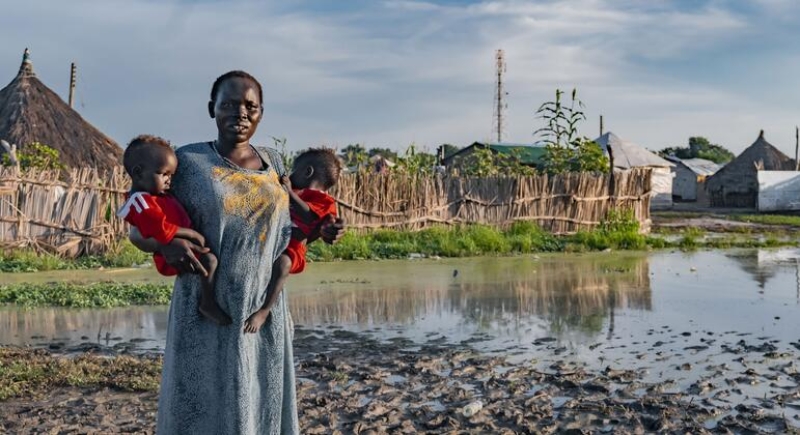
A woman holds her children in front of her flood-affected house in South Sudan.
More than one in three women and girls worldwide — around 1.5 billion people — live in so-called climate hotspots, where high exposure to hazards such as cyclones and droughts coincides with insecure employment and deep-rooted gender inequality.
This is according to a new fact sheet titled Gender Equality in the Age of Climate Crisis, released by UN Women at the COP31 climate conference in Antalya, Türkiye, on Tuesday.
“The climate crisis threatens planetary life and is deepening the inequalities that leave women and girls most at risk,” the fact sheet says.
It finds that women and girls in countries least responsible for climate change are among those hardest hit by its consequences.
Rights, Resources and Power
If current trends continue, the world is heading towards 1.8°C of warming by 2050, bringing more devastating droughts, floods, wildfires and cyclones.
Under a worst-case scenario, climate change could push up to 141 million additional women and girls into extreme poverty by the middle of the century, UN Women warns.
“Across the world, women are already leading the fight for a better future — in their communities, in laboratories, in parliaments and on the front lines of the climate crisis,” said Sima Bahous, the agency's Executive Director.
“We must give women and girls equal rights, resources and the power to lead, and they will help drive the change our world so urgently needs.”
Rising Temperatures, Falling Incomes
Data from 24 countries indicate that a 1°C increase in average temperatures could cause women's total incomes to decline 34 per cent more than men's.
This is likely linked to women's more limited opportunities to move into non-agricultural employment or migrate when harvests fail.
Climate change is also increasing women's unpaid care responsibilities, including collecting water and fuel and looking after family members following disasters.
Rising temperatures and climate-related pressures can also intensify existing drivers of gender-based violence.
Across 14 countries, exposure to prolonged extreme drought was associated with a 21 per cent higher likelihood of sexual violence against adolescent girls and young women.
Progress at Risk
The climate crisis is also threatening progress towards ending child marriage.
In 24 of 46 countries with relevant data, child marriage rates were higher in more arid environments than in more humid areas.
Meanwhile, 326 million women and girls still lack access to electricity, even as growing demand from artificial intelligence technologies adds pressure to energy systems.
Women Underrepresented in Climate Decisions
Although 73 per cent of countries' climate action plans recognise the risks facing women and girls, only slightly more than one-third address those risks comprehensively.
Women remain largely excluded from climate-related decision-making, holding just 12 per cent of energy portfolios. Meanwhile, only four per cent of climate-focused official development assistance prioritises gender equality.
Women environmental defenders also face harassment and even death for standing up for their communities and the planet.
At COP31, UN Women is urging world leaders to place gender equality and women's rights at the centre of climate action. This includes recognising and guaranteeing their right to a clean, healthy and sustainable environment.
The agency is also calling for stronger protection for women environmental rights defenders and greater participation by women and girls in climate-related decision-making.
Source- UN News