

- Islami Bank organizes orientation for 1000 Trainee Assistant officers |
- 2025: People’s Resistance Against Hydro Projects in Himalaya |
- Fully ready to hold free, fair, peaceful elections: Prof Yunus |
- Khaleda Zia’s Mausoleum Opens to Public at Zia Udyan |
- Bangladesh cuts fuel prices by Tk 2 a litre at start of 2026 |
2025: People’s Resistance Against Hydro Projects in Himalaya
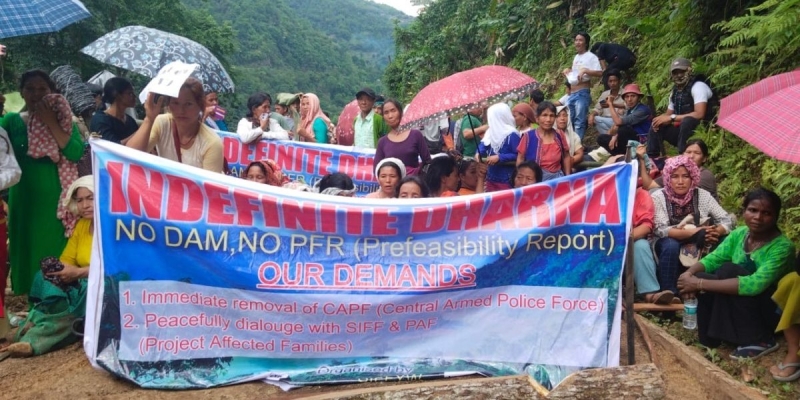
Villagers in Siang district opposing the SUMP. Photo courtesy - SANDRP
January 1, 2026. SANDRP
The local communities have continued their collective resistance against destructive hydro power (HEP) projects in North East and North West Himalayan states in India all through 2025. The ACT in Sikkim has condemned the EAC decision to rebuild the washed-out Teesta III dam. The SIFF along with dependent villagers and concerned citizen groups have opposed the forceful deployment of armed forces for SUMP surveys in Siang river basin.
The NEHR has sought reevaluation Etalin HEP as its EIA was found flawed and outdated by MoEF in Dec 2023. The local people and citizen groups in Arunachal & Assam have raised concerns over adverse impacts of Dibang, Kalai II, Subansiri Upper & Lower HEPs. The local communities have also objected to Dima Hasao & Kulsi (Ukiam) projects in Assam & Meghalaya.
The Kulsi project in particular has faced strong resistance by tribals groups who are unanimous to get it scrapped. Though the Assam CM in June month hinted at its cancellation but no formal decision has been taken so far. It is worth mentioning that every section of society including villagers, activists, experts, women, students and even political leaders have openly raised their voices against unjustified hydro projects in North East. The year also witnessed mass protests against hydro projects in Chenab valley in Lahaul Spiti region of Himachal Pradesh.
These projects are either proposed or under construction or built and in Teesta case even destroyed. The concerns include adverse impacts over river ecosystem, water sources, damage to community and forest land, degradation of environment and biodiversity, flood threats in downstream areas. The demands are genuine and basically asking for honest appraisal, informed and participatory decision making, exploring alternatives and providing promised compensation, rehabilitation and employment, ensuring monitoring and compliance.
The climate change impacts have already turned the fears into realities which can not be ignored anymore under the grab of strategic or national interest projects and the demand for credible cumulative basin level assessment is basic need. While MoJS Minister has openly accepted the unviability and unfeasibility of large dam projects due to huge cost, time, land issues and gradual decline in river flows, it’s time to walk the talk.
Sikkim: Teesta III HEPACT condemns fresh EC to damaged Teesta III HEP The Affected Citizen of Teesta (ACT), condemned the MoEF&CC decision to amend the Environment Clearance for the project on Jan. 10, 2025 for rebuilding the 1200 MW Teesta III dam project. It is shocking to know that environment ministry panel has cleared a proposal to build a new 118.64-m-high concrete gravity dam, without a fresh public hearing and even as the design aspects of the dam are yet to be approved, with plans to expand the capacity of the spillways. The clearance ignores the multiple disasters associated with dam building. The Teesta III dam disaster of Oct. 04, 2023 is a direct outcome of ignoring the warnings by environmentalists and communities and the high fragility and seismicity of Himalayan geology in Sikkim, said Gyatsho Tongden Lepcha, General Secretary, ACT, Sikkim.
The EAC decision raised questions because the design of the new structure has not been cleared by the Central Water Commission (CWC), the Geological Survey and Central Soil and Materials Research Station (CSMRS). Demanding immediate cancellation of the approval, local people opposed the EAC clearance to Teesta III without fresh EIA, Public hearing or appraisal. After strong criticism from the BJP-Sikkim unit and Citizen Action Party-Sikkim, the Sikkim Democratic Front (SDF) also voiced concerns over the approval. Days after the clearance, a study warned that the increasing number of such projects near glacier lakes in the Himalayas amplifies GLOF risks. As per expert, the revised plan was based on old rainfall and flood data which could have implications on dam safety.
In “Voices of Teesta” documentary, directed by Minket Lepcha, showed the struggle of the indigenous people against the Teesta dam construction. Mayalmit Lepcha an activist, president of the Sikkim Lepcha Indigenous Tribal Association, and general secretary of the ACT asks some tough questions: Why are we rebuilding the dam in the face of escalating climate risks such as expanding glacial lakes? Why are financial institutions funding another risky venture? Will local communities see any real benefits?
Arunachal Pradesh: SUMP Residents oppose surveys, demand dialogue Hundreds of people took to the streets in three districts on May 23, against the deployment of Central Armed Police Forces (CAPF) for surveys of Pre-Feasibility Report for the project at Beging in the East Siang district. Residents have been opposing 11500 Mw Siang Upper Multipurpose Project (SUMP) since Nov 2024 which proposes about 300 m high dam on Siang river a tributary of Brahmaputra. They resisted attempts to conduct surveys and feasibility studies, prompting the Union government to deploy central paramilitary for them and thwart protests. The deployment triggered the fresh protests.
On May 22, residents under the banner of Dibang Resistance issued a statement, saying they were deeply disturbed by the forceful deployment of CAPF despite protests from affected landowners. They urged the state govt to have a constructive dialogue with the affected families. “It is essential that we listen to their concerns and work collectively towards a solution that acknowledges their rights and perspectives,” said the statement. “A meeting with the actual affected families can pave the way for a more peaceful and respectful resolution.”
The project is estimated to affect at least 100,000 residents who could be uprooted. There are also concerns about the environmental impact of the project involving construction activities on the Siang River in Dite Dime, Parong, and Uggeng. The govt has stressed the project’s national importance in countering potential threats from China’s release of large volumes of water from a dam being built on the Yarlung Tsangpo, as Siang is known in Tibet.
On May 23, the CAPF were deployed in several areas, including Beging, Geku, Jengging, and district headquarters Pasighat, Boleng, and Yingkiong. According to The Dibang Resistance the paramilitary presence was meant to assist officials from the NHPC in carrying out a PFR. They alleged that drilling machinery has already been installed at the Beging site, sparking widespread anger.
The villagers started an indefinite dharna against the deployment of armed forces. Their main concerns included displacement, loss of homes and agricultural lands, as well as the environmental impacts, such as the loss of rich biodiversity that the area is home to. To make matters worse, the project is proposed in a seismically-active area. The Adi Students’ Union, which represents the interests of the Adi tribe condemned the deployment, calling it a “draconian activity”.
The Siang Indigenous Farmers’ Forum (SIFF) on May 29, appealed to the future president and general secretary of the Adi Bane Kebang to “keep the SUMP for discussion in their election/ selection process on July 06 in Dambuk.” SIFF spokesperson Tagori Mize also urged the union Jal Shakti minister to hold dialogues with SIFF representatives regarding the alleged threat to national security vis-à-vis “the water policy with China.” “We are not anti-dam, but we are against mega dams,” Mize said.
Scores of civil societies and organizations across the country expressed solidarity with SIFF and demanded an immediate halt to SUMP-related activities, dialogue with the local communities, a transparent and participatory environmental and social review process of the Siang basin, restoration of indigenous land rights, and implementation of the Forest Rights Act in Arunachal. They also urged the govt to explore “ecologically responsible alternatives” to mega-hydropower projects.
The ACT, Sikkim also called for a broader regional movement to reassess hydropower projects in the Himalayas, advocating for community-driven solutions and stricter environmental safeguards. This underscores a growing resistance to development models that sideline indigenous voices and ecological realities.
A collective of scientists, researchers and practitioners on June 09 called for suspending all SUMP activities, citing its ecological, cultural and socio-political risks. The statement noted that the Siang river, also known as ‘Ane’ or Mother Siang, was sacred and central to the cultural identity and livelihoods of the Adi tribe.
On June 15, the SIFF submitted a representation to Deputy CM and Hydropower Minister Chowna Mein, reiterating its grievances vis-à-vis the proposed SUMP. It sought rolling back of the Cabinet decision of June 13 with regard to the SUMP. The forum maintained that any further talks between the SIFF and the state govt would only be possible after the fulfilment of these demands.
In the last week of July 2025, the Ugeng villagers protested the Panchayat Minister Ojing Tasing’s attempt to conduct meeting for survey of the SUMP. Why the minister & developer are keen when the entire village is protesting against SUMP, the villagers wondered.
In press conference in Delhi on Aug 2, the civil society groups from the Arunachal urged the govt to publicly engage in dialogue with China to gain a clear understanding of the hydrology and dimensions of the Motuo dam before pushing SUMP. They said that both the Union and state govts are suppressing public protests against the PFR.
“The Union and State govts are militarizing the entire region to prevent people from organizing protests,” said Bhanu Tarak, a lawyer and activist. Another lawyer and protest leader, Ebo Mili, echoed these concerns. “The govt is resorting to violent means to silence our protests,” he said, adding that state police have illegally detained him three times. The proposed PFR surveys and pre-construction activities and other outreach activities are being conducted “by force” without the informed consent of the affected indigenous communities, SIFF alleged.
The concerns of the people are important since without knowing the features, dimensions, operating procedures and impact assessments, all the projections being made about the possible impacts of the projects are completely speculative and unfounded. Demanding these is also within India’s right as per international norms and an order of the international Court that in fact there should be joint impact assessments of any projects taken up by the upstream country on shared rivers.
Later, in a memorandum submitted on Aug 25, Adi Students’ Union (AdiSU) appealed to CM Pema Khandu to address concerns regarding the SUMP. AdiSU further expressed concern over the suspension of several gaon burahs (GBs) and head gaon burahs (HGBs), which it said has intensified dissatisfaction among local communities. Day after, the longest serving CM of the state Gegong Apang strongly opposed construction of SUMP, cautioning that if the dam bursts, it will submerge Lower Arunachal, Assam and even Bangladesh. This, he warned, is nothing less than a man-made disaster in the making.
In last week of Sept. Arunachal Law Students’ Union (ALSU) urged CM Pema Khandu and his deputy Chowna Mein to halt all SUMP activities until consent of the affected villages is formally obtained through a transparent, participatory, and documented process. The ALSU said development must not come at the cost of human dignity, peace and constitutional rights. The union said that no project-related activity can be lawfully or justifiably undertaken without obtaining free, prior and informed consent of the affected villages.
Etalin HEP NEHR seeks re-evaluation of EIA, SIA & land acquisition The Northeast Human Rights (NEHR) on Apr 2, requested a re-evaluation of the EIA, SIA and land acquisition for the Etalin Hydro Project (EHP) (3097 Mw) in Dibang Valley district, citing that the project was scrapped in early 2023 due to discrepancies found in the original EIA. NEHR stated that the MOEFCC has deemed the existing EIA flawed and outdated, thereby rejecting the proposal in its current form. The ministry has requested the state govt to submit a revised proposal aligns with the latest guidelines and regulations.
The NEHR urged that not only should a new EIA and SIA be conducted to reflect current environmental and social conditions, but that these studies should also be made public. Although final clearances are still pending, the project is planned to include two dams – one on the Dri River and another on the Talo (Tangon) River – with an underground powerhouse complex located near Etalin village. The project is slated for completion in Dec 2033.
Dibang HEP AJYCP sounds alarm over Dibang HEP The 2880 Mw project sparked serious concerns in Upper Assam with the influential Asom Jatiyatabadi Yuba Chatra Parishad (AJYCP) warning of catastrophic consequences for downstream districts. The project, located at Achu Pani in Lower Dibang Valley district, involves the construction of a dam towering approximately 945 feet above ground. AJYCP in July 2025 launched a scathing critique of the project, alleging that it is being executed without any public hearing or consent from people living in the downstream floodplains of Assam. They warned that if the dam collapses or is mismanaged, the resulting deluge could wipe out entire towns and villages within minutes, putting millions of lives at risk. “Unlike the Subansiri River, the Dibang river’s banks are even more susceptible to landslides and erosion. A disaster here would be swift and irreversible,” AJYCP leaders said in a press statement.
On Aug 3, Tapir Gao, MP (Lok Sabha) Arunachal East raised serious concerns over the unfulfilled commitments of the Dibang HEP during Zero Hour discussion in Parliament Session, urging the Ministry of Power (MoP) to intervene and ensure that the 2007 MoU between NHPC and the state govt is fully honored. Speaking in the House, Gao emphasized that the MoU, which was meant to provide employment opportunities for locals, business contracts for local entrepreneurs and overall economic benefits for the state, remains largely unimplemented. He pointed out that these unfulfilled promises have deprived the people of Arunachal Pradesh of their rightful entitlements, leading to growing frustration among the affected communities.
The discontent over project escalated sharply, with downstream communities threatening street protests and legal action over broken promises and official neglect. The Dibang Multipurpose Hydro Project Downstream Affected Area Committee (DMHPDAAC) accused the govt of failing to carry out crucial downstream protection works, despite the sanctioning of Rs 154-crore budget. In a letter to the Deputy Commissioner, Roing, the committee warned that over 150 villages in Arunachal Pradesh and Assam face risks to their land, livelihood, and quality of life from the ongoing dam construction.
Setting Aug 24 as a hard deadline for work to begin, the committee cautioned that any further delay could trigger a massive, region-wide democratic agitation. Adding to the pressure, the Uttama Bor Abor Sanrakshana Sanrachana (UBSS)—one of Arunachal’s few public charitable trusts—is preparing to challenge in court the “unjust exclusion” of downstream communities from the list of officially recognized project-affected areas.
Earlier on Aug 4, Leader of the Opposition (LoP) in the Assam Assembly, Debabrata Saikia, had urged the Union govt to address Assam’s downstream concerns before moving ahead with the Dibang Project. In a letter to the Union Minister, Saikia highlighted the negative experience with the LS HEP, which faced years of mass protests in Assam due to unaddressed safety, environmental, and livelihood concerns. He warned that overlooking similar issues in the much larger and ecologically sensitive Dibang project could trigger widespread public opposition and erode trust in the govt. “If past mistakes are repeated, the project may again face prolonged opposition and risk losing public trust,” he stated.
Saikia pointed out that the districts of Dhemaji, Tinsukia, and Dibrugarh are particularly vulnerable to the impacts of upstream hydropower development. He presented a five-point demand to the Union Govt: (1) Inclusive Public Consultations in all affected districts, conducted in local languages and involving grassroots stakeholders; (2) Independent Cumulative Impact Assessment of the Dibang and other upstream hydropower projects; (3) Formal Consent from the Assam state government and involvement of downstream district administrations in project planning; (4) Safety Reviews that account for seismic risks, dam-break scenarios, and climate impacts and (5) Advance Mitigation Measures, including EWS, flood management strategies, disaster compensation plans, and continuous ecological monitoring. Saikia also cited the Assam Assembly’s 2010 House Committee recommendations and the report of the Technical Expert Committee led by Dr. C.D. Thatte and Dr. M.S. Reddy as key references for making informed and responsible decisions regarding the project.
Subansiri Lower HEP AASU flags safety concerns All-Assam Students’ Union (AASU) in April 2025 reiterated its longstanding concerns over the safety and environmental impact of mega dams in the region. In a memorandum to CM Himanta Biswa Sarma, the student body demanded a scientific and permanent resolution to the risks posed by large hydroelectric projects, especially the Lower Subansiri Lower Hydroelectric Project (LSHEP). AASU president Utpal Sarma and general secretary Samiran Phukan criticized the Central govt for failing to honour its previous commitments and urged for smaller, safer HEPs. ASSU leaders also highlighted the failure of tripartite meetings and expert panels in reaching a conclusive, unified resolution. The AASU demanded a cumulative downstream impact assessment for all proposed dams in Arunachal Pradesh and called for an immediate suspension of ongoing construction until comprehensive scientific studies are completed.
Hydrologists and environmentalists in Assam and beyond said that the concerns relate to the recommendations of a three-member expert committee on reservoir management in 2019 and a report submitted by the WII to the NBWL on the possibility of elephants getting washed away during “panic release” of water from the LSHP reservoir. The committee said the Centre should constitute a Subansiri Independent Integrated Reservoir Management Authority (SIIRMA) or Subansiri River Basin Authority (SRBA) to regularly monitor the reservoir level and minimize downstream “danger” during panic water releases, especially during floods.
People from several villages in Lower Siang district staged a dharna on July 28 in protest against the NHPC’s move to seek clearance from the National Dam Safety Authority (NDSA) to start the process of commissioning 3 units (250 mw each) of the Lower Subansiri HEP in Gerakamukh. The villagers stated that until the issues concerning land acquisition and payment of fair and adequate compensation under the state’s Rehabilitation and Resettlement (R&R) Policy, 2008 are resolved, the clearance should not be given to the NHPC.
The Central Electricity Authority (CEA) identified the 2,000 Mw project as ‘vulnerable’, and issued an advisory to the NHPC for implementing an Early Warning System in the project. This was mentioned by Minister of State for Power Shripad Naik in the Lok Sabha on Aug 7.
Again in Oct. 2025, expressing frustration over what they describe as years of neglect and disregard for scientific cautions, AASU member Dipak Sarma said, “AASU has been saying from the beginning that this hydroelectric project will endanger the lives of the people of Assam and disrupt Assam’s culture. Scientists warned against building the dam here, but the govt ignored those suggestions. Any lives lost downstream will be the govt’s responsibility.”
The location is fraught with ecological sensitivities; the dam sits amid a biodiversity hotspot and immediately upstream of forests and riverine tracts that form a critical elephant corridor. Tongam Rina, journalist from Arunachal who has closely tracked and written about hydropower and dams in her state for over two decades, says that poor environmental impact assessment has been a known aspect of hydropower development in Arunachal Pradesh, including downstream impacts in Assam. “This case has gone a step further and become a new low,” Rina said.
Subansiri Upper HEP Protest erupts in Daporijo Hundreds of people took to streets to protest against the NHPC’s proposed 2,000Mw Subansiri Upper HEP in Daporijo in Upper Subansiri dist on Oct 8. The protesters, mostly from Subansiri Upper Hydro Project Land Affected People’s Forum and students, demanded the state govt to scrap the project. The protesters went around the town and shouted slogans such as, ‘No Dam over Ane Subansiri River’, ‘Our ancestral land is precious, we cannot exchange it for compensation’, and ‘Protect lives, stop displacement’. Later, the protesters staged a dharna in front of the DC’s office.
After this, a 12-hour bandh was observed on Oct 28 across Upper Subansiri district, called by the All Upper Subansiri District Students Union in collaboration with the All Tagin Students Union and other local groups. Protesters demanded the permanent cancellation of the 1,650 Mw Subansiri Upper HEP, citing threats to the region’s environment, culture, and livelihoods.
NHPC office in SU HEP closed until further notice In the order, it cited multiple reasons for temporarily closing the office and suspending all operations in the district. The NHPC has been awarded the 1,605 mw Subansiri Upper Hydroelectric Project (SUHEP) in Upper Subansiri dist. The NHPC informed that the decision has been taken in view of the cancellation of the public hearing for the SUHEP. The public hearing, scheduled for Sept 12, was cancelled after the All Tagin Students’ Union (ATSU) called a bandh opposing it. However, the bandh was withdrawn after the district administration agreed to postpone the hearing to a later date.
The first hearing had also been cancelled on 28 Oct following a similar bandh called by the ATSU. The NHPC stated in the order that the current situation has created an atmosphere not conducive to the implementation of its project in the district. Considering the gravity of the protests, the safety of employees, and the overall administrative difficulties, the NHPC said that it has decided to close down its office until further notice. All field activities, project-related movements, and official engagements related to the SUHEP have also been suspended until further orders.
The NHPC further stated that it will reconsider its position regarding the future course of action for the implementation of the project, keeping in view the prevailing situation. The ATSU, along with several other groups, has opposed the SUHP, as it will displace a significant number of villages and trigger demographic changes in tribal and indigenous areas. They have demanded immediate cancellation of the proposed SUHEP.
Human & ecological cost of mega dams We are the people living in one of the most vulnerable regions of our country. Our land is rich in natural resources, including minerals and vast forests. Additionally, we are blessed with abundant water resources. However, this abundance often turns into a curse, as flooding and erosion pose serious threats to our communities. While we have developed adaptive capacities to cope with natural flooding, the increasing frequency of unnatural floods and severe erosion—primarily driven by aggressive developmental projects—has left us struggling to adapt. This situation is exacerbated by the lack of awareness and understanding among local leaders regarding the consequences of such developments. Many infrastructural projects are being undertaken with insufficient or half-baked feasibility studies. An example is the LS HEP. (Keshoba Krishna Chatradhara)
Kalai-II HEP FIR lodged over dubious EIA A citizen of Anjaw district, Roshman Tawsik, lodged an FIR at the police station on Oct 2 against Shilpa Shinde, chairperson of WAPCOS Ltd, a scientist from the EIA Survey Committee of WAPCOS Ltd, Anjaw Deputy Commissioner Millo Kojin, and Land Management Secretary Audesh Kumar Singh. In his FIR, Tawsik, who is also the chairman of the Nukung Welfare Society, alleged that despite sending a legal notice to WAPCOS and writing letters to the DC and the land management secretary, raising concerns over the manner in which the EIA was conducted for the proposed Kalai-II hydropower project, no one has responded to his concerns.
The 1,200 Mw HEP in Anjaw district is being executed by THDC India Limited. The EIA was conducted in August this year. In his FIR, Tawsik sought a thorough investigation into the matter, including an examination of the EIA reports (2013 and 2025), email correspondences, and administrative records. He further called for appropriate legal action against the persons named in the FIR to prevent further harm to the environment, affected communities, and scheduled tribe (ST) lands. Earlier, in his legal notice, Tawsik accused WAPCOS of gross negligence in preparing the EIA report to obtain environmental clearance. He alleged that fraudulent methods were used to get the clearance & said that the environment would be severely affected by the project.
Assam Dima Hasao residents oppose 1200 Mw HEP In last week of Sept. 2025, villagers of Moti Lampu, Moti Hojai and Riam Bathari in Dima Hasao district opposed the proposed 1200 MW hydro-electric power project to be set up jointly by Assam Power Generation Company Ltd. (APGCL) and Adani Green at Moti Lampu. In a memorandum submitted to the chief executive member (CEM) of the North Cachar Hills Autonomous Council (NCHAC) in Haflong, at least six headmen representing the three villages urged the council to withdraw the ‘no objection certificate’ (NOC) reportedly issued to the companies. The villagers said they have also come to know that the forest department has conducted a survey for the project.
The signatories expressed deep concern that the project would submerge a large area of fertile land, leaving hundreds of families without a livelihood. The villagers alleged that the project would benefit only a handful of rich people, while rendering the poor landless. The signatories said the residents have unanimously decided to launch a democratic agitation until the project is scrapped. They appealed to the NCHAC to review and revoke the NOC granted to APGCL and Adani Green in the interest of protecting the people’s livelihood.
In last week of Nov. 2025, the residents sent a detailed memorandum to Dilip Saikia, president of the Assam BJP, expressing deep alarm over reports that the NCHAC has issued a NOC for the project site. The objection letter strongly underlines the severe ecological implications: it warns that this project could result in the permanent destruction of rich forest cover, rare wildlife habitat, streams, flora and fauna, and the delicate ecological balance of the region.
Assam-Meghalaya 55 Mw Kulsi (Ukiam) HEP opposed Members of 19 organizations hit the streets in a southwestern Assam town on June 25, 2025 to oppose a 55 Mw hydropower project planned jointly by the govts of Assam and Meghalaya on the Kulsi River, a natural habitat of the endangered Gangetic river dolphin. They submitted a memorandum each to Assam CM Himanta Biswa Sarma and his Meghalaya counterpart Conrad K. Sangma who announced the 62 m high dam project after a meeting on June 2.
People from both states agreed that the dam plan was “unreasonable” and would kill the lifeline of the cultivators and fishermen in the area, apart from harming the environment irreparably. The organizations said the natural vegetation and crops are dependent on the Kulsi River, whose water level falls significantly during the dry season. The organizations stated that the dam-controlled ebb and flow of the river would impact at least 12 wetlands in the area, including Chandubi, which is known as the fifth-largest tectonic lake in the world. The organizations listed 16 villages in Assam’s Kamrup district and three in Meghalaya’s West Khasi Hills district, which would be affected by the proposed dam.
There was strong opposition to both the Kulsi HEP at Ukiam and the satellite townships at Borduwar. In the meeting, protesters voiced several demands: cancellation of satellite townships that would displace residents, issuance of land titles to indigenous people in Barduar Bagan, protection of tribal belts and blocks, provision of a maximum of 29.5 bighas of land to forest dwellers as per the Forest Rights Act, protection of the biodiversity of the tourist destination ‘Chandubi Lake’, immediate halt to the eviction of indigenous people in the name of “development,” cessation of the HEP, stopping the construction of a logistics park in the Darabil wetlands and an end to the “inhumane” eviction in Karbi Anglong, Dima Hasao, BTR, and various other parts of Assam.
Before this, a public meeting held at the Ukiam public playground on June 10 witnessed an extraordinary convergence of indigenous community groups, student bodies, and civil society organizations from both states. The demonstrators raised powerful slogans – “Assam Govt Go Back! Meghalaya Govt Go Back! Stop the Kulsi Dam!” – as the air reverberated with chants denouncing what they described as an anti-people and ecologically disastrous project.
The protesters alleged that the HEP threatens to displace local tribal communities, destroy natural ecosystems, and jeopardize the cultural heritage of several indigenous groups including the Rabha, Garo, and Khasi communities.
On June 22, the locals recalled how the British once called it “Cool-C,” and how older generations referred to it as Kolahi, likening its monsoon torrents to water poured from a traditional earthen pot. The leftward branch of the Kulsi, locally known as the Kukurmara channel, is believed to have started as a man-made irrigation trench. Over time, it evolved into a full-fledged river, supporting farmlands and villages along its banks. Despite its importance, no formal research has yet confirmed its origins. As the govt pushed forward with the dam proposal, residents and activists demanded comprehensive environmental and cultural assessments before any construction begins. They argued that the project’s long-term impact on biodiversity, water flow, and indigenous heritage has not been adequately studied or addressed.
On June 29 protest meeting the committee also unanimously resolved to intensify their protests through a series of grassroots initiatives, with a strong emphasis on mobilizing women and youth. Despite multiple public meetings and awareness campaigns, residents expressed frustration that elected officials, such as Chhaygaon MLA Rekibuddin Ahmed, RHAC Executive Member Tonkeswar Rabha, and Meghalaya Chief Minister Conrad Sangma, have yet to visit the affected areas or engage directly with concerned communities.
After this, the Assam CM on June 30 hinted at possible cancellation of two major development projects, citing local opposition. A proposed 55 Mw Kulsi HEP on the Kulsi river and a satellite township at Barduar – both near Guwahati and along the Meghalaya border – have drawn protests from indigenous groups worried about displacement and threats to their way of life.
Kulsi HEP faces fierce opposition At a protest meeting held on Sept 25 at Ukiam’s picnic spot, the Garo National Council (GNC), Rabha National Council (RNC) and several other organizations vowed to resist the dam “under any circumstances.” The meeting was attended by multiple groups under the Assam–Meghalaya Joint Protection Committee, speakers warned that the project would devastate both ecology and livelihoods. GNC president Enindra Marak alleged that the govt’s claim that only 10–15 villages would be affected was misleading. “The impact will extend from Meghalaya to the Brahmaputra basin in Assam,” he said.
RNC chief convenor Gobinda Rabha claimed nearly 1.9 lakh bighas of land would be lost if the dam is built. He insisted that projects in tribal belt and block areas must have local consent, while accusing the govt of ignoring indigenous voices. The Khasi Hills Autonomous District Council (KHADC) recently told protestors that only the traditional chiefs (Rajas) of Nongmynsaw, Nongkhlaw and Rambrai could give a NoC. GNC leaders reiterated that without such approval, no dam will be allowed at Ukiam. The dam is planned at the confluence of the Drone, Shree, and Dilma rivers, which form the Kulshi river
Earlier, local organizations had submitted memorandums to both the Assam and Meghalaya governments demanding cancellation of the project, but no positive response has been received. On September 19, the Assam–Meghalaya Joint Protection Committee submitted a memorandum to the KHADC in Shillong. However, KHADC authorities stated that the matter should be discussed with the traditional chiefs (Rajas) of Nongmynsaw, Nongkhlaw, and Rambrai areas.
Before end of year, one more protest meeting was organized by the Assam-Meghalaya Joint Action Committee against the Kulsi river dam on Dec. 27 at the playground of the Ukiam ME School. Addressing the gathering, senior advocate of the Gauhati High Court Santanu Borthakur alleged that under the present govt, indigenous and tribal communities are being forced to abandon their homes and settlements. He claimed that across different parts of Assam, tribal and indigenous people are facing eviction in the name of development projects. He further questioned where the people of 25 villages would go if the dam is constructed at Ukiam. “In a democratic country, the government must consult the affected people before undertaking any such project. However, till date, no discussion has been held with the local residents regarding this dam,” he said.
Subrata Talukdar, central office-bearer of the Land Rights Joint Struggle Committee, said that while the government speaks of development, it is attempting to achieve it by destroying Nature. “If development is truly the objective, then provide good schools and hospitals in border areas. What we are witnessing today is development for corporate houses at the cost of indigenous communities,” he said, warning that the dam project must be withdrawn or the agitation would be intensified up to Dispur and even New Delhi.
Meghalaya: Wah Umiam III Land hurdles stall 85 Mw HEP NEEPCO Executive Director Jayanta Sharma said the Corp aggressively pursued Wah Umiam Stage-III and even got the DPR approved. “However, we could not acquire land. In Meghalaya, the govt does not own land; only 5-6% of the land is under the Forest Dept, and local communities are unwilling to part with their land,” he said. The project has also failed to secure forest clearance.
Manipur No Dams Over Rivers The Centre for Research and Advocacy Manipur and the Lingjel Leibi VLF, Nungbrung Ngamukhong and the Legal Aid Clinic, Nungbrung jointly organized the international Rivers day at Ngamukhong Nungbrung Village along the Thoubal River on March 14. The observation of the River day was attended by community members affected by the Mapithel dam in the downstream areas. The observation of the international river day in Manipur is in the context of increased construction of large dams, viz, the Mapithel dam, 105 MW Loktak Hydroelectric Project, Dolaithaibi dam etc over the Rivers of Manipur, changing flow regime of rivers due to deforestation, increased rainfall due to climate change, besides increased pollution of Rivers and unregulated river bed sand and stone mining.
The participants called upon the govt to rethink all unsustainable development processes affecting the health of rivers, forest and land and to stop building large dams over the Rivers of Manipur. The participants also stressed the importance of rejuvenating health of the Thoubal River and other rivers in Manipur the rightful participation of indigenous peoples.
Himachal Pradesh Chenab Valley Mass protest against proposed HEPs On May 23, under the banner of Lahaul-Spiti Ekta Manch, hundreds of local residents gathered in Lahaul-Spiti’s Udaipur to protest against the proposed hydropower projects in the Chenab Valley. In a memorandum submitted to CM Sukhvinder Sukhu, the protesters demanded immediate cancellation of the MoU signed with the Telangana govt for the Seli and Miyar hydropower projects on the Chenab River.
According to the Manch, Lahaul is a cold desert region that is extremely fragile both geographically and ecologically with very limited vegetation cover. It is also one of the most disaster-prone areas in the Himalayas. Furthermore, this is a tribal region protected under the Fifth Schedule of the Constitution — therefore before implementing any developmental project in this area, tribal rights and ecological concerns must be prioritised.
The Manch has demanded that all proposed hydropower projects in the Lahaul Valley be put on immediate hold until the full CEIA report is released to the public and proper public hearings are held in accordance with the Fifth Schedule protections. Local residents argue that a re-evaluation of the Seli and Miyar hydropower projects is urgently needed, as their current EIA reports are incomplete and inadequate. They fail to address critical issues such as the presence of glacial lakes, avalanche risks, impacts of tunnel construction on water sources, and the large-scale deforestation involved.
The decision was made at a meeting of panchayat representatives from Udaipur sub-division and members of Lahaul-Spiti Ekta Manch (LSEM), an environmental protection body from the district. According to LSEM president Sudarshan Jaspa, the protest is part of a movement against nearly 18 large hydroelectric projects proposed in the Chenab basin of Lahaul valley. Guman Singh, coordinator of the Himalayan Niti Abhiyan, called upon residents to unite and reject these ‘destructive developments’, asserting that the government’s push for such large-scale projects is driven more by commission-based gains than public welfare. Sachin Mirupa, Pradhan, Koksar panchayat, warned that these projects threaten the very existence of the Lahaul Valley and advocated for intensified resistance. Former state minister Dr Ramlal Markanda echoed this concern, vowing that the people of Lahaul will not allow any displacement and actively oppose any construction activity.
Lahaul society opposes hydro projects In Jan. 2025, the ‘Save Lahaul and Spiti Society’ strongly voiced its opposition against the state govt’s plan to commission large-scale hydroelectric projects in the Chenab basin, which spans several districts, including tribal district Lahaul and Spiti. The society argues that the proposed projects, ranging from 6.5 Mw to 400 Mw, pose significant threats to the delicate ecosystem of the region, which is home to fragile Himalayan glaciers and diverse biodiversity. The local residents, social activists and environmentalists expressed serious concern over the projects. They have threatened to launch a mass agitation in Lahaul Spiti if the state govt goes ahead with the plan.
Tribals open front against Seli & Miyar HEPs In March end, Lahaul-Spiti Tribals opened front against 400 Mw Seli and 120 Mw Miyar Power Projects in the Fragile Valley. Seli located on Chenab River, Miyar is located on Miyar tributary of Chenab river in Udaipur sub division. Save Lahaul Spiti Society condemned the agreement between HP and Telangana on these two projects on BOT basis. Both projects have been facing resistance for many years. Lahaul-Spiti Ekta Manch and other local organizations termed this decision against public sentiments and have demanded the govt to cancel the MOU, else, a big movement will be started.
Beas Valley Kullu villagers demand suspension of Sarbari-I HEP Blaming Sarbari I Small HEP for causing reoccurring disasters, the villagers of Mashana panchayat in Lag Valley of Kullu district in Sept. 2025 demanded suspension of the 4.5 Mw project. As per the villagers the leakages in the surge shaft and head race tunnel and burst of penstock of the project in Aug-Sep have caused landslides and flash flood disasters impacting their land and livelihoods. They have said that due to these disasters about 80 meter Mashana link road, some houses, a water tank and over hundreds of bigha of fertile farmland have been severely damaged.
Sutlej Valley Villagers object to Kurpan HEP Villagers on Nov. 25 mobilized against the Kurpan Valley HEP categorically stating that they will not allow any forest cutting or road construction for the project. They claimed that the NoC from Baga Sarahan panchayat was obtained illegally, they demanded administration to make it public immediately. The 1.5 Mw project has been granted permission for 0.7449 hectares of forest land under the Forest Rights Act (FRA). Siting violations of FRA and Forest Conservation Act (FCA), they also sought explanation against tree felling for building a project road. They stated that several villagers depend on the stream water for irrigation and water mills operation.
During a meeting on Nov. 25, affected villagers stated that their struggle has been ongoing for 14-15 years and will continue. They also recognized and decided to revive their committee to oppose the project. Local residents stated that the forests are their ancestral heritage and their preservation is their primary responsibility. The Dora Nullah villagers also opposed the project.
Uttarakhand Lakhwar Dam Affected farmers send memorandum of demands to PM in first week of Nov. 2025, the farmers affected by the Lakhwar Multipurpose National Project sent a memorandum to the PM, reiterating their demand for compensation and rehabilitation of land and assets. They said that the 300 Mw project was started in 1975 and the affected farmers were compensated in the initial years until 1991. However, work on the project later stopped due to various reasons. In 2022, the project work was resumed. However, the affected farmers’ problems have remained unresolved. Over past three years, the farmers sent numerous memorandums to local administration yet their grievances have not been addressed forcing them to sit on protest since Oct. 24. The memorandum demands land, asset compensation, rehabilitation, and protection of the interests of those affected by the project.
On sixth day of protest, the affected villagers accused local authorities and L&T company for ignoring their rights and exploiting them. A large number of villagers and local leaders were present at the protest site. They stated that two villages are completely affected by the project, but many people have not yet received compensation for their land and crops. According to the locals, 70 percent of the jobs in the project were supposed to go to local people, but only 4 percent have been employed. They said that previously, 12 employees were terminated from their jobs, and false cases were filed against them. One of these employees even died due to depression.
They alleged that L&T company was awarding large contracts to big companies from outside the state. The villagers appealed to the administration to fulfill their 22-point demands. They warned that if their demands are not accepted, the movement will intensify.
On Oct. 29, the Tehri Garwal district administration, along with L&T officials held a meeting with residents of 32 villages affected by the Lakhwar multipurpose dam on the Yamuna river. Locals claimed that 105 hectares of agricultural and forest land was acquired from 1974 to 1992, but villagers have yet to receive full compensation and settlement, causing livelihood issues. They said that they would continue to oppose the dam construction till they are compensated. Anand Singh Tomar, a protester, said, “Now, 53 more hectares across 17 villages are being acquired. Families affected earlier and now should receive fair compensation at current market rates in Kempty village, and one govt job per family.” He also accused the company of ‘illegally’ starting work on their farms without proper compensation and acquisition.
On 30th day of the protest (Nov. 22), residents accused the govt of neglecting their demands. They asked govt to reappoint local people in the project work who were previously laid off by the companies.
The 49 day long protest ended on Dec. 11, after assurance from local MLA that L&T had agreed to address their issues. Mahipal Singh Sajwan, convenor of the Lakhwar Dam Affected Farmers’ Joint Struggle Committee, said that several points were agreed upon between the company officials and the affected residents under the leadership of Vikasnagar MLA Chauhan. Issues at the govt level, such as increasing the compensation amount for the farmers and increasing the number of jobs for the unemployed, will be raised by the MLA at the govt level. Another meeting between the dam-affected residents and company officials will be held within a week, where written responses will be provided on all the issues. He said that if the demands of the affected people are not met soon, they will resume their protest.
Relevant Reports
Dangers of expediting Hydro Projects in the Himalayas According to a report in the National Daily, the Centre has decided to hire outside experts on fixed contracts to evaluate designs of planned hydropower projects, a move aimed at speeding up construction of several dams in the pipeline, an official said on Oct 1. The Union Govt plans to expedite construction of a slew of hydroelectric projects, especially in J&K and the northeastern state of Arunachal Pradesh. This seems like looking for short cuts for major interventions in high-risk, fragile, disaster-prone Himalayan region where such regions have already proved to be major force multipliers. The climate change is making the Himalayas even more prone to high-risks and disasters for multiple reasons, often compounded by multiple factors.
Opposition to large hydro as strategic projects Indeed, there is little sense in building large hydro projects as strategic assets as seems to be the case in Himachal Pradesh and J&K (Chenab basin) and Arunachal Pradesh. Use of security forces to complete PFR when local communities are strongly against the project, as is being done in case of SUMP is clearly counter-productive in so many ways. The Himalayan areas are vulnerable to several kinds of disasters, made worse by climate change and mindless infrastructure development projects. We clearly need to mend the ways we plan these projects in highly vulnerable areas.
Hydropower getting less reliable Demand for power is growing fast, but hydro plants, the oldest source of clean energy, are struggling because of droughts, floods and other extreme weather linked to climate change. Critics, including many environmental groups, have long argued that hydroelectric projects impede rivers, endanger wildlife and contribute to deforestation that harms locals. Environmental activists say world leaders should focus on restoring aging dams rather than constructing new ones.
Jal Shakti Minister says building dams no longer viable Jal Shakti Minister CR Paatil on Nov. 28 said building new dams is no longer a viable and long-term water management solution due to high costs, land acquisition hurdles, and shrinking river flows. The minister urged states to align with the Centre’s push for conservation, and emphasized the need for collective action. “We need water every moment, but we have not been able to organize it properly,” he said.
Highlighting the difficulties in constructing new dams, he said, “We have more than 6,500 dams, but we still store only about 750 bcm of water. It takes 25 years and Rs 25,000 crore to build a dam. Do we have that much time? Do we have that much money?” Paatil further said that high cost, land acquisition hurdles, and shrinking river flows are key hurdles in pursuing a dam-based water storage strategy.
SANDRP