

- Bangladesh Begins Nuclear Power Era With Fuel Loading |
- With Canal Digging Tarique Revives Zia's Legacy |
- Trans Fat From Edible Oil Reuse Causing Health Risk for Millions |
- Medicinal Plant Farming Turns Lucrative as Demand Soars |
- Trump reviews peace plan; UN calls for Hormuz to reopen |
With Canal Digging Tarique Revives Zia's Legacy
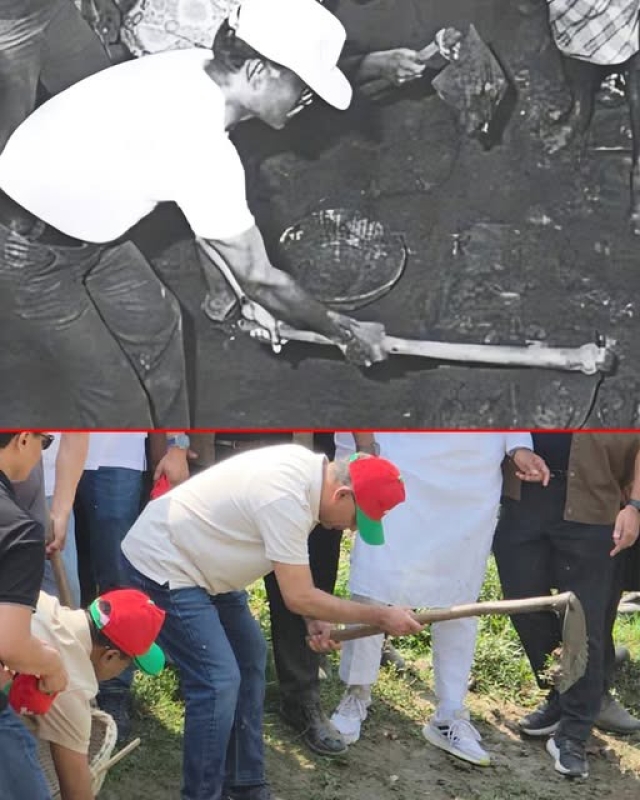
Photo collected
Half a century after defining a chapter in Bangladesh’s rural transformation, the country is once again turning to its waterways as a lifeline for agriculture and economic revival. With a shovel in hand and a sweeping national plan, Prime Minister Tarique Rahman has launched an ambitious programme to excavate or re-excavate 20,000 kilometres of rivers, canals and water bodies over the next five years—reviving a vision once pioneered by his father, late President Ziaur Rahman.
The nationwide initiative, formally inaugurated on March 16 from the Sahapara canal in Dinajpur’s Kaharol Upazila, marks one of the most extensive water management programmes undertaken in recent decades. Simultaneous launches across 54 districts signal the government’s intent to fast-track implementation and deliver visible results early in its tenure.
To understand the significance of the current programme, one must look back to the late 1970s. In the years following independence, Bangladesh’s agriculture was heavily dependent on erratic rainfall. Floods would submerge crops during the monsoon, while drought in the dry season left fields parched.
In 1977, Ziaur Rahman introduced a nationwide canal excavation initiative aimed at storing excess rainwater and ensuring irrigation during dry months. In a symbolic and practical gesture, he personally participated in digging canals, galvanising mass public involvement.
Between 1979 and 1981, around 3,636 miles of canals were excavated or re-excavated under nearly 279 projects. The impact was immediate and far-reaching. Previously single-crop lands became multi-crop fields, irrigation expanded dramatically, and food production surged. The programme played a key role in what later came to be described as Bangladesh’s “green revolution,” fostering self-sufficiency and revitalising rural economies.
Professor Mohammad Safi Ullah of Dhaka University noted that the initiative was not just an engineering project but also a social model. “It was community-driven, involving local participation through food-for-work programmes. Even without modern technology, it reflected an integrated understanding of water management that remains relevant today,” he said.
Over the decades, many of those canals fell into disrepair. Encroachment, siltation, and unplanned development choked waterways that once sustained agriculture and transport. According to official data, Bangladesh’s navigable waterways have shrunk significantly—from about 24,000 kilometres before independence to roughly 4,000 kilometres in the dry season today.
At the same time, climate change has intensified both floods and droughts. Groundwater levels have dropped sharply in many regions due to over-reliance on deep tube wells, while waterlogging has become a persistent problem in low-lying areas.
Against this backdrop, the government’s new canal excavation programme is being framed as both a revival and a necessity.
“We want to build a strong foundation for agriculture,” Prime Minister Tarique Rahman said while inaugurating the project. “When farmers do well, the country does well. Our goal is to improve people’s lives through agricultural and rural development.”
He added that many rivers and canals have lost their capacity to retain water, causing sudden floods during the monsoon and acute shortages in the dry season. “By restoring canals, we can store excess rainwater and use it productively in agriculture,” he said.
The plan targets 1,200 kilometres for excavation within the first six months. The work is being coordinated by multiple ministries, including water resources, agriculture, local government, and disaster management.
Each kilometre of excavation is estimated to cost around Tk 2 million, with additional investments expected for complementary activities such as embankment protection, dredging, and tree plantation.
A notable feature of the programme is its emphasis on community participation. While mechanical dredging will be used where necessary, the government is encouraging the involvement of local labourers and volunteers.
State Minister for Water Resources Forhad Hossain Azad said, “The prime minister has emphasised public participation. Alongside machinery, manpower will be used to create employment opportunities and ensure local ownership.”
The Sahapara canal project in Dinajpur offers a glimpse into the expected benefits. Once completed, the nearly 12-kilometre canal is projected to provide irrigation facilities to around 31,000 farmers, covering about 1,200 hectares of land. Approximately 350,000 people are expected to benefit directly or indirectly.
Officials estimate that crop production in the area could increase by nearly 60,000 tonnes annually once the canal becomes fully operational.
Beyond irrigation, the programme is expected to diversify rural economies. Year-round water availability in canals can support fish farming, duck rearing, and other water-based activities, creating new income streams for rural communities.
Professor Shamsul Alam of Jahangirnagar University said, “If implemented properly, this initiative could bring a structural shift in rural economies. Agriculture, fisheries, and small-scale enterprises will all benefit together.”
The canal network is also being positioned as a key tool in climate adaptation. By improving water retention and drainage, the programme aims to reduce the impact of floods and droughts—two extremes that are becoming more frequent due to climate change.
In coastal areas, restored canals could help retain fresh water and limit salinity intrusion, which has been affecting agriculture and drinking water supplies. In drought-prone regions like the Barind tract, improved surface water management could reduce dependence on groundwater and help recharge aquifers.
The programme also includes plans to plant up to 250 million trees along canal banks over the next five years, contributing to environmental balance and local biodiversity.
For many local residents, the revival of canals is deeply personal. In Keraniganj’s Joynagar, where Ziaur Rahman once dug a canal connecting the Buriganga and Dhaleshwari rivers, memories of a vibrant waterway still linger.
Seventy-year-old Lal Chan Miah recalled how irrigation and improved farming changed lives. “He made things easy for us,” he said. “But later, the canal was destroyed by encroachment and neglect.”
Despite widespread optimism, experts warn that excavation alone will not guarantee long-term success.
Syeda Rizwana Hasan of the Bangladesh Environmental Lawyers Association stressed the importance of maintaining natural flow. “The connection between rivers and canals must be restored. Priority should be given to areas facing severe waterlogging and water scarcity,” she said.
Encroachment remains a major concern. Data suggests that more than 28,000 illegal occupiers were identified across the country as recently as 2022, many with political backing.
Professor Adil Muhammad Khan of Jahangirnagar University cautioned, “The purpose of canal excavation will be undermined if encroachment is not strictly controlled. The government must ensure that canals are not occupied again.”
Former National River Protection Commission chairman Manjur Ahmed Chowdhury emphasised systemic reform. “We must stop pollution at its source and ensure proper maintenance. Otherwise, the benefits will be short-lived,” he said.
Historically, such initiatives have succeeded when local people felt ownership and participated actively. The earlier programme under Ziaur Rahman thrived on that foundation, blending state initiative with grassroots involvement.
Today, with advanced technologies such as geospatial mapping and data modelling available, the government has the tools to implement a more scientific and targeted approach. However, real success will depend on planning, execution, and long-term maintenance.
Prime Minister Tarique Rahman appears aware of the stakes. “People are the owners of this country,” he said in Dinajpur. “If they stand with us, we can achieve anything.”
Bangladesh’s identity as a riverine nation has long shaped its economy and culture. Reviving its waterways could unlock significant opportunities—not only in agriculture but also in transport, environmental management, and rural development.
If successfully implemented, the 20,000-kilometre canal programme could mark a new chapter in the country’s growth story, echoing the transformative impact of the late 1970s.
But the path ahead is complex. Sustained political will, strict enforcement against encroachment, transparent governance, and active community participation will determine whether this initiative becomes a lasting success or another missed opportunity.
For now, as excavators and workers begin operations across rural Bangladesh, the hope is simple yet powerful—that flowing canals will once again bring life, livelihoods, and resilience back to the country’s fields and communities. (This story has been published in the April print edition of the GreenWatch)