

- Dhaka Tops Global Pollution List with Hazardous Air |
- Country Observes Martyred Army Day Today |
- 100 CSOs rally against Trump’s trade tactics, urge access to drugs |
- BNP believes in multiparty democracy, not revenge: Moyeen Khan |
- Bangladesh reaffirms commitment to revitalise SAARC process |
Six Planets to Align in Rare Parade Across Night Sky
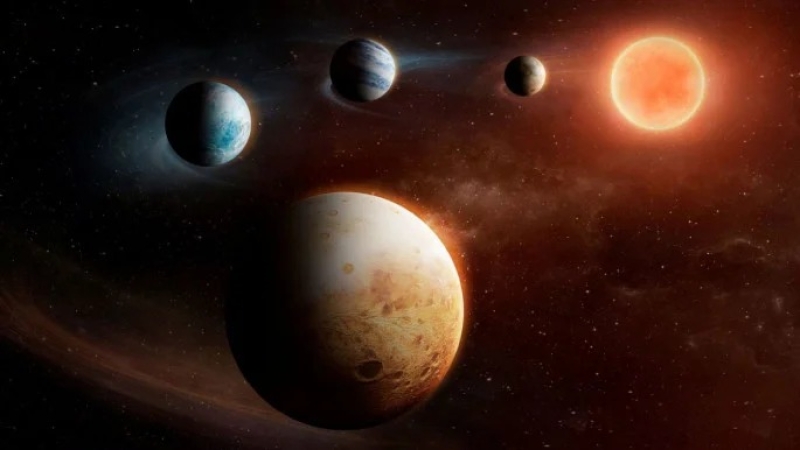
Space enthusiasts have a rare treat at the end of February as six planets will appear closely aligned in the night sky, creating a phenomenon known as a planetary parade, according to NASA.
On 28 February, Mercury, Venus, Jupiter, Saturn, Uranus and Neptune will be positioned near one another, offering a striking visual display. While the planets remain separated by millions of kilometres, from Earth they will appear to cluster together.
Planetary alignments occur because the planets orbit the Sun along the same flat plane, called the ecliptic. Different speeds and distances mean alignments are rare, making multi-planet parades a special event.
A similar event occurred on 27 February 2025, when seven planets aligned. Astronomers note that while small groupings of three to five planets are common, full multi-planet parades are unusual and highly anticipated.
Four of the planets — Mercury, Venus, Mars and Jupiter — will be visible to the naked eye, while Uranus and Neptune will require binoculars or a telescope. Mercury may be tricky to spot due to its low position near the horizon.
The parade will be visible worldwide, though exact timing may vary by region. Optimal viewing is about 30 minutes after local sunset in a clear western sky. Star Walk recommends 25 February in São Paulo, 28 February in New York, Athens, Mexico City and Tokyo, 1 March in London, Beijing, Berlin and Mumbai, and 2 March in Reykjavik for the best views.
NASA advises that for the best experience, planets should be at least 10 degrees above the horizon, as the lower atmosphere dims their light, making them harder to see. This rare alignment offers stargazers an exceptional opportunity to witness multiple planets together in one spectacular display.