

- 2025: Resilient Economies, Smart Development, and More Jobs |
- Dhaka rejects India's statement on incident at BD HC residence, New Delhi |
- Stocks end lower; trading falls at DSE, improves at CSE |
- No need to be kind to election disruptors: EC to law enforcers |
- No Media Faced Arson Attacks in 53 Years: Mahfuz Anam |
Editors, journalists urge BNP to ensure press freedom, if elected
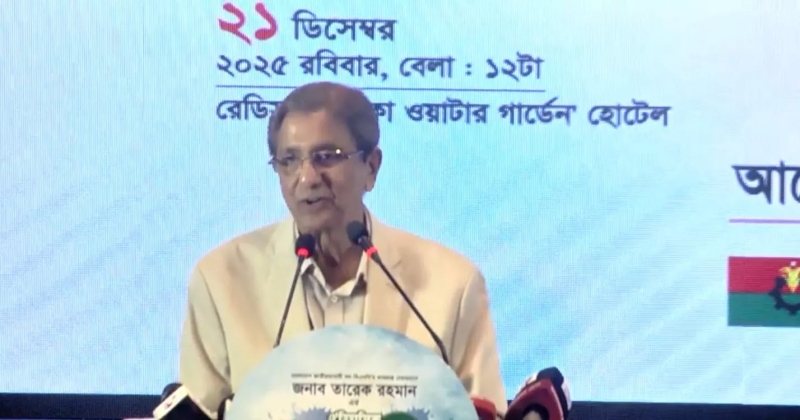
Prothom Alo Editor Matiur Rahman speaks at a views-exchange meeting organised by BNP, at a city hotel on Sunday. Photo- UNB_11zon
Dhaka, Dec 21 - Editors and senior journalists on Sunday urged BNP to guarantee full press freedom and critical journalism if the party returns to power, stressing that independent media must be protected as a pillar of democracy.
Speaking at a views-exchange meeting, they also said the press is facing one of the toughest periods in Bangladesh’s history following arson attacks on the offices of two leading dailies, calling for unity and long-term commitment beyond political divisions.
They also asked BNP to remain tolerant of criticisms in the future and ensure accountability if it forms the next government.
The programme, organised by BNP, was held at a city hotel ahead of Acting Chairman Tarique Rahman’s homecoming on 25 December, after nearly 18 years in exile in London.
The Daily Star Editor Mahfuz Anam said no media outlet in Bangladesh’s 53-year history had ever faced arson attacks like the recent ones.
“Bangladesh is currently in a deeply devastated state as its institutions are being challenged and destroyed. Please remember that in 53 years, no media office had ever been set on fire. For the first time, the offices of Prothom Alo and The Daily Star have been attacked with arson. Why did this happen? What crime did we commit?” he asked.
Mahfuz Anam urged political parties to accept critical journalism as essential for good governance and press freedom. While freedom of expression exists in the country, there is little space for expressing critical opinions, he said.
“What we need is the freedom to criticise. One major lesson from our 53 years of politics is that no government has fully accepted critical journalism. I hope that in a new Bangladesh, you will embrace it,” Mahfuz Anam said.
The noted editor said critical journalism is not only about press freedom but also an opportunity for good governance.
He expressed the hope that the new Bangladesh, to be built under Tarique Rahman’s leadership, will encourage independent media. “Building a new Bangladesh will require creating a new media environment and this presents a unique opportunity for Tarique Rahman,” he said.
Prothom Alo Editor Matiur Rahman called the 16 years of Awami League rule a “difficult period for the media,” citing false cases, arrests, ownership changes and pressure on newsrooms.
He said BNP’s previous period in power had been comparatively more comfortable for the media.
“BNP is the biggest political force now and carries the responsibility to protect press freedom,” the editor said, urging leaders and activists to remain humble if they return to power.
“I think there is a political vacuum in the country at the moment. This is a dangerous situation and it is somewhat difficult for BNP as well,” he said.
The editor also expressed gratitude to all political parties and people from different professions who stood by them after the arson attacks on the offices of Prothom Alo and The Daily Star.
Manabzamin Editor Matiur Rahman Chowdhury said the country is going through an unstable and difficult time. “The country is divided, and it’s very challenging to have dialogue amid such division. But attending today’s event has been very encouraging for me.”
“If BNP comes to power in the future, it is now clear from the statements of Salahuddin Ahmed and Rizvi Ahmed what the media policy will be. I want to be very hopeful that if these steps are implemented, the media in Bangladesh will move forward,” he added.
Chowdhury said Tarique Rahman is returning at a time when security is the biggest concern in Bangladesh. “Many challenges lie ahead. People want to feel safe, but currently, they do not.”
He said with road blockades, attacks on the Indian High Commissioner’s residence in Delhi, assaults on security guards, and the recent attacks on The Daily Star and Prothom Alo, the situation is uncertain. “What will happen next, we do not know. In this situation, the public has very high expectations from BNP. People expect BNP to stand by them”
“To face the challenges ahead, we must work together in unity. The existence of the state could be at risk. If we are not united, the state could be endangered, and if the state falls, none of us will be safe,” Chowdhury added.
Jaijaidin Editor Shafik Rehman said journalists have a duty to criticise, which is important, but they must also acknowledge and praise the government’s good work.
The veteran editor said journalists have a duty to do both—praise and criticism. “Becoming a journalist does not give you a free licence to criticise the government or Mr Yunus. The government can make mistakes, and journalists can make mistakes too. But the most important thing is to have the courage to admit those mistakes.”
UNB Editor Mahfuzur Rahman emphasised honest and ethical journalism. “The encouraging thing is that even before we speak, BNP leaders have already recognised journalism as the Fourth Estate. The future government must open the doors and give the courage to practise honest and ethical journalism.”
He also said political parties should include provisions in their manifestos to ensure opportunities for independent and ethical media.
Jamuna TV CEO Fahim Ahmed said many people were hurt by the attacks on The Daily Star and Prothom Alo, while some reacted with excitement.
He questioned BNP’s role in resisting the assault as a major political party in the country. “BNP may say they are not in power, but they could still have stood strongly against it. Did BNP speak loudly enough? Did local leaders resist it?” he asked.
He said the media must continue questioning the government and exposing irregularities. “We hope the era of labelling journalists as fascist collaborators for criticising power will end,” he said.
AK Azad, President of the Newspaper Owners’ Association of Bangladesh (NOAB), called for giving the media the opportunity to operate freely.
Urging open space for constructive criticism, he said, “If we are given freedom and the chance to offer constructive criticism, we will do so responsibly.”
Azad proposed that after the election, the government to be formed should hold regular dialogues with the media. “If every six months you invite us in this way, we will be able to point out your mistakes.”
Media personality Kamal Ahmed said people must have the right to humour and satire. “I admire Tarique Rahman because he set an example by sharing a cartoon of himself after the fall of the dictatorship.”
He also said there should be no interference from security agencies telling the journalists whom to invite to talk shows.
Ahmed noted, “It is very hopeful that Tarique Rahman, after 17 or 18 years in exile in the UK, is returning as Acting Chairman. During his time in Britain, he had the opportunity to observe how democracy works there, especially how newspapers operate. We hope he will bring that experience here.”
BNP Standing Committee Member Salahuddin Ahmed said their party will ensure full media freedom if it returns to power. “Learning from persecution under the previous fascist rule, we will stand beside the media and support your independence,” he said.
The BNP leader said many consider the media the Fourth Estate and that BNP will fully cooperate with the press if entrusted with running the country. “We want to move on from past mistakes, but we must remember what fascist forces have done.’
Referring to Tarique Rahman’s return, Salahuddin said the public hopes it will strengthen democracy. “We want to use his return to strengthen democracy. We are not trying to empower any individual.”
He warned about the rise of harmful forces, especially after 5 August, and stressed that print and electronic media play a crucial role in keeping the nation informed and united.
The meeting was attended by editors, senior journalists, media personalities and senior BNP leaders. - UNB