

- BNP Expels Nine Leaders Over Defiance and Poll Bids |
- India, Pakistan FMs to Attend Khaleda Zia’s Funeral |
- Global Leaders Pay Tribute as Condolences Pour In for Khaleda Zia |
- Govt Declares 3-Day Mourning, Wednesday Holiday for Khaleda Zia |
- Khaleda Zia: Icon of Bangladesh’s Democracy and Leadership |
Khaleda Zia: The making of a political icon
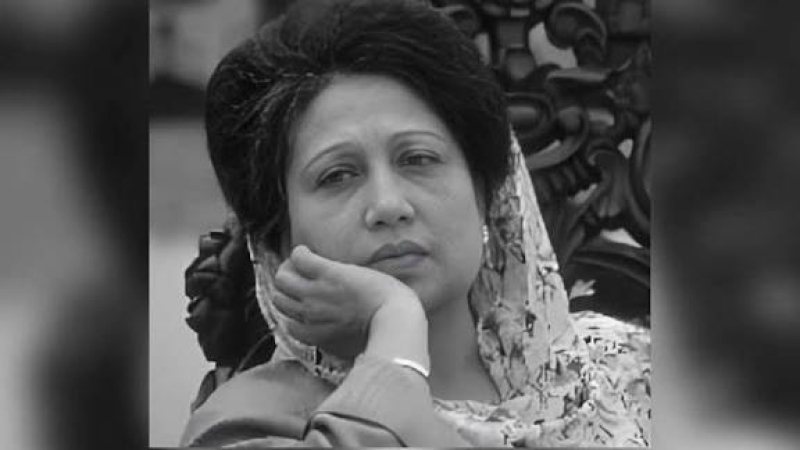
History rarely announces its chosen figures in advance. BNP Chairperson Khaleda Zia has proven it. Her life was a testament to resilience, determination and leadership, marked by an unwavering commitment to democracy and deep patriotism.
Starting as a homemaker, she entered politics seven months after the assassination of her husband, late President and BNP founder Ziaur Rahman and rose to become Bangladesh’s first female Prime Minister in less than a decade.
Over a political career spanning nearly 43 years, she faced personal tragedies, imprisonment and political turbulence, yet remained a steadfast leader and a unifying symbol of democracy in Bangladesh.
According to political analysts, Khaleda’s rise began with public sympathy as the wife of Ziaur Rahman, but she soon turned that sympathy into genuine respect through her merit, modesty, generosity, wisdom and soft-spoken manner.
Political analyst and author Mohiuddin Ahmad, in his book Khaleda, wrote, “In practical terms, she was the first Prime Minister of independent Bangladesh elected under a neutral government. No one can take away this achievement from her.”
Late journalist Mahfuz Ullah, in the foreword to his book ‘Begum Khaleda Zia: Her Life, Her Story’, highlighted her unique rise, writing, “She (Khaleda Zia) carved out an independent political position at a time when society was overwhelmingly male-dominated.”
Khaleda Zia entered politics with no prior experience, joining BNP in 1981 to help stabilise the party during internal divisions after her husband’s death.
She quickly rose through the ranks, becoming senior vice chairperson in March 1983, acting chairperson in January 1984, and BNP chairperson unopposed in May 1984, still under the age of 40.
Under her leadership, BNP came to power three times, and she personally never lost an election. She became Bangladesh’s first female Prime Minister in 1991 and the second woman to lead a Muslim-majority country after Pakistan’s Benazir Bhutto.
Analysts describe her as a charismatic and uncompromising leader. She led a long struggle against military rule under HM Ershad, forming a seven-party alliance that played a key role in his fall.
Her political journey was not without hardships. She endured imprisonment, family tragedies—including the deaths of her husband and younger son, Arafat Rahman Koko—and repeated political harassment.
Even when the army-backed government in 2007 offered her opportunities to return to power or to go abroad, she firmly refused, saying that Bangladesh was her only home and the place where she wished to live until her death. Through this stance, she emerged as a symbol of resilience, integrity and national unity.
Khaleda Zia was also known for her pragmatic approach. She supported dialogue and compromise when necessary, including the introduction of a neutral caretaker government system into the constitution, even when initially opposed within her party.
She skillfully led BNP through multiple alliances, protests, and elections, balancing strategic decisions with her principles.
Born on August 15, 1945, as Khaleda Khan and nicknamed ‘Putul’ by her family, she married Ziaur Rahman in 1960 and became a widow at 36, raising her two sons, Tarique Rahman and Arafat Rahman, while gradually emerging as a decisive political leader.
Throughout her leadership of BNP, Khaleda Zia earned respect not only from her followers but also across political parties. Analysts describe her as a unifying figure, a champion of democracy, and a symbol of perseverance who transformed Bangladesh’s political landscape, paving the way for women to lead at the highest level.
Khaleda Zia was admitted to Evercare Hospital on November 23 due to heart and lung infections and passed away at 6:00 pm on Tuesday.
She was nominated for three constituencies—Dinajpur-3, Feni-1 and Bogura-7—for the upcoming 13th parliamentary election, although her party also fielded alternative candidates in view of her critical health condition.
Khaleda Zia leaves behind a legacy as a steadfast leader, a symbol of unity and one of Bangladesh’s most influential and enduring political figures, reports UNB.