

- After the blaze, Kalshi slum dwellers see what little remains |
- Dhaka, 5 other divisions to see heavy rainfall in 24 hours |
- Over 1.6 Million Pilgrims Gather at Sacred Arafat |
- Mayoral candidates' Eid greetings to Kalapara residents on social media |
- Dhaka moves for new $4-4.5 bn IMF programs, drops current one |
The July Declaration—A Nation’s Pledge to Reclaim Democracy
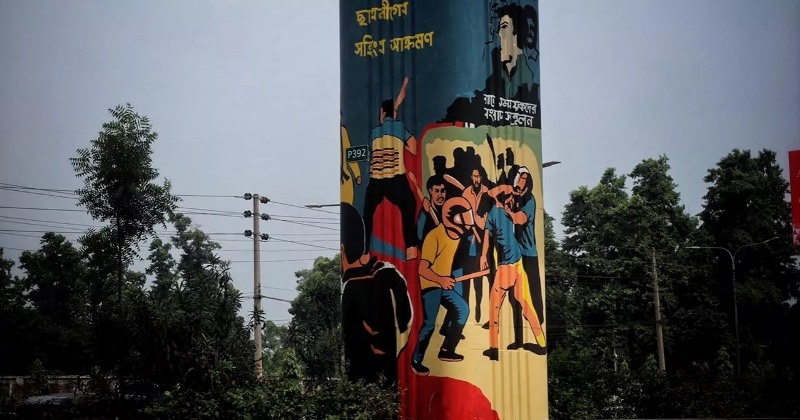
Graffiti - Student demonstrators brave repressive measures. Photo Tahiyat Nazifa Noor - UNB
Chief Adviser Dr. Muhammad Yunus stood before the nation on late Tuesday evening and delivered a historic address that, together with the July Declaration, marks a turning point in Bangladesh’s political trajectory. These twin proclamations do more than commemorate the fall of a regime—they chart a bold and principled roadmap for democratic renewal, constitutional reform, and national healing.
The July Declaration is not merely a political document—it is a chronicle of Bangladesh’s long and painful journey from liberation to authoritarian relapse. It revisits the ideals of the 1971 War of Independence, the betrayal of those ideals through the imposition of BAKSAL, and the nine-year dictatorship that culminated in the mass uprising of 1990. It acknowledges the restoration of democracy in 1991, only to lament its erosion through the 1/11 changes and the farcical elections of 2014, 2018, and 2024.
The declaration does not shy away from naming the crimes of the past regime: enforced disappearances, extrajudicial killings, rampant corruption, and the dismantling of democratic institutions. It condemns the restoration of discriminatory job quotas and the violent suppression of student protests that ultimately ignited the mass uprising of 2024.
In a powerful gesture of national reconciliation, the July Declaration calls for constitutional recognition of the martyrs of the student-mass movement as national heroes. It pledges legal protections for those who participated in the uprising and affirms the people's desire to build a society free from discrimination, exploitation, and autocracy.
This is not symbolic rhetoric—it is a foundational promise. The declaration will be incorporated into the schedule of the reformed Constitution, ensuring that the sacrifices of 2024 are enshrined in law and memory.
Dr. Yunus’s address laid out a clear strategy for transition: a return to liberal democratic constitutionalism by February 2026, following 18 months of interim stewardship. The declaration commits to free, fair, and inclusive elections; restoration of judicial independence and media freedom; institutional safeguards against authoritarian relapse; a climate-resilient, inclusive development strategy; and protection of human rights and rule of law.
The July Declaration is a mirror held up to the nation. It reflects the pain of betrayal, the courage of resistance, and the hope of renewal. It is a call to action for every citizen, every institution, and every future leader to uphold the principles of justice, dignity, and democracy.
Bangladesh now stands at a crossroads. The path ahead is not without obstacles, but the compass is clear. The people have spoken through blood, sacrifice, and unwavering resolve. The July Declaration ensures that their voice will echo through the chambers of the new Constitution and the conscience of the nation.
Let this be the beginning of a new chapter—one where democracy is not a privilege granted, but a right reclaimed.