

- Bangladesh, US sign strategic civil nuclear cooperation agreement |
- Bangladesh Unveils Five-Year Plan to Tackle Pollution |
- Potential For Stronger Saudi Investment Considerable: Ambassador |
- Padma Barrage To Restore River Ecosystem In SW Bangladesh |
- The Urge To Contain Super AI, Today’s Frankenstein |
BNP always stood by people during crises, restored democracy: Nazrul
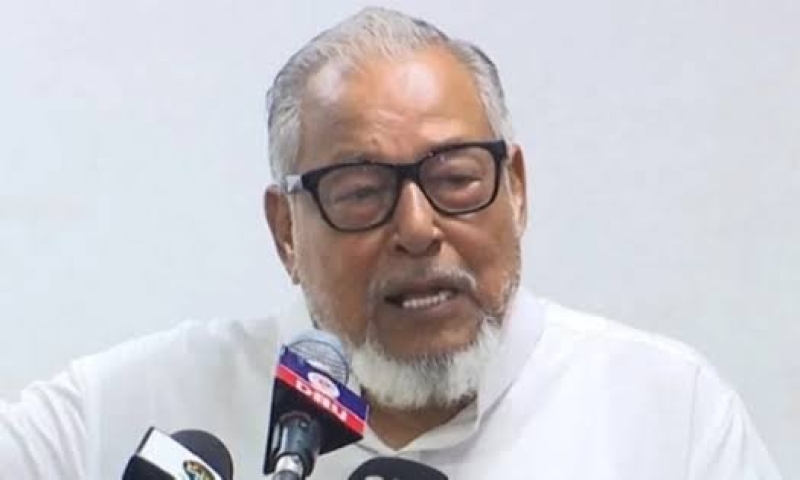
BNP Standing Committee member and Prime Minister's Political Adviser Nazrul Islam Khan today said BNP has always stood by the country's people during times of any crisis and has played an effective role in restoring democracy.
"The Awami League slaughtered democracy, while the BNP restored it," he said speaking as the chief guest at an event, organised by Jatiyatabadi Mohila Dal, in front of the BNP's Nayapaltan central office here.
Nazrul Islam Khan noted that in January 1975, a one-party rule was established in Bangladesh by banning all political parties.
A single party named 'BAKSAL' was formed and all other political parties were banned, he said, adding that it was the BNP founder, Shaheed President Ziaur Rahman, who restored multi-party democracy in the country.
He mentioned that in 1982, Ershad established a military dictatorship after overthrowing the elected government. Several political parties cooperated with him to perpetuate that rule, he said.
Although parties like the Awami League and Jamaat-e-Islami participated in the 1986 elections, the BNP did not betray the people, the BNP leader said.
"Under the leadership of Deshnetri Begum Khaleda Zia, the BNP waged an uncompromising struggle to restore democracy. Consequently, in the 1991 elections, the people entrusted the BNP with the responsibility of governing the state, and the party introduced a multi-party parliamentary democratic system," he said.
Nazrul Islam Khan said the '1/11' government attempted to distort and destroy the democratic system, and through a conspiracy, the Awami League was brought to power.
For 16 years, the fallen Awami League has maintained an autocratic rule and descended into fascism, he said.
The BNP waged a continuous struggle against this - first under the leadership of Deshnetri Begum Khaleda Zia, and in her absence, under the leadership of Prime Minister Tarique Rahman.
He said the number of leaders and activists from the BNP and its affiliated organisations who have been martyred, subjected to enforced disappearance, tortured, or oppressed in this struggle exceeds the total number of individuals from all other political parties in Bangladesh combined who have faced similar fates.
Nazrul said in the elections held in last February, the people once again placed their trust in the BNP, electing the party with a massive majority.
"Currently, the BNP bears the responsibility of governing the state. This is not merely about power; it is a responsibility," he added.
The Prime Minister's political adviser said BNP has consistently viewed power not as a privilege, but as a responsibility. To fulfill this obligation, the government - under the leadership of the Prime Minister - along with BNP and its affiliated organisations, is making tireless efforts.
He stated that the BNP's role has extended beyond restoring democracy; whenever the country's economy faced peril or collapse, the party had to shoulder the responsibility of revitalising it for the welfare of the people.
He said when Shaheed President Ziaur Rahman assumed office on November 7, 1975, the country lacked a national parliament and a cabinet, while chaos prevailed across the armed forces, administration, business sector, and society at large.
Nazrul Islam Khan mentioned that upon assuming leadership, Deshnetri Begum Khaleda Zia successfully revived the national economy, earning Bangladesh the recognition of an "Emerging Tiger."
He noted that when Tarique Rahman took charge this time, the country's economy was in a critical state.
The nation had been left destitute due to a heavy debt burden, the squandering of funds, corruption and the laundering of money abroad, he said, adding that efforts are now underway to move the country forward despite these challenging circumstances.
Nazrul Islam Khan emphasised the need for everyone to work together for the country's welfare.
He warned that any disruption to development activities would cause suffering to ordinary citizens, as well as to the working class and wage earners.
Addressing opposition parties, he urged them to ensure that their words and actions do not inadvertently benefit the ousted autocracy or fascism.
The BNP standing committee member highlighted that the government has introduced "Family Cards" and initiated a programme to provide Taka 2,500 per month to the female head of each family.
Additionally, "Farmer Cards" have been issued to ensure that farmers receive fertilizers, seeds, and pesticides at fair prices, he said.
He urged all to propose better plans instead of opposing these initiatives, reports BSS.