

- Board of Peace quietly met with UNRWA, ex-agency chief says |
- Man arrested with cocktail ingredients, 9,000 masks in Keraniganj |
- Anthrax detected in 3 of 11 people tested in Rangpur |
- Woman killed, 4 of her family missing in Meghna boat capsize |
- State can never be strong keeping citizens powerless: PM at UNGA |
Bangladeshi Nationalism Represents Inclusive Identity: Swapon
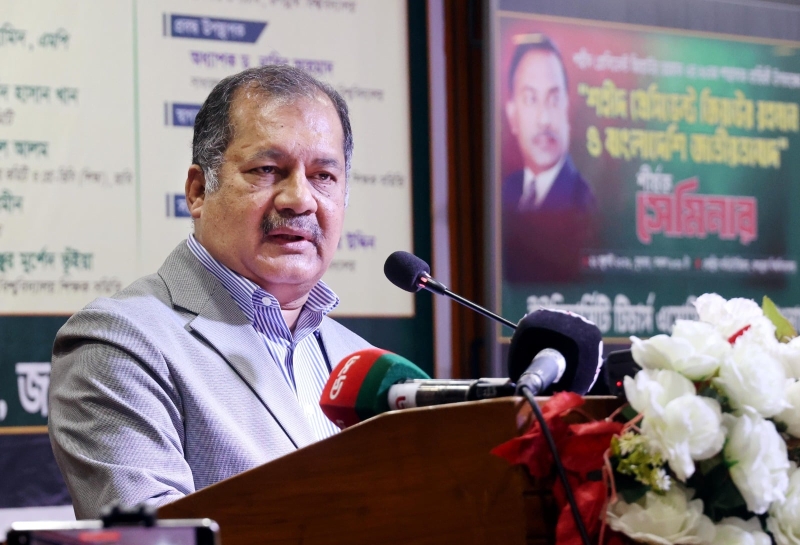
Information and Broadcasting Minister Zahir Uddin Swapon spoke at a seminar titled "Shaheed President Ziaur Rahman and Bangladeshi Nationalism".
Information and Broadcasting Minister Zahir Uddin Swapon has said the philosophy of Bangladeshi nationalism introduced by former president Ziaur Rahman represents an inclusive national identity that embraces people of all languages, religions, cultures and ethnic communities.
"In the concept of modern nationalism, no particular tribe, language, race or religion alone determines national identity. Rather, a modern national identity evolves by embracing the diversity of a territory, shared interests and aspirations for a common future," he said.
The minister made the remarks at a seminar titled "Shaheed President Ziaur Rahman and Bangladeshi Nationalism" held on Wednesday at the central auditorium of Jagannath University (JnU).
The JnU chapter of the University Teachers’ Association of Bangladesh (UTAB) organised the event.
Referring to the country's historical background, Swapon said the creation of Pakistan was based on religion, but religion alone could not sustain unity in a diverse society, which eventually led to the Language Movement of 1952 and the Liberation War of 1971.
He said Ziaur Rahman's role in the Liberation War, including his declaration of independence and leadership during the conflict, was part of the country's history.
The minister said that after independence, a debate over national identity continued, as a language-based identity was not equally accepted by all communities. In this context, he said, Ziaur Rahman introduced the concept of citizen-based "Bangladeshi nationalism."
Swapon said the philosophy of Bangladeshi nationalism recognises the identity of ethnic communities, including Chakma and Marma people, as well as citizens of different faiths, while ensuring respect for diverse cultures.
“Bangladesh first, Bangladesh last — this philosophy has united citizens under a common national identity with equal dignity and has played a role in protecting the country's territorial integrity,” he said.
On foreign policy, the minister said Bangladesh would maintain friendships with all countries based on national interests.
"Everyone is our friend, but we will practice friendship on the basis of Bangladesh's interests. Beyond the country's interests, Bangladesh has no alternative destination," he said.
He also warned that any approach that moves away from this philosophy could affect national unity.
Speaking as the special guest, Dhaka-7 lawmaker Hamidur Rahman Hamid said Ziaur Rahman played a key role in shaping modern Bangladesh. He said Ziaur Rahman guided the country during a challenging period after the November 7, 1975 uprising and worked towards state development.
JnU Vice-Chancellor Professor Rais Uddin attended the seminar as the keynote speaker.
The event was chaired by UTAB JnU chapter President Professor Dr Mohammad Nasir Uddin and attended by university teachers and officials, including UTAB central committee Senior Vice-President Professor Dr Shamsul Alam, JnU Treasurer Professor Dr Sabina Sharmin and acting President of the JnU Teachers’ Association Professor Dr Muhammad Manjur Murshed Bhuiyan.
Professor Dr Nasir Ahmad, general secretary of the UTAB JnU chapter, presented the keynote paper, while JnU Teachers’ Association General Secretary Professor Dr Imranul Haque delivered the welcome address.