

- More than 500 Rohingya vanished at sea - what happened? |
- EU, G77 Back Bangladesh's Smooth LDC Graduation |
- US hits Iran infrastructure in tit-for-tat strikes |
- Trump to attend World Cup final on Sunday: White House |
- IEA Warns Hormuz Disruption Threatens Energy Security |
BNP Committed to July Charter: Fakhrul
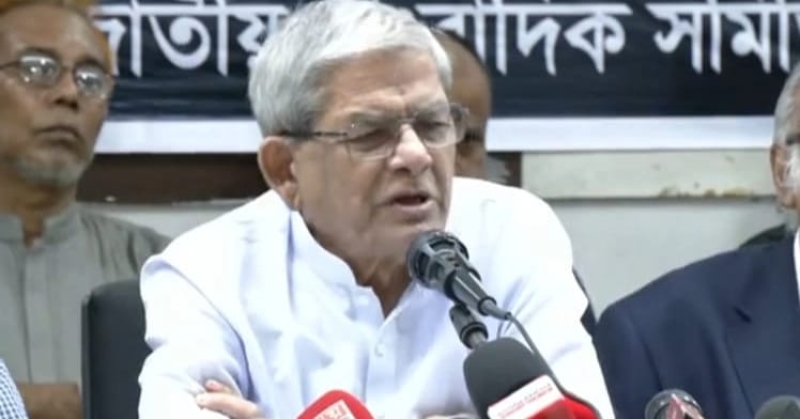
BNP Secretary General Mirza Fakhrul Islam Alamgir on Friday reaffirmed the party's commitment to implementing every provision of the July National Charter, accusing the opposition of attempting to mislead the public by claiming otherwise.
"We have always said that we want to amend the Constitution. We have never said that we want constitutional restructuring. BNP remains committed to implementing every provision of the July National Charter," Fakhrul said while addressing a discussion marking the sixth death anniversary of former Dhaka University Vice-Chancellor Prof Emajuddin Ahmed at the Jatiya Press Club.
Fakhrul, who also serves as the Local Government, Rural Development and Cooperatives Minister, said the BNP secured a two-thirds parliamentary majority based on the election manifesto it presented to the people.
"The people gave us their mandate based on that manifesto. BNP has been entrusted with governing the country with a two-thirds majority, so there should be no confusion over our position," he said.
Referring to recent criticism from the opposition, Fakhrul alleged that some political parties were trying to mislead the public regarding the BNP's stance on the July Charter.
He said all parties that participated in the anti-fascist movement had jointly signed the charter and reiterated that the BNP remained committed to implementing every provision of it.
However, Fakhrul noted that the party had not agreed with certain proposals, including introducing a proportional representation system for the proposed upper house of Parliament.
He claimed that the Reform Commission had incorporated several recommendations without BNP's consent and pointed out that the July Charter clearly states that elected political parties would implement reforms in line with their respective election manifestos.
"As we are committed to our 31-point reform agenda, we are equally committed to the July Charter. We will implement it in accordance with the commitments we have made to the people. Claims that BNP does not want to implement the charter are completely false," he said.
Rejecting allegations that BNP opposes reforms, Fakhrul said the party had played a pioneering role in introducing key democratic reforms in Bangladesh.
"BNP introduced multi-party democracy after one-party rule, restored the parliamentary system of government, and enacted the caretaker government provision," he said.
He also accused some opposition groups of attempting to exploit the legacy of the July mass uprising for political gain.
"They are trying to use July merely as a vehicle to capture power. We do not want the July movement to become another instrument of political power," he said.
According to Fakhrul, the July uprising was the culmination of nearly two decades of struggle against what he described as authoritarian rule.
He claimed that around 6 million BNP leaders and activists had faced politically motivated cases, about 1,700 had been subjected to enforced disappearance, and thousands had been killed during the movement against the previous regime.
Fakhrul said the July-August 2024 student-led mass uprising created a historic opportunity to establish a democratic and liberal state, though rebuilding the country would require patience and sustained effort.
"The challenges are enormous and cannot be resolved overnight. We must move forward patiently and work together to rebuild the country," he said.
Paying tribute to Prof Emajuddin Ahmed, Fakhrul described him as a distinguished political scientist, a committed democrat and a patriot who played an important intellectual role in the movement for democracy.