

- Speaker sees no possibility of Hasina's return even in 10-yrs |
- Bangladesh Ambassador to Japan returns home ahead of PM’s visit |
- Sajek Road Blockade: 2,933 Tourists Evacuated Amid Gunfire |
- Climate Crisis May Displace 7.5% of Bangladeshis by 2050 |
- NEIR Rollout Targets Tk 2,000cr Revenue Loss From Illegal Phones |
UNGA Revitalization Needs Real Reform, Not Repetitive Routine
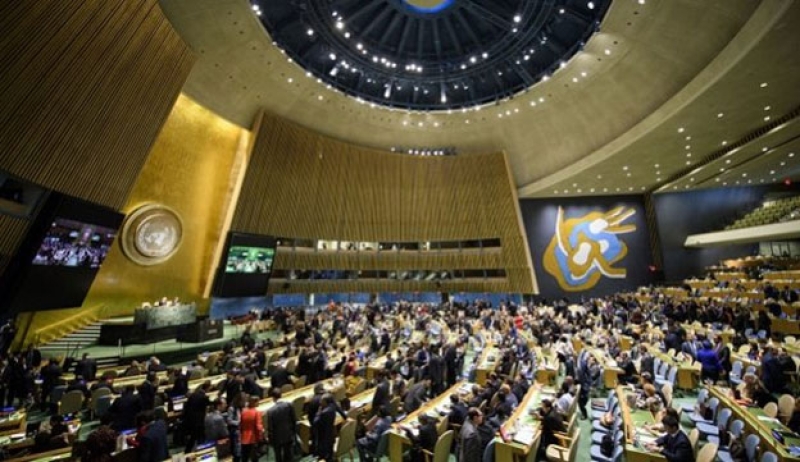
The UN General Assembly in session. Credit: UN Photo/Manuel Elias.
From its inception, the UN General Assembly (UNGA) has been engaged in improving its working methods, mindful, as early as 1949, of “... the increasing length of General Assembly sessions, and of the growing tendency towards protracted debates.”
Since the leadership of the legendary Ambassador Samir Shihabi of Saudi Arabia as President of the General Assembly (PGA) during the 46th session in 1991 and thereafter, the Assembly’s agenda has included a dedicated item on the revitalization of the work of the Assembly and its Main Committees.
Since the 60th session in 2005, under the guidance of its articulate and forward-looking President, Ambassador Jan Eliasson of Sweden, the Assembly established the Ad Hoc Working Group on the revitalization of the work of the General Assembly. Its mandate was “to identify ways to further enhance the role, authority, effectiveness, and efficiency of the General Assembly.”
To date, more than 200 outcomes have been recorded in 30 different areas. The incumbent President of the landmark 80th session, Annalena Baerbock of Germany, has now taken the initiative to move forward substantively on this perennial exercise of the world’s most universal multilateral body.
Election of a Woman as the Next Secretary-General
I strongly suggest that her forward-looking leadership would restore the operational credibility of the United Nations by including in its revitalization exercise the role of the Secretary-General, facilitating the election of a woman as the next Secretary-General, ensuring transparency in the UN’s budgetary processes, addressing current and future liquidity crises, and promoting meaningful inclusivity of civil society in the Assembly’s work.
The role, functions, and leadership of the Secretary-General need special attention from the Assembly as the appointing authority. The 75th PGA in 2020, Volkan Bozkir, rightly identified that “the Secretary-General is the engine and the transmission system.”
It is unfortunate that questions have been raised about the reticence of the Secretary-General in getting his hands dirty and becoming more proactively involved in, and in mobilizing his senior management team towards, ending ongoing global conflicts and wars and promoting peace and reconciliation.
In a recent op-ed, former UNICEF Deputy Executive Director and longtime UN watcher Kul Chandra Gautam even exhorted the SG “not to hide behind the glasshouse at Turtle Bay and go beyond invisible subtle diplomacy to more visible shuttle diplomacy.”
After choosing nine men successively to be the world’s topmost diplomat, I strongly believe that the United Nations should have the sanity and sagacity to elect a woman as its next Secretary-General.
In its resolution A/79/372 adopted as recently as 5 September this year, the Assembly, in paragraph 42(c), said that “noting with regret that no woman has ever held the position of Secretary-General, [it] encourages Member States to strongly consider nominating women as candidates.” It also asserted in paragraph 42(k) that “the Secretary-General shall be appointed by the General Assembly upon the recommendation of the Security Council, in accordance with Article 97 of the Charter.”
The same resolution (79/327) committed the UNGA “... to the continued implementation of ... its resolution 76/262 of 26 April 2022 on the veto initiative, to enhance the work of the General Assembly, taking into account its role on matters related to the maintenance of international peace and security ...”. In the current exercise, this area, of course, needs further attention and elaboration.
Transparency and accountability are essential in the UN’s budget processes.
Two other areas that need more scrutiny are extra-budgetary resources received from Member States and consultancy practices, including budgetary allocations for them by the Organization. Special attention in these areas is needed to restore the UN’s credibility and thereby its effectiveness and efficiency for the benefit of humanity as a whole.
Future Financial and Liquidity Crises
Tough decisions needed to avoid future financial and liquidity crises require genuine engagement by all sides — yes, ALL sides — particularly the major “assessed” contributors.
Peacekeeping operations also face increasing liquidity pressure, as outstanding contributions for that area are reported to be $3.16 billion. These accumulations have been building up for years. Why was no extra effort made by all sides well ahead of time to avoid the recurrent panic about the Organization’s liquidity crises?
Today’s financial and liquidity crisis is not caused by recent withholding of payments by a few major contributors for political reasons. Outstanding contributions for the UN’s regular budget reached $2.27 billion last month.
At the UN, although the “process is an intergovernmental one and thereby Member States-driven,” the absence of civil society involvement would seriously undermine the role and contribution of “We the Peoples...”. PGA Bozkir asserted that “civil society is the pillar of democracy, and we must, after some time, find a way that civil society is (re)presented here.”
Enhancing the UN’s Credibility
I am also of the opinion that a formalized and mandated involvement of, and genuine consultation with, civil society would enhance the UN’s credibility. The UN leadership and Member States should work diligently on this without fail for a decision by the ongoing 80th session of the General Assembly.
Under the bold, upbeat, and clear-sighted leadership of the incumbent PGA Annalena Baerbock, whose proactive and forward-looking role has already drawn wide appreciative attention, the international community needs to wish her the best of luck in this very important endeavour to revitalize the apex body of the most universal multilateral entity — the UN General Assembly — in a positive way.
For that, now is the time to discuss and decide on the urgent, focused, and meaningful areas of action. The UN’s long-drawn revitalization efforts should not once again end in the repetitive regularity of an omnibus of redundancy.
Ambassador Anwarul K. Chowdhury is former Under-Secretary-General and High Representative of the United Nations; Permanent Representative of Bangladesh to the UN; Initiator of UNSCR 1325 as President of the UN Security Council in March 2000; Chairman of the UN General Assembly’s Main Committee on Administrative and Budgetary Matters; and Founder of the Global Movement for the Culture of Peace (GMCoP).