

- OPEC faces mounting pressure as officials meet in Vienna |
- Locked in poverty and riverbank erosion: The reality of Kurigram |
- DC conference 2026: 498 proposals set for policy review |
- Govt moves to amend Const; opposition wants reform |
- Govt Proposes 17-Member Panel for Constitution Reform |
Sundarbans World Heritage for Mankind in Distress
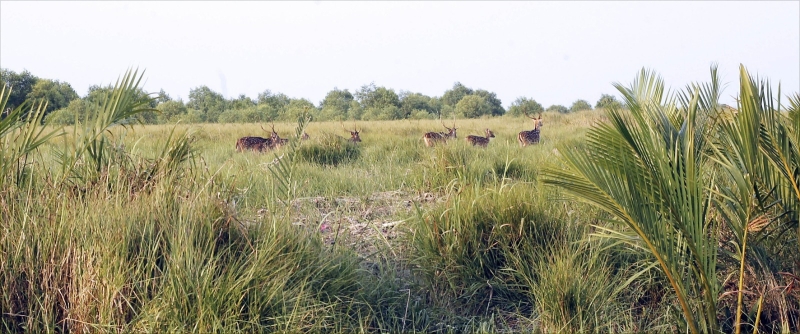
We saw deer, not tiger not even at one of their dining rooms, as forest guide Hiron told us, in the Kotka region of the Sundarbans. We saw the familiar marking of territory by doubtlessly a male tiger at the lower part of a tree stem with its paws to guard predators from entering. We went deep into the wood for what the guide called an adventure walk, saw more deer and experienced a foul smell that the guide said was of a tiger. Apparently, a tiger was hiding itself somewhere around there and did not dare come out in the open near us. The stink came back and back with the back and forth of wind for at least three minutes.
In the so-called dining room, there is a stretch of barren forest where tigers chase deer and devour their preys after haunting them down. Twigs spread here and there with fallen leaves forming mats at places. Gewa and Goran trees abound; Sundries are not seen in the area at all. We were a little over two dozen men and women from Change Initiative, a research organisation, and the Forum of Environmental Journalists of Bangladesh (FEFB) on a 3-day study tour of the World Heritage for Mankind, designated by UNESCO for its unique mangrove biodiversity still alive but gasping for breath due to cutting off of fresh water flow from rivers at upstream during the lean season. The Sundarbans lies at the lowest reach of the Ganges river system and its fresh water maintains a critical balance with brackish water to sustain the mangrove ecosystem of the largest forest on earth in one patch.
Spread across 10,277 square km (3,968 sq mi), it is the world's largest mangrove forest. It covers over 6,017 square km (2,323 sq mi) in Bangladesh's Khulna Division. In West Bengal's Presidency division, it extends over 4,260 square km (1,640 sq mi). The forests provide habitat to 453 wildlife, including 290 bird, 120 fish, 42 mammal, 35 reptile and eight amphibian species. The forest is suffering from increased salinity caused by sea level rise due to effects of climate change and reduced freshwater supply. The coal-fired Rampal power station is, as anticipated in a 2016 report by UNESCO, causing further damage to this unique mangrove forest.
Taking an early breakfast, we set off for the Jamtala reserved forest by an engine boat from the ship Ship Jol Safari which anchored near the Kotka Tourist Jetty. On one bank of the Kotka canal we saw a wild cock majestically walking. It had a fully grown-up tail. The size and colour were so familiar like our backyard poultry birds. It was not alarmed by the laud noise of the boat's engine. But it did not consider whispers by group members as a welcome gesture and quickly ran into dense forest and beyond our sight.
The reserve area, linked to the river by the Kotka Canal, is known for the presence of Royal Bengal Tigers. Forest guide Hiron advised, none should detach from the group because tigers normally target the loners. He said once attacked it would be a vain attempt to escape. So strong are the big cats of the Sundarbans that they can drag two men each with their two paws in one go.
On way to Kachikhali from there we saw a large mother deer taking water from the canal while its fawn, raising its ears, had its cautious eyes on us on the boat. The sound of the engine alerted her and she along with her fawn sped into the forest. In Kachikhali we walked to a pond dug for rain water to collect for drinking by wild animals. Beside it, was an earthen mound built as a shelter for the beasts at times of natural disasters like cyclones and tidal floods. Here also a mother deer and her fawn were grazing. They were alerted by whispers and gestures made by the members of our group. After staring at us for a while they walked further west and disappeared. As we walked further, we came across some monkeys, a mother wild boar with a number of young wild boars. They were feeding freely in the wild fallen nuts and other things they found on the floor of the forest. They moved to the denser forest as the visitors became active with their cameras. On way to the pontoon to take our engine boat through the beach on the edge of the forest we saw more wild boars and a herd of monkeys running towards night shelters. People having experience of touring the Sundarbans said there was no big cat in the vicinity at the time, or else the monkeys would not have been there.
We then moved to the other side of the river to Dimer Char after cruising about a kilometre inside a canal with the engine boat. There were a plenty of deer on its two sides. Several spotted deer were sighted on our right side. A large herd of at least 12 well-grown deer some with beautiful horns was sighted on the left. They also spotted our boat, ran away along the waist high shrubs. The beach of Dimer Char was strewn with medium size mangrove trees along with roots, twigs and seeds of mangrove trees carried by sea currents. This is the natural process of regeneration of the Sundarbans mangrove forest. After sun set, the ebb tide carried away the water from the char-side so fast that the engine boat could no longer touch the dry part of the bank. Half a dozen member of our group had to walk into knee-deep water to board the engine boat.
At the Harbaria Eco-Tourism Centre a warning given by our tour guide proved true. One of our group members contrary to his guidance wore a bright red half-shirt that angered some monkeys which attacked him as he was walking lonely at the rear. We first thought his hue and cry was just a fun. But later he showed us the monkey bruises, one of those going deep into the skin in one hand. He had to take a vaccine course to protect against viral attack. A fairly large red lily pond there was excellent, with deer we found roaming on its banks both at times of entry and departure. The Karamjal Eco-Tourism Centre favoured by tourists for a day-long trip to the Sundarbans has some captive animals including deer and crocodiles. Incidentally it was at these two centres that we saw Sundri trees in large numbers. These are located closer to Mongla and Khulna and apparently the soil there is less saline than the soil deep in the Sundarbans.
Our experience on this tour was mixed. Everyone, including tour operators, is dumping garbage from their watercraft into the rivers and canals flowing through the forest. During low tide, this garbage can be found on the banks of the rivers and canals. The loud noise of the engines of the small boats carrying tourists into the canals embarrasses the wildlife in their sanctuaries and, with them, the human guests. We did not see any 50-100-year-old trees in the Sundarbans. Why? The forest managers will have to find the answer. The Sundarbans are still alive. But its deteriorating picture is visible to any observer.
However, sincere efforts to create a supportive environment for forest conservation by facilitating the life cycle, biodiversity, and livelihood of the human communities associated with the mangrove environment of the Sundarbans were also seen during this educational tour. These are inadequate compared to the vastness of the Sundarbans. Along with increasing such nature-friendly initiatives, it is important to take strict steps against those who cause damage to the mangrove forest. Again, all these efforts will be of little use unless the flow of the Ganges is maintained and a balanced mixture of fresh water from the upstream and brackish water from the sea is maintained in the Sundarbans area. Mangroves remain healthy and natural only with a balanced mixture of saline and fresh water. In its absence, the main tree species of the forest, the sundri tree, has been almost wiped out at many places of Sundarbans.