

- Trump says US holding ‘very positive discussions’ with Iran over war |
- Dhaka ranks 4th among the world’s most polluted cities Monday |
- Cabinet approves tax relief for brand new electric vehicle imports |
- Energy prices surge to highest in 4 years as conflict spreads |
- 16 DIGs Among 17 Police Officials Sent on Retirement |
Guterres Urges Action on Safe Migration Pact
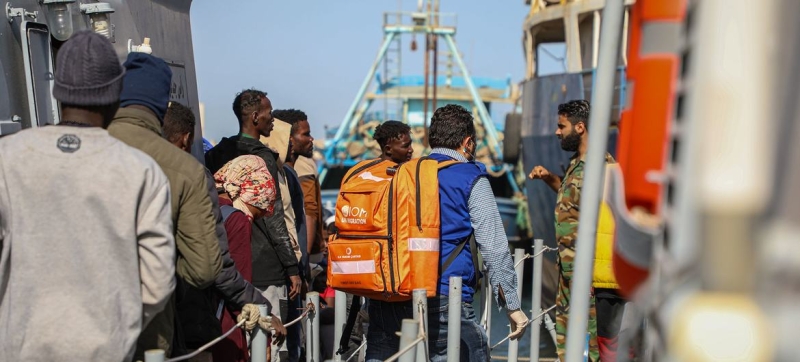
UN teams provide medical assistance to migrants who are disembarking in Abusita port in Tripoli, Libya.
A 2018 agreement aimed at strengthening international cooperation on migration management must be fully implemented, the UN Secretary-General said on Friday in New York.
António Guterres presented his latest biennial report on the Global Compact for Safe, Orderly and Regular Migration to Member States during an informal meeting of the UN General Assembly.
The report shows that in 2024, an estimated 304 million people were migrants, representing 3.7 per cent of the world’s population. Children accounted for between 12 and 14 per cent, or roughly 37 to 42 million.
Guterres told ambassadors that the report makes one truth unmistakably clear: “Migration is not a crisis. The crisis is the failure to manage it together.”
Politicised and Dehumanised
The Global Compact underscores that no country can manage migration alone, particularly as the world faces challenges such as climate change, demographic shifts, and economic transformation.
Although human mobility is profoundly shaping the world, “the global reaction has too often been driven by fear, division, and rank opportunism,” the Secretary-General said.
“Across continents, migrants are being instrumentalised to score political points — with devastating human consequences,” he added. “They are being dehumanised in public discourse and denied the rights and dignity that belong to every member of the human family, despite the enormous contributions they make to economies and societies.”
Safe Pathways Decreasing
This trend comes as safe and regular migration pathways — such as labour schemes and family reunification — are becoming more restrictive, pushing people towards smugglers and forcing them to undertake dangerous journeys.
More than 48,000 migrants have died or gone missing in transit since the Compact’s adoption, according to the report. This follows confirmation by the UN migration agency that sea crossings, including the central Mediterranean route, remain among the deadliest in the world.
“It is a moral outrage that thousands of men, women, and children die or go missing every year because no safe alternative exists,” Guterres said.
Victims, Not Criminals
He stressed that migrants are not criminals but victims. The real criminals, he said, are the “ruthless smuggling and trafficking networks” that profit from despair, exploit the absence of safe alternatives, and thrive when cooperation fails. These networks must be prosecuted and brought to justice.
Since the Compact’s adoption, many countries have taken steps to improve migration governance, including expanding regular pathways, strengthening labour mobility initiatives, improving search-and-rescue operations at sea, and supporting safer returns and reintegration.
However, “progress is uneven and far below what today’s realities demand,” he said. Migration governance must be rights-based, gender-responsive, and child-sensitive, while also respecting national sovereignty and upholding human dignity.
From Progress to Action
To be effective, countries must work collectively on two fronts. The first is expanding and simplifying clear, regular migration pathways. The second focuses on countries of origin, ensuring development cooperation that invests in education, skills, and decent job creation.
“We must now translate vision into accelerated action for safe, orderly and regular migration,” the Secretary-General said.
This includes strengthening cooperation to save lives and build resilient communities, cracking down on smuggling and trafficking networks, ending child immigration detention, matching migrants’ skills with labour market needs, and confronting toxic narratives with evidence and humanity.
Looking ahead, Guterres said the International Migration Review Forum in May should push countries towards decisive and measurable action.
“Migration is a story as old as humanity — a story of courage, resilience, and mutual benefit,” he said. “Our task is to ensure that it never becomes a story of death and despair.”
He concluded by urging countries to make the Global Compact a reality “in every region, on every route, for every migrant.”