

- PM Tarique inaugurates three pilot SDG villages |
- Indian High Commissioner Trivedi meets PM Tarique |
- SSC, Equivalent Exam Results Published, Pass Rate 62.25% |
- Global Oil Prices Rise Again Amid Hormuz Uncertainty |
- 17 Bangladeshis Killed in Saudi Arabia Factory Fire |
FICCI urges wider tax net, digital reforms, better investment climate
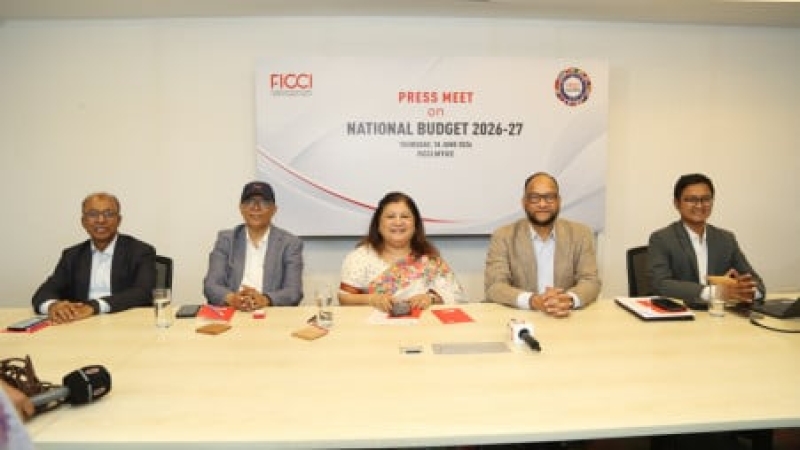
The Foreign Investors' Chamber of Commerce and Industry (FICCI) on Thursday called for broadening the tax base, accelerating digitalization of tax administration and creating a more competitive business environment to boost investment and revenue collection.
Speaking at a post-budget press briefing on the proposed national budget for FY2026-27, FICCI said sustainable revenue growth and higher domestic and foreign investment would require structural reforms, policy predictability and measures to reduce the cost of doing business.
"As Bangladesh prepares for LDC graduation and seeks to attract greater investment, expanding the tax net, improving compliance and ensuring a level playing field for businesses should remain key priorities," the chamber said.
FICCI President Rupali Haque Chowdhury presented the chamber's observations and recommendations, describing the proposed budget as "positive and relatively predictable."
She welcomed increased allocations for social protection programmes targeting marginalized communities, saying effective implementation would improve the quality of life of vulnerable groups. She also praised higher budgetary allocations for the education and health sectors, noting that investment in human capital would support long-term economic growth.
While highlighting Bangladesh's continued dependence on remittance inflows, Chowdhury stressed the need for stronger investment in skills development and vocational education to build a more productive workforce.
She also welcomed incentives for green initiatives and solar energy, saying the measures would help reduce reliance on fossil fuels and cushion the economy from global oil price volatility.
Identifying inflation as the country's biggest economic challenge, she said the government's target of reducing inflation from around 9.5 percent to 7.5 percent would require a clear strategy and effective implementation roadmap.
Chowdhury also welcomed efforts to reduce dependence on commercial bank borrowing through alternative financing sources but said clear policy direction and implementation plans would be critical for success.
On revenue mobilization, FICCI urged the government to bring more non-filers into the tax system. The chamber recommended making Proof of Submission of Return (PSR) mandatory for issuing and renewing licences and permits, linking PSR requirements to VAT return submissions, and introducing a 360-degree cross-checking mechanism between tax returns and withholding tax records.
Presenting the chamber's detailed tax proposals, FICCI Tax Consultant Snehasish Barua FCA called on the National Board of Revenue (NBR) to adopt a comprehensive automation roadmap integrating customs, VAT and income tax systems while ensuring interoperability with other government agencies.
FICCI also proposed establishing a dedicated data and analytics unit within the NBR to assess market share against revenue contribution across industries as a quick-win measure to improve the tax-to-GDP ratio.
To enhance the investment climate, the chamber recommended a roadmap for lowering Bangladesh's effective tax rate through reduced corporate tax rates, gradual transition to a cashless economy, phased reduction of minimum tax on sales and a review of the personal income tax structure in light of inflation, investment and employment considerations.
The chamber further called for customs reforms to improve trade competitiveness, including valuation based on actual transaction values, proper classification of raw materials and intermediate goods, faster clearance of capital machinery and the gradual removal of non-tariff barriers ahead of LDC graduation.
FICCI also urged the government to conduct Time Release Studies (TRS) to speed up cargo clearance, maintain a non-discriminatory business environment through moderate and uniform price adjustments, and withdraw the proposed increase in supplementary duty on raw materials.
The chamber reiterated its commitment to working with policymakers and stakeholders to strengthen revenue collection, improve the ease of doing business and position Bangladesh as a more attractive destination for local and foreign investment.
FICCI Vice-President Mohammad Iqbal Chowdhury, Director Habibur Rahman Bhuiyan, Executive Director T I M Nurul Kabir and members of the chamber's Tax Committee were present at the briefing.