

- NCP Announces 27 Candidates, Aims for Seats After Exit |
- Govt Defends Prof Yunus’ Backing of ‘Yes’ Vote |
- Protecting health demands no money: Bangladeshi expert |
- EU Deploys 56 Long-Term Observers Across Bangladesh |
- Appeals over nomination papers:18 more regain candidacies back |
Guterres at UN 80: Humanity strongest when united
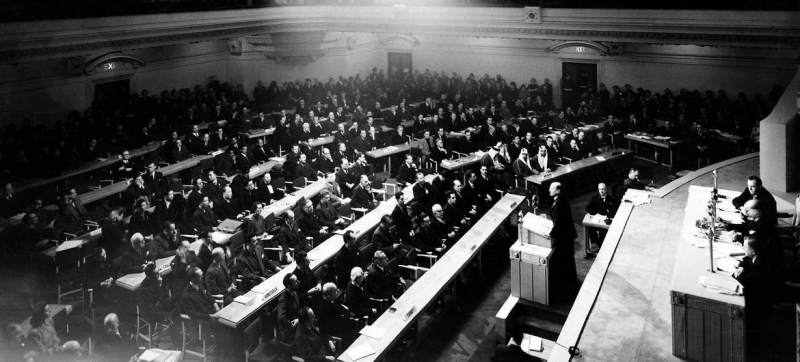
Having survived the Second World War intact, Methodist Central Hall was chosen as the first venue of the UN General Assembly on 10 January 1946. (file)
Powerful forces are lining up to undermine global cooperation, United Nations Secretary-General António Guterres warned at a landmark event in London on Saturday commemorating the 80th anniversary of the General Assembly. He urged, however, that “humanity is strongest when we stand as one.”
Speaking at Methodist Central Hall, the same venue where the first-ever UN General Assembly was held on 10 January 1946, Mr Guterres called on delegates to be “bold enough to change, bold enough to find the courage of those who came to this Hall 80 years ago to forge a better world.”
From bomb shelter to diplomatic gathering
Organised by the United Nations Association–UK, Saturday’s anniversary event brought together more than 1,000 delegates from around the world. Speakers included President of the General Assembly Annalena Baerbock, UN Champion for Space Professor Brian Cox, and UN Refugee Agency Goodwill Ambassador Maya Ghazal.
The event also marked the 80th anniversary of the first UN Security Council meeting, held on 17 January 1946 at nearby Church House.
In his keynote address, Mr Guterres reflected on the symbolic location of the commemoration. The first General Assembly took place within the same walls four months after the end of the Second World War, in a heavily bombed London where tens of thousands had been killed, a powerful reminder of why the UN was created.
“To reach this Hall, delegates had to pass through a city scarred by war. Buckingham Palace, Westminster Abbey and the House of Commons had been shelled by the Luftwaffe. And as those bombs fell, terrified civilians huddled here, in the basement of Methodist Central Hall — one of the largest public air-raid shelters in London,” the Secretary-General said.
Throughout the Blitz, as many as 2,000 people gathered in the hall for protection, before the nations of the world assembled there in 1946 to “save succeeding generations from the scourge of war”.
“In many ways, this Hall is a physical representation of what the United Nations is: a place people put their faith — for peace, for security, for a better life,” Mr Guterres said.
The world of 2026 is not the world of 1946
In the 80 years since the first General Assembly, the UN has expanded from 51 members to 193. Mr Guterres emphasised that the General Assembly, the UN’s chief deliberative, policymaking and representative body, is “the parliament of the family of nations”.
“It is a forum for every voice to be heard, a crucible for consensus and a beacon for cooperation,” he said.
While acknowledging that the Assembly’s work “may not always be straightforward or seamless,” he described it as “a mirror of our world, its divisions and its hopes — and the stage on which our shared story plays out”.
Reflecting on the past decade, Mr Guterres said conflicts in Gaza, Ukraine and Sudan had been “vicious and cruel beyond measure”, artificial intelligence had become ubiquitous almost overnight, and the pandemic had poured accelerant on the fires of nationalism, stalling progress on development and climate action.
He described 2025 as a “profoundly challenging” year for international cooperation and the UN’s values.
“Aid was slashed. Inequalities widened. Climate chaos accelerated. International law was trampled. Crackdowns on civil society intensified. Journalists were killed with impunity. And United Nations staff were repeatedly threatened — or killed — in the line of duty,” he said.
The UN reported in 2025 that global military spending reached $2.7 trillion — more than 200 times the UK’s current aid budget, or equivalent to over 70 per cent of Britain’s entire economy.
Fossil fuel profits continued to surge while the planet broke heat records, Mr Guterres added.
“And in cyberspace, algorithms rewarded falsehoods, fuelled hatred and provided authoritarians with powerful tools of control.”
Multilateralism over division
A “robust, responsive and well-resourced multilateral system” is needed to address the world’s interconnected challenges, the Secretary-General said, warning that the “values of multilateralism are being chipped away”.
He cited a landmark international agreement to protect marine life in international waters and the seabed — which comes into force on Saturday — as a model of modern diplomacy led by science and inclusive participation, including civil society, Indigenous Peoples and local communities.
“These quiet victories of international cooperation — the wars prevented, the famine averted, the vital treaties secured — do not always make the headlines,” he said. “Yet they are real, and they matter.”
As he addressed the London audience, Mr Guterres expressed gratitude to the United Kingdom for its decisive role in creating the United Nations and for continuing to be a strong pillar of multilateralism.
High stakes for a better world
Looking ahead, the Secretary-General called for an international system that reflects today’s world, including reforms to international financial institutions and the UN Security Council.
“As global centres of power shift, we have the potential to build a future that is either more fair — or more unstable,” he warned.
Recalling the UN’s early days, Mr Guterres said many staff members bore the visible wounds of war.
“There is a persistent myth — now echoing louder each day — that peace is naïve, that the only ‘real’ politics is the politics of self-interest and force,” he said.
“But the founders of the United Nations were not untouched by reality. They had seen war, and they knew peace, justice and equality are the most courageous, the most practical and the most necessary pursuits of all.”
Miranda Alexander-Webber is a communications officer with the United Nations Regional Information Centre for Western Europe (UNRIC).