

- Body of Osman Hadi Returns to Dhaka From Singapore Late |
- Fakhrul condemns attacks on media, calls for unity, justice |
- 2 cops among 4 hurt in clash outside Indian Assit H.C. in Ctg |
- Inqilab Moncho urges people to avoid violence |
- Hadi’s death: Prothom Alo, Daily Star offices set afire |
Debate Grows Over Single Seven-Year UN Chief Term
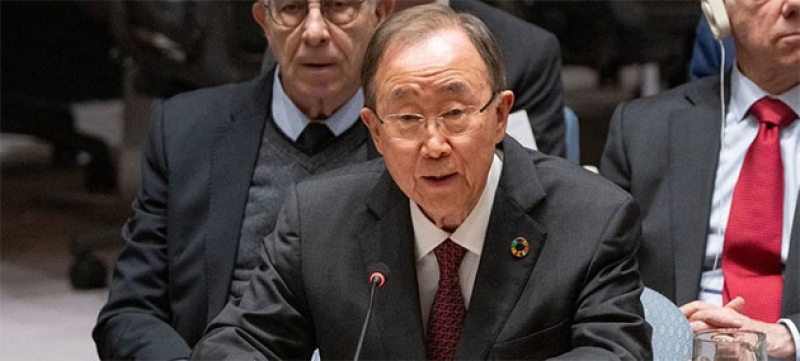
Former UN Secretary-General Ban Ki-moon, addresses the Security Council warning the Council it risks irrelevance without reform.
A long-standing proposal dating back to 1996—to establish a single, non-renewable seven-year term for the Secretary-General of the United Nations—has been revived by former UN Secretary-General Ban Ki-moon.
The original proposal was part of a study sponsored by the Dag Hammarskjöld and Ford Foundations. According to the study, a seven-year term “would give the Secretary-General the opportunity to undertake far-reaching plans free from undesirable pressures.”
Ban has said that a single, non-renewable seven-year term would strengthen the independence of the office. The current practice of two five-year terms, he argued, leaves Secretaries-General “overly dependent on the Security Council’s permanent members for an extension.”
Former Secretary-General Boutros Boutros-Ghali of Egypt was denied a second five-year term when the United States vetoed his reappointment, despite his receiving 14 of the 15 votes in the Security Council.
“As the highest policy-making organ of the United Nations, and as the ultimate appointing body, the General Assembly should adopt a comprehensive resolution establishing a single seven-year term and all key features of an improved appointment process,” the study said.
The same seven-year term, the study added, should also apply to the heads of UN agencies and programmes. The 1996 study, authored by Sir Brian Urquhart and Erskine Childers, was titled A World in Need of Leadership: Tomorrow’s United Nations—A Fresh Appraisal. Sir Brian was a former UN Under-Secretary-General for Special Political Affairs, while Childers served as a senior adviser on development and international economic affairs.
Ambassador Anwarul K. Chowdhury, former Under-Secretary-General and High Representative of the United Nations and Bangladesh’s Permanent Representative to the UN, said the proposal carries substantive merit. He argued that, in the interest of the organisation’s operational credibility, a single non-renewable term would enhance the Secretary-General’s independence.
In an opinion piece published in June 2011, he wrote that the current re-election process is “unclear, closed-door, behind-the-scenes and exclusionary,” resulting in a Secretary-General who begins thinking about re-election from the first day in office.
He further noted that the temptation of a second term often shapes the Secretary-General’s priorities, with the preferences of the five permanent Security Council members receiving disproportionate attention. According to him, the political debt accumulated during a first term is often “repaid” during the second.
Asked whether current Secretary-General António Guterres supports the proposal, UN Deputy Spokesperson Farhan Haq said that Guterres respects his position and remains outside member states’ discussions on the issue. Any change to the Secretary-General’s term, he said, would require agreement among member states.
Dr Palitha Kohona, a former chief of the UN Treaty Section, acknowledged that some see value in extending the term to seven years but cautioned against potential risks. He argued that granting a single long term to an ineffective leader could burden the organisation for an extended period.
An effective Secretary-General, he said, can achieve significant results within five years, provided they possess strong leadership, management skills and the ability to select capable senior officials. The current tendency for powerful states to impose candidates, he warned, undermines the institution’s effectiveness.
Sanam B. Anderlini, founder and CEO of the International Civil Society Action Network, supported the seven-year term idea, saying it would allow a Secretary-General to be more courageous and visionary without the pressure of seeking re-election. However, she stressed the importance of ensuring that future leaders possess the necessary values, courage and competence.
Any change to the Secretary-General’s tenure would require an amendment to the UN Charter and the consent of the five permanent Security Council members, observers noted.