

- Intimidation or bloodshed cannot halt Bangladesh’s march to democracy |
- Khaleda Zia integral to an important chapter in BD history: Yunus |
- Enthusiasm marks Victory Day celebrations across Bangladesh |
- Dhaka-Delhi ties deep; to be shaped by trust, dignity, mutual respect |
- EU deploys election observation mission to Bangladesh |
Gaza Ceasefire Fragile as Winter Cold Turns Deadly
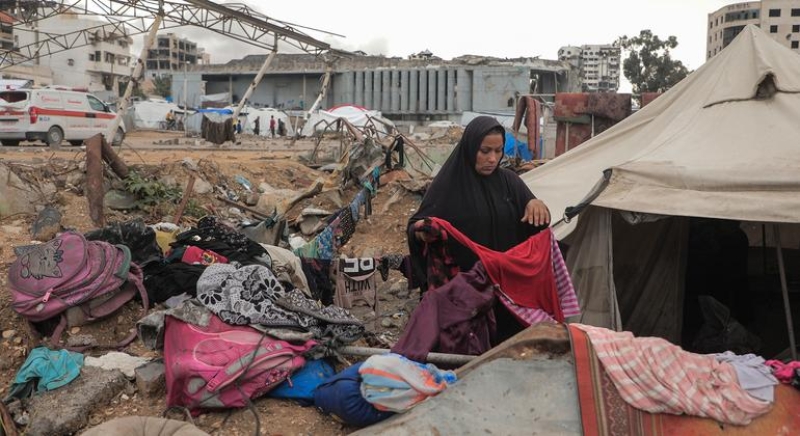
A woman sorts through clothes outside a tent in Gaza City.
The ceasefire in Gaza remains fragile as humanitarian agencies continue to face obstacles in delivering aid, a senior UN official told the Security Council on Tuesday, warning that winter conditions are worsening an already dire situation.
Ramiz Alakbarov, Deputy Special Coordinator for the Middle East Peace Process, provided the update during his quarterly briefing on Security Council Resolution 2334 (2016), which calls on Israel to cease settlement activity in the Occupied Palestinian Territory.
He said the United Nations is working to support the ceasefire, which came into effect in October under a plan put forward by United States President Donald Trump, with mediation by the US alongside Egypt, Qatar and Türkiye.
Speaking from Jerusalem, Alakbarov urged Israel and Hamas to fully implement the truce, exercise maximum restraint and adhere to international law, including relevant UN resolutions. “The ceasefire must be consolidated to enable recovery and reconstruction in Gaza,” he said.
As winter deepens, UN agencies are distributing tents, blankets and other essential supplies, but conditions remain critical and the risk of hypothermia is rising. Alakbarov confirmed the first hypothermia-related death: a two-week-old newborn boy from Khan Younis.
He stressed that preserving and expanding operational space for the UN and its humanitarian partners, including through renewed NGO registrations, is essential.
Alakbarov expressed deep concern over the broader humanitarian situation, noting that while hunger has eased slightly due to increased aid and commercial food supplies, access to protein, clean water, medical care and adequate shelter remains severely limited.
Humanitarian access continues to be restricted, with aid convoys facing logistical and security challenges. He called on all parties to allow the full and unimpeded entry of humanitarian assistance.
Meanwhile, heavy rains have compounded the crisis. UN Deputy Spokesperson Farhan Haq said flooding has affected more than 40 emergency shelters, mostly in Khan Younis and Gaza City, damaging around 700 tents and impacting thousands of people.
Despite the challenges, the UN and its partners continue relief efforts across Gaza. On Monday, nine humanitarian missions were coordinated with Israeli authorities, allowing the delivery of food, fuel, blankets, tents and winter clothing, although several convoys were delayed or only partially completed.
Humanitarian teams are also operating a rapid joint response system to flooding alerts, distributing tents, tarpaulins, warm clothing, blankets and dignity kits. Over the weekend, high-energy biscuits were provided to more than 1,000 families affected by recent storms, while veterinary aid distributions for herders have resumed following weather-related disruptions.