

Sunday, October 11, 2026
News update
- PM Seeks Marubeni Investment in AI Data Centre, KAFCO |
- Global trade reaches record $35 trillion despite conflicts |
- Attack on Riyadh airport kills 12, injures over 300: Saudi |
- Dhaka ranks 6th most polluted city |
- El Niño Could Threaten 347 Million Children Worldwide |
Myanmar Junta Accused of Selling Youths to the Military
GreenWatch Desk:
International
2026-10-11, 2:42pm
# Myanmar Junta Accused of Selling Youths to the Military
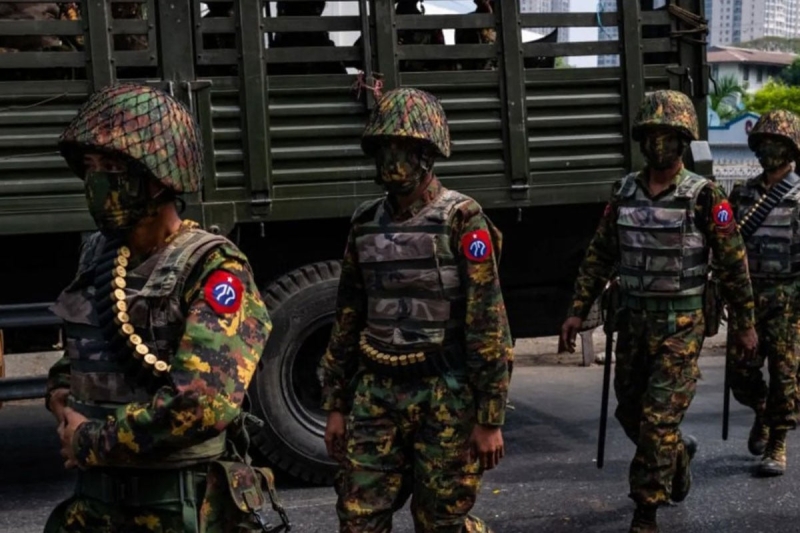
Young men in Myanmar are living in fear of abduction and forced military recruitment, as allegations emerge that local officials and other individuals are transferring recruits between areas in exchange for money to meet military enlistment quotas.
The alleged recruitment racket is placing the greatest burden on young people from poor families, while those who can afford to pay may be able to avoid serving in the military.
In Hpa-An, the capital of Myanmar’s southern Kayin State, many young men are afraid to go out after dark. The fear has spread in recent months, particularly among those who are young and physically fit.
Zaw Min, a 26-year-old tuk-tuk driver whose name has been changed for his safety, says he cannot stay home because he needs to earn a living. Before he leaves for work, his family warns him not to travel too far with passengers and to be careful about whom he picks up.
“I am extremely worried, but I have to go out for work. My family repeatedly calls to warn me. I have to remain alert all the time,” he said.
“People are frightened and afraid. Some people I know have been taken away,” he added.
Residents allege that plainclothes members and supporters of Myanmar’s military authorities patrol the streets of Hpa-An, detaining teenagers and men in their twenties and early thirties and forcing them into military service.
Leaked documents reviewed during an investigation indicate that local administrative areas have been instructed to strictly meet their recruitment quotas. The campaign comes as the military faces mounting pressure in its prolonged conflict with ethnic armed groups, pro-democracy organisations and civilian resistance forces.
## Young men flee to avoid conscription
Zaw Min is the only one among his siblings who falls within the age range for compulsory military service. He says many men his age have fled their homes, with some crossing into neighbouring Thailand and others taking refuge with relatives in distant areas. Those who remain are often told by their families to return home before nightfall.
Myanmar’s military seized power in February 2021, ousting elected leader Aung San Suu Kyi and triggering a prolonged and bloody civil war.
In 2024, the military authorities activated a compulsory military service law amid battlefield losses, declining morale and growing desertions. The law requires men aged 18 to 35 and women aged 18 to 27 to serve for at least two years. Refusing to comply can carry a prison sentence of up to five years.
Major Naung Ye, a former military officer who left the armed forces and now works with the Myanmar Defence and Security Institute, described the implementation of compulsory recruitment as one of the military authorities’ most far-reaching measures against civilians since the coup.
An estimated 100,000 young people have been recruited under the system over the past two and a half years. Many are alleged to have been enlisted through coercion, extortion or abduction. Hpa-An has now become a new focus of the campaign.
Naung Ye alleges that security personnel monitor young people's movements, detain those considered eligible for service and extort money by threatening them with arrest. Young men have also reportedly been detained during administrative exercises, including checks of household lists.
The military recruitment authorities declined to comment on allegations of forced enlistment and recent abductions.
## Wife alleges husband was sold for recruitment
The compulsory service system has allegedly created an illicit network through which young men are transferred to the military in exchange for money. As pressure to meet recruitment quotas grows, local-level officials are accused of exploiting the process for financial gain.
Ma Moe San Pan, a resident of Yangon, says her 33-year-old husband, Phyo Wai, disappeared after leaving home on May 8, 2025.
Following an argument with his wife, Phyo Wai left the house. She told a relative, who worked at a local ward administration office, about the incident and asked the relative to help bring him home.
Two days later, Phyo Wai called his wife and said he was at a military recruitment centre on the other side of the city.
Ma Moe San Pan alleges that the relative first took her husband to the ward administration office. He was then transferred to another ward in exchange for 4 million kyats, or around $900 at the time, to help that ward meet its military recruitment quota.
The relative could not be reached for comment.
In a desperate attempt to secure her husband's release, Ma Moe San Pan says she was subsequently defrauded by several people who took 4.5 million kyats from her after falsely promising to free him.
U Maung Maung Lwin, the administrator of the ward to which Phyo Wai was transferred, acknowledged having a role in sending him to the military recruitment authorities.
He said that when a ward cannot meet its quota, recruits may be brought in from other areas. However, he denied that money changed hands in such transfers and claimed no payment was involved in Phyo Wai's forced recruitment.
Ma Moe San Pan said her husband had told her that he was asked to sign documents under the pretext that people were trying to help him.
“If my husband had been selected through a normal and lawful military recruitment process, perhaps I could have accepted it. But I cannot accept that our own ward administration office sold him to another ward,” she said, adding that she regretted trusting her relative.
She has lodged two complaints with police: one over the alleged sale of her husband for military recruitment and another over the money she says was taken from her in exchange for a false promise to secure his release.
According to her, police accepted the complaints but refused to include a human trafficking charge, arguing that trafficking applied only when someone was sold abroad.
She still does not know where her husband is being held.
## Abductions and payments to meet recruitment quotas
Phyo Wai's case highlights concerns about abuses linked to Myanmar's compulsory military service system. As pressure from the central authorities intensifies, local administrators and people connected to security forces are accused of resorting to irregular methods to meet quotas.
Naung Ye alleges that young men are being detained at roadside checkpoints, tracked and seized while travelling to work, lured by fake job advertisements or taken by force from their homes.
He described the alleged practices as a system resembling modern slavery and human trafficking operating under the cover of compulsory military service.
In late August, police arrested a fire service official and his brother-in-law in Yangon over allegations that they abducted four young men and attempted to sell them for military recruitment.
According to the allegations, the official, a commander in a reserve fire brigade unit, lured the four men to his home by promising them employment. They were allegedly held in specially constructed detention rooms until police raided the property on August 25.
The official was charged with abducting people for unlawful confinement, an offence punishable by up to seven years in prison. Attempts to obtain further information from the police station where he was being held were unsuccessful.
Naung Ye said lower-level local administrators, military personnel and criminal networks were using various methods to seize young men and transfer them to military units and regional commands facing personnel shortages.
He also alleged that wealthier people could pay to avoid service, while young men from poorer families were sent in their place.
## Poor families bear the greatest burden
Under the recruitment system, villages, wards and towns are required to provide a specified number of recruits based on their populations. Although the rules are formally applied across communities, allegations of payments to avoid service have raised concerns about growing inequality.
Those with financial means may be able to pay to avoid enlistment or arrange for someone else to serve in their place. Poorer families often lack that option, leaving their sons more exposed to the risk of forced recruitment.
Naung Ye said meeting monthly recruitment quotas was becoming increasingly difficult, while the opportunity to make money by transferring recruits between local administrative areas was encouraging further abuses.
International human rights organisations, including Amnesty International, Human Rights Watch and Fortify Rights, have also accused Myanmar's military of abducting civilians and forcing them into military service.
In July, data analysis organisation Myanmar Witness reported that it had examined hundreds of Facebook posts seeking information about missing people between 2021 and 2025. Its analysis found that the number of January posts seeking missing people rose from four in 2021 to 82 in 2025.
Researchers concluded that a significant portion of military recruitment appeared to involve detention, coercion and disappearances rather than formal summonses. In many cases, families were not informed about the whereabouts of those taken, with men and teenage boys making up a large share of the missing.
## Military personnel shortages deepen the crisis
Fear of forced recruitment is driving young people to leave their homes, worsening displacement and putting further pressure on Myanmar's already struggling economy and labour market.
Some young people leave to join armed resistance groups, while others flee to avoid fighting against their own countrymen. Many seek safety in neighbouring countries.
Sandeep Singh, a military studies researcher and lecturer at the National University of Singapore, said the forced recruitment of unwilling young people was another attempt by the military authorities to sustain their war effort. He said the measures reflected the military's fragile position in the civil war.
The persistent threat of abduction has added to the hardships facing young people and their families, who have already endured years of conflict and uncertainty.
In a statement published in June, the Myanmar Defence and Security Institute said military leaders were benefiting from the use of conscription laws to compel citizens to fight one another.
After years of civil war, allegations that the military authorities are using compulsory recruitment as a tool of repression have highlighted the growing strain on civilians. As the military struggles to find enough personnel to continue fighting, young people and their families are facing mounting fear, displacement and financial hardship.