

- Dhaka's air quality ‘moderate’ during Eid holiday |
- Thousands of tourists flock to Kuakata during Eid festival |
- 45th anniversary Ziaur Rahman's death Saturday |
- India’s Muslims denied public spaces for Eid prayers |
- China steps up efforts to protect rare golden monkeys at world heritage site |
UN Reports 26 Killed in Gaza Over Eid Holiday
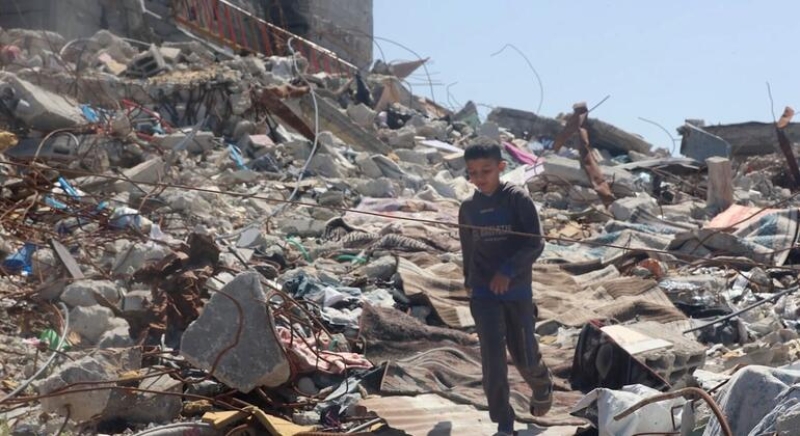
A child walking among the rubble in the city of Gaza.
At least 26 Palestinians have been killed in the Gaza Strip since Tuesday—the eve of one of Islam’s most important holidays—the UN human rights office (OHCHR) reported on Friday.
The information was provided by monitors in the Occupied Palestinian Territory (OPT), who condemned the increase in Israeli attacks as families prepared to observe Eid al-Adha.
According to initial reports, 12 Palestinians were killed in three airstrikes on May 26, while a teenage girl later died from injuries sustained in a strike the previous day that had also killed a woman and a young girl.
One airstrike killed four men in a camp in central Gaza, reportedly after they resisted attempts by armed gangs allegedly backed by the Israeli military to search their homes. Two other men were killed when a strike hit a car in Khan Younis.
The third airstrike, targeting an apartment in Gaza City, killed a newly appointed commander of the Hamas Al-Qassam Brigades, along with his wife, three children, and a female passerby.
Ten people allegedly affiliated with the Al-Qassam Brigades were also reportedly killed in a strike on May 27.
Death, Displacement and Deprivation
The rights office said Israeli forces have killed 922 Palestinians in attacks since the announcement of the ceasefire in October, bringing the total death toll since the Hamas-led attacks of October 7, 2023, to nearly 73,000, according to local authorities.
At least 32 children and eight women have reportedly been killed since the truce.
Meanwhile, Palestinians continue to face severe shortages of shelter, essential medicines, food, and other necessities as the blockade on Gaza persists.
Nearly the entire population remains displaced and concentrated “into a progressively narrower strip of land,” with multiple displacement orders issued in recent days.
Dire Conditions and ‘Unthinkable’ Attacks
The investigators also referred to Prime Minister Benjamin Netanyahu’s announcement on Thursday directing Israeli forces to expand their deployment to cover 70 per cent of Gaza’s territory.
They warned that the shrinking areas available to civilians raise serious concerns about access to humanitarian aid and safe shelter.
Ajith Sunghay, head of the human rights office in the OPT, said concerns over possible war crimes in Gaza remain high.
“It is difficult enough to navigate life in chronic displacement in the ruins of Gaza, under blockade, and after Israeli attacks have virtually destroyed every essential system—healthcare, education, food production, law enforcement and civil order,” he said.
“Continuing military attacks on a population living under these conditions is unthinkable.”
Airstrike Near Aid Facilities
Separately, the UN aid coordination office (OCHA) said an airstrike on Thursday struck a residential area near five humanitarian facilities in Deir al-Balah in central Gaza. No casualties were reported.
The strike came shortly after the Israeli military ordered residents to shelter in place.
OCHA reiterated calls for more crossings into Gaza to be opened for humanitarian aid and commercial supplies, as only Kerem Shalom remains operational.
Humanitarian partners provided mental health, psychosocial support, and other protection services to more than 10,000 people between May 11 and 17.
These services—including recreational activities, art and drama sessions, counselling, and parenting support—were delivered in shelters, camps, schools, and displacement sites.
“Partners reiterate that to continue these services—particularly for children and adolescents—fuel, safe spaces, staff, and other basic resources are needed,” OCHA said.