

- Zaima Rahman calls for common platform to build inclusive BD |
- Uprising’s expectations failed to be met in last 18 months: TIB |
- World Bank to Provide $150.75m for Bangladesh RAISE Project |
- Press Secretary Alleges Indian Media, AL Spread Disinformation |
- Hasina Gets 10 Years in Purbachal Plot Corruption Cases |
Gaza Rafah Crossing Reopens, Raising Hope and Deep Fears
An injured child waits in the courtyard of Al-Amal Hospital in Khan Younis.
The reopening of the Rafah crossing in the southern Gaza Strip on Monday, after more than a year, is being met with both optimism and fear, a senior official of the UN agency assisting Palestinian refugees, UNRWA, has said.
The sole border point with Egypt is a vital lifeline to the outside world, particularly for thousands of severely ill or injured Palestinians who require medical treatment abroad, as last October’s fragile ceasefire between Israel and Hamas continues to hold.
The development comes, however, amid reports of renewed violence over the weekend, with the UN expressing concern over civilian deaths and Israeli airstrikes.
‘Competing dynamics’
“As we have seen many times throughout this conflict, we are witnessing competing dynamics: on the one hand, positive progress with the reopening of Rafah; on the other, over the past 24 hours, 30 Palestinians were killed in airstrikes during a ceasefire,” Sam Rose, Acting Director of UNRWA Affairs in Gaza, told the BBC on Sunday.
“At the same time, international organisations that are equipped and capable of carrying out urgently needed work continue to face major constraints,” he added.
For this reason, Palestinians in Gaza are experiencing “massive trepidation — hope that people will be able to leave, but real fear about the future,” Rose said.
UNRWA said it remains on the ground delivering lifesaving assistance in an environment where “fear and uncertainty persist,” noting that access remains limited, protection concerns continue, and humanitarian needs are acute amid ongoing operational constraints.
Limited movement
The reopening of the Rafah crossing was a key component of the 20-point peace plan put forward by US President Donald Trump last September, followed days later by the ceasefire.
For now, Israel will allow only around 50 Palestinians to enter or exit Gaza each day — and only on foot, according to international news agencies.
The crossing will be coordinated with Egypt and supervised by the European Union (EU), according to the UN humanitarian affairs office, OCHA.
Returns will be permitted only for residents who left during the war and after obtaining prior authorisation from Israeli security services. Returnees will be checked by the EU at Rafah and undergo a second identification and screening process in a designated corridor managed by the Israeli army.
Support for returnees
OCHA welcomed the reopening of the crossing, stressing that “civilians must be allowed to leave and return voluntarily and safely, as required under international law.”
Over the weekend, the UN conducted an advance mission to assess road conditions.
The UN Development Programme (UNDP) will provide bus transportation for returnees from the internal checkpoint to Nasser Hospital in Khan Younis, where UN agencies and NGO partners have established a reception area to provide assistance.
The centre is staffed by psychologists and protection specialists, with food, information materials and internet connectivity available.
Medical evacuations
The World Health Organization (WHO) also supported medical evacuation efforts on Monday.
Some patients and their companions exited Gaza directly to Egypt, while others transited through the Israeli-controlled Kerem Shalom crossing.
Israeli authorities approved the travel of only five wounded patients from a list of 27 submitted to both Egyptian and Israeli authorities, according to Palestinian sources.
Treatment beyond borders
Families gathered in the courtyard of Al-Amal Hospital in southern Gaza to bid farewell to sick relatives and their companions travelling to Egypt for treatment.
A UN News correspondent witnessed buses preparing to depart, carrying hopes that the wounded would return fully recovered.
A young boy, Youssef Awad, who uses a wheelchair, expressed optimism. “I hope to travel for treatment and return walking like other children,” he said.
‘Expedite the process’
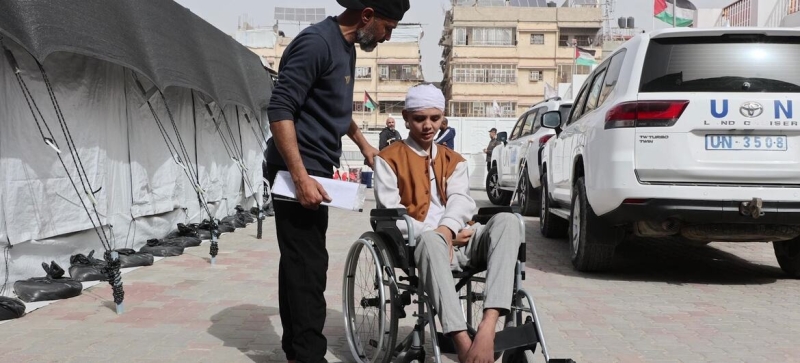
Another injured child, Ahmed Iyad Abu al-Khair, sat in a wheelchair beside his father as they waited for the medical evacuation convoy.
“We hope decision-makers and the World Health Organization will expedite the process and help my son travel to complete his treatment, as every hour he remains here affects his health,” his father said.
Thousands still waiting
Reflecting widespread despair, dozens of injured Palestinians staged a protest near the hospital, sitting in wheelchairs and demanding that the daily travel quota be increased to “hundreds” instead of 50.
“We have been waiting since the beginning of the war,” said Farid al-Qassas, an injured protester.
“In this building alone, about 100 patients need medical referrals, while around 13,000 wounded people are waiting to travel. We hope the world will hear us and save what remains of these patients.”
The last medical evacuation through Rafah took place in May 2024. Overall, more than 18,500 patients in Gaza — including 4,000 children — remain in need of treatment abroad.
OCHA said the most effective solution would be to resume medical referrals to the West Bank, including East Jerusalem, and rehabilitate damaged health facilities inside Gaza.
Until then, UN Member States are urged to accept more patients to ensure access to life-saving treatment.
Aid delivery update
OCHA also stressed that essential humanitarian supplies must enter Gaza in sufficient quantities and with fewer restrictions through Rafah and other crossings.
Between 23 and 29 January, at least 13,800 pallets of UN-managed humanitarian aid were unloaded at crossing points, nearly 60 per cent of which contained food.
Since the ceasefire announcement on 10 October, at least 272,000 pallets of humanitarian aid have been unloaded, with 270,000 collected at various crossing points.