

- Speaker sees no possibility of Hasina's return even in 10-yrs |
- Bangladesh Ambassador to Japan returns home ahead of PM’s visit |
- Sajek Road Blockade: 2,933 Tourists Evacuated Amid Gunfire |
- Climate Crisis May Displace 7.5% of Bangladeshis by 2050 |
- NEIR Rollout Targets Tk 2,000cr Revenue Loss From Illegal Phones |
UN Warns of Rising Hardship for Palestinians in Occupied West Bank
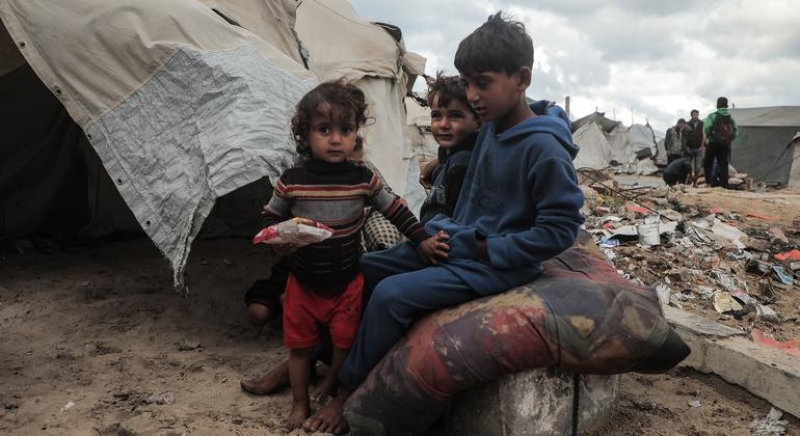
Children sit outside a tent in Gaza.
The UN human rights office, OHCHR, has expressed alarm at reports that a so-called “settler road” is being built in the occupied West Bank.
Around 100 hectares of Palestinian land have reportedly been confiscated to make way for the new route.
This, the head of OHCHR’s Office in the Occupied Palestinian Territory, Ajith Sunghay, warned, would be another step toward the progressive fragmentation of the West Bank.
“We are alarmed to hear that Israel has actually started building a new barrier and a road in the heart of the Jordan Valley,” he said on Friday.
“This is the most fertile land in the West Bank, and the road is likely to separate Palestinian communities from each other and Palestinian farmers in Tubas from the land they own on the other side of the planned barrier.”
Mr. Sunghay said the move would consolidate Israel’s annexation of the West Bank and eliminate vital sources of livelihood for Palestinians.
He also noted that Jenin, Tulkarem and Nur Shams camps have been emptied, and after nearly a year, residents have not been allowed to return.
This raises concerns about forcible transfer, which is prohibited under international law, the UN rights official added, and he expressed concern about warnings to continue bulldozing Palestinian camps.
General Assembly Boost for UNRWA
On Friday, the UN General Assembly gave “strong endorsement” to a ruling by the International Court of Justice (ICJ) that claims about UNRWA — the UN agency serving Palestine refugees — being infiltrated by Hamas militants in Gaza lack substance.
UNRWA chief Philippe Lazzarini tweeted that the resolution, backed by 139 states, also countered allegations that the main aid provider in Gaza is not neutral.
“This vote is an important sign of support for UNRWA from the overwhelming majority of the international community. As the ICJ has stressed, UNRWA is the key humanitarian actor in the Occupied Palestinian Territory, and everything must be done to facilitate our work, not hinder it,” he said.
Nineteen nations abstained and 12 voted against, including the United States, Argentina, Bolivia and Hungary, which joined Israel in opposition.
Deputy UN Spokesperson Farhan Haq said at the daily briefing that Secretary-General António Guterres was “heartened by the tremendous amount of support” for UNRWA from member states.
Winter Storms Deepen Humanitarian Crisis
Heavy rains across the Gaza Strip have flooded displacement sites, collapsed damaged buildings in Jabalya and Gaza City, and caused further casualties, including children.
Humanitarian agencies warn that overflowing drainage systems and contaminated water sources are heightening the risk of waterborne disease outbreaks.
“The immediate and sustained entry of spare parts and essential machinery must be facilitated,” OCHA said, noting that waste collection and safe disposal are now severely constrained.
As temperatures fall, families without gas or electricity are struggling to stay warm and are repeatedly moving to higher, safer ground.
Tent Shortage
Aid partners are distributing winter clothing, tarpaulins and tents, but an estimated 1.3 million people still require urgent shelter support.
Since the ceasefire two months ago, fewer than 50,000 tents have entered Gaza for around 270,000 people. Thousands of pallets of shelter materials have been rejected, and many NGOs have been blocked from operating.
Restrictions on the entry of aid must be lifted, OCHA said, including the ban on UNRWA, which has supplies for more than a million people stockpiled outside Gaza.
In the West Bank, over 1,000 Palestinians have been displaced this year in Area C and East Jerusalem, largely due to demolitions for lacking Israeli permits, which are nearly impossible to obtain.
OCHA continues to record an average of five Israeli settler attacks per day, with severe humanitarian impacts. The UN is calling for strengthened protection for Palestinians and an end to unlawful demolitions and settler violence.