

- Govt Backs Off Package VAT After Business Outcry |
- Power Outages Continue to Disrupt Life in Sylhet |
- PM Tarique Makes Surprise Visit to SPARRSO |
- Argentina Beat Jordan 3-1 to Top Group J |
- 12 Chinese companies interested to invest over $9bn in Bangladesh |
Venezuela Quake Leaves 680,000 Children Needing Aid
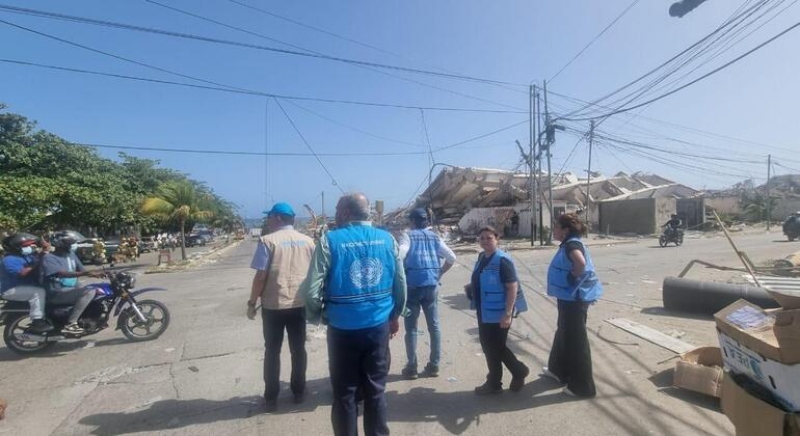
The UN System is present in La Guaira, the region most severely affected by the devastating twin earthquakes that struck Venezuela.
Around 680,000 children are among the 1.8 million people in need of urgent humanitarian assistance following the devastating earthquakes that struck Venezuela on 24 June, UNICEF said on Sunday as rescue and relief operations continue across affected areas.
Damage to hospitals, schools and water systems has worsened conditions for affected families, many of whom remain displaced and are struggling to access essential services.
The twin earthquakes, measuring 7.2 and 7.5 in magnitude, have killed at least 1,430 people and injured 3,238 others, according to the latest official figures. More than 3,100 families have been directly affected, while authorities continue damage assessments amid ongoing aftershocks.
Search and rescue operations remain underway as teams race against time to locate survivors trapped under rubble.
On Saturday, UN Humanitarian Coordinator in Venezuela Gianluca Rampolla visited La Guaira, the state hardest hit by the disaster, alongside representatives from several UN agencies.
The mission included visits to heavily damaged areas and the coordination centre overseeing search and rescue operations.
Together with local authorities, the UN team also identified locations for temporary service centres to support families who lost their homes or cannot safely return.
Rampolla praised the strong solidarity shown by communities, volunteers and international rescue teams.
“At a time when we’re often focused on negative developments around the world, here we are seeing extraordinary solidarity to support Venezuelans,” he said.
He stressed that rescuing survivors remains the top priority.
“The first priority is getting people still alive out of the rubble. At the same time, we must support those who have survived.”
More than 2,200 rescuers and 140 search dogs from 27 countries are currently involved in the search operation, working with UN-supported coordination.
UN Emergency Relief Coordinator Tom Fletcher stressed the urgency of rescue efforts, saying every minute matters.
Relief workers say hope remains strong despite fear and exhaustion.
Emergency responders described an emotionally intense situation, with communities balancing hope, grief and fear of further aftershocks.
“People have not lost hope,” one relief official said. “All efforts remain focused on saving lives and helping affected families.”
UNICEF warned that the humanitarian crisis extends far beyond collapsed buildings.
Hundreds of thousands of children now face severe disruptions in healthcare, education, access to safe water and protection services.
“Hospitals are operating beyond capacity, thousands of children lack reliable access to clean water, and many schools have been damaged,” said Manuel Rodríguez Pumarol, UNICEF Representative in Venezuela.
He said UNICEF is working with authorities and partners to scale up emergency assistance but warned that sustained funding will be essential in the coming weeks.
According to UNICEF, damage to hospitals in La Guaira, Caracas, Carabobo, Aragua and Falcón is affecting healthcare access for children and pregnant women.
In Caracas, preliminary assessments indicate damage to 432 schools, representing more than one-third of educational institutions in the capital district.
Some schools that remain safe are now being used as temporary shelters for displaced families.
UNICEF has mobilised emergency staff and relief supplies to assist around 650,000 people, including 234,000 children, with healthcare, nutrition, water and sanitation, child protection and education support.
Its first emergency flight carrying 20 tonnes of medical supplies and water and sanitation equipment arrived on Friday. A second shipment from UNICEF’s global supply hub in Copenhagen is expected in the coming days.
The earthquake has also intensified pressure on Venezuela’s healthcare system.
Preliminary assessments by the Pan American Health Organization (PAHO) show that of 21 health facilities surveyed, three are in critical condition while six others have suffered structural damage or are only partially operational.
Hospitals continue to operate under severe strain as demand for trauma care, orthopaedic treatment and neurosurgery remains high.
Urgent needs include medicines, intensive care supplies, water, electricity and stronger systems for patient transfer between healthcare facilities.
In La Guaira, the UN has established three hospital tents equipped with intensive care units, treatment rooms and trauma care facilities to expand emergency services closer to affected communities.
Mental health and psychosocial support have also emerged as urgent priorities for survivors, families searching for missing relatives, healthcare workers and emergency responders.
As rescue operations continue, the focus is gradually expanding toward long-term support for affected families.
The United Nations and Venezuelan authorities have agreed to establish multi-service centres in strategic locations to provide food, medical care, clean water, sanitation and protection services.
These centres will also offer child-focused support and services aimed at preventing and responding to gender-based violence.
For thousands of families, the crisis extends beyond rescue efforts. Access to safe shelter, healthcare, clean water and education will remain critical in the weeks ahead as communities begin the long road to recovery.